Ohno Michihiro, Costanzi Stefano, Kim Hak Sung, Kempeneers Veerle, Vastmans Karen, Herdewijn Piet, Maddileti Savitri, Gao Zhan-Guo, Harden T Kendall, Jacobson Kenneth A
Molecular Recognition Section, Laboratory of Bioorganic Chemistry, National Institute of Diabetes and Digestive and Kidney Diseases/NIH/DHHS, Bethesda, MD 20892-0810, USA.
Bioorg Med Chem. 2004 Nov 1;12(21):5619-30. doi: 10.1016/j.bmc.2004.07.067.
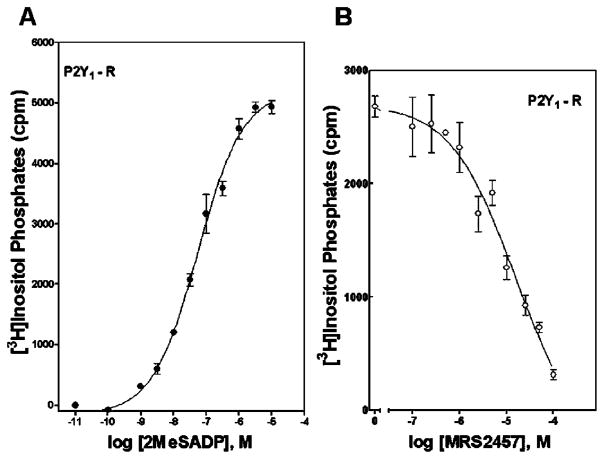
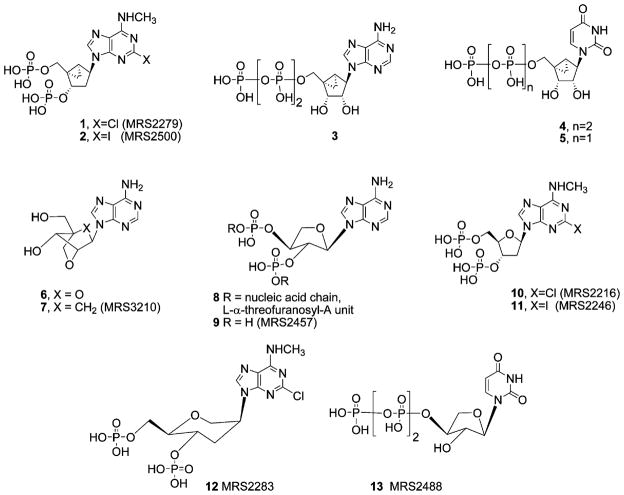
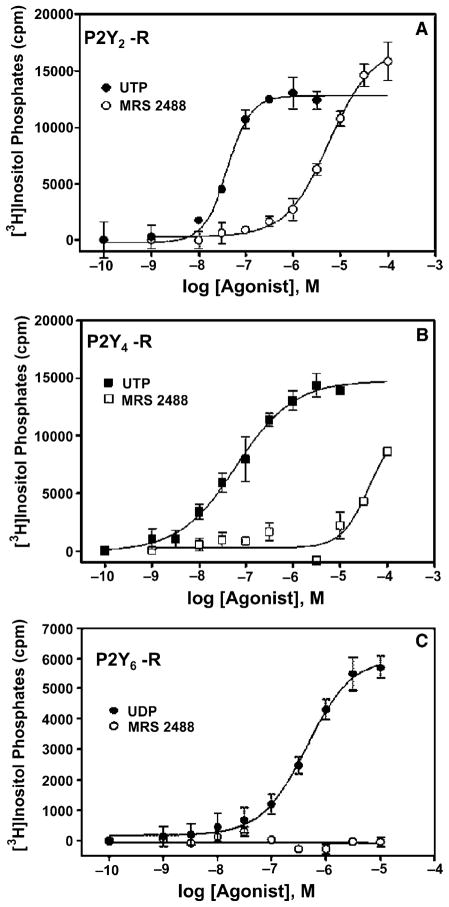
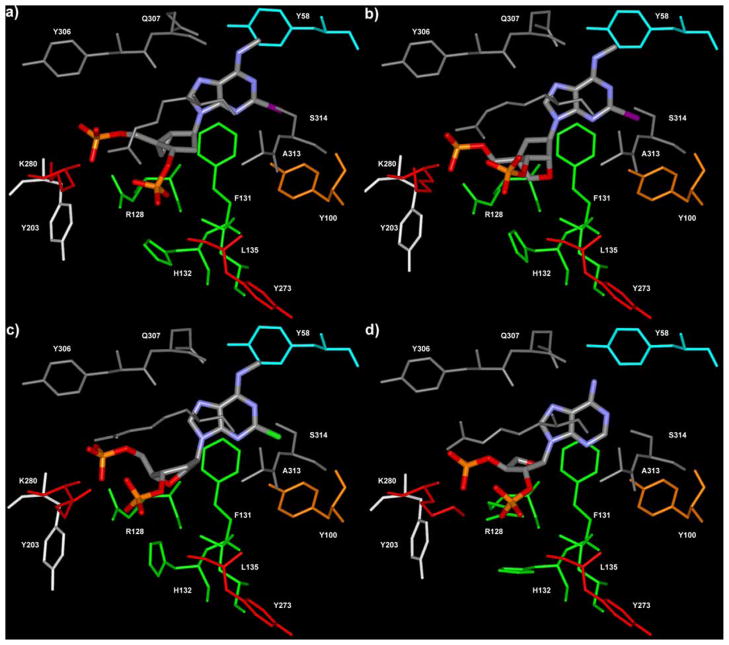
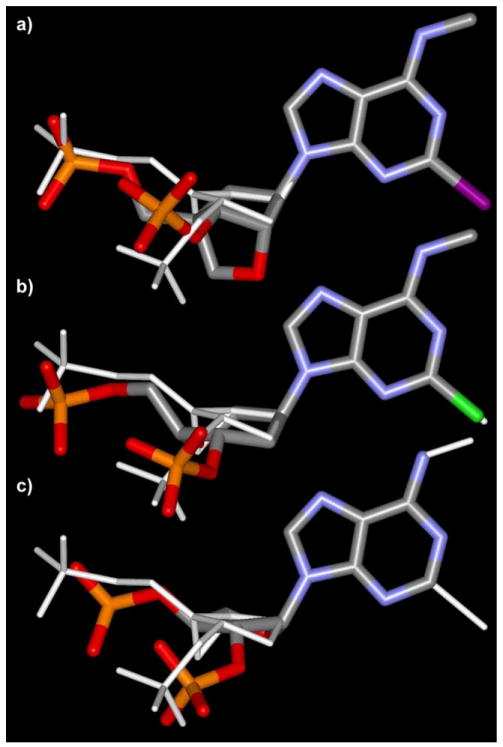
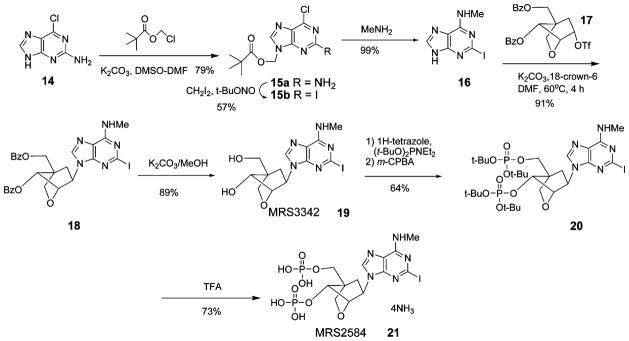
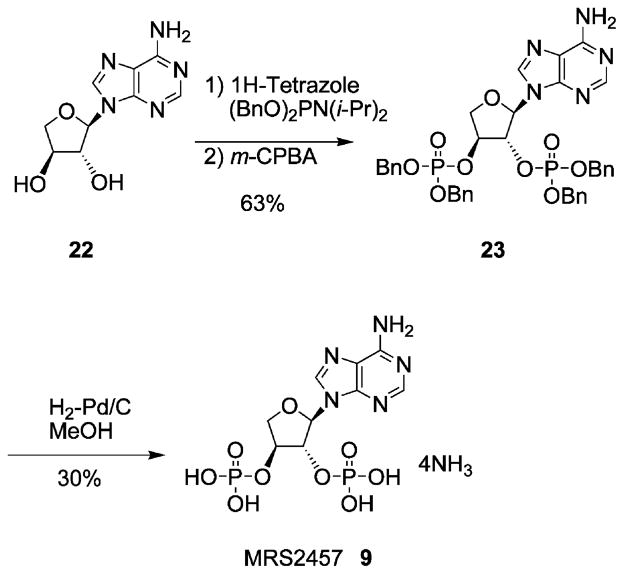
The ribose moiety of adenine nucleotide 3',5'-bisphosphate antagonists of the P2Y(1) receptor has been successfully substituted with a rigid methanocarba ring system, leading to the conclusion that the North (N) ring conformation is preferred in receptor binding. Similarly, at P2Y(2) and P2Y(4) receptors, nucleotides constrained in the (N) conformation interact equipotently with the corresponding ribosides. We now have synthesized and examined as P2Y receptor ligands nucleotide analogues substituted with two novel ring systems: (1) a (N) locked-carbocyclic (cLNA) derivative containing the oxabicyclo[2.2.1]heptane ring system and (2) l-alpha-threofuranosyl derivatives. We have also compared potencies and preferred conformations of these nucleotides with the known anhydrohexitol-containing P2Y(1) receptor antagonist MRS2283. A cLNA bisphosphate derivative MRS2584 21 displayed a K(i) value of 22.5 nM in binding to the human P2Y(1) receptor, and antagonized the stimulation of PLC by the potent P2Y(1) receptor agonist 2-methylthio-ADP (30 nM) with an IC(50) of 650 nM. The parent cLNA nucleoside bound only weakly to an adenosine receptor (A(3)). Thus, this ring system afforded some P2Y receptor selectivity. A l-alpha-threofuranosyl bisphosphate derivative 9 displayed an IC(50) of 15.3 microM for inhibition of 2-methylthio-ADP-stimulated PLC activity. l-alpha-Threofuranosyl-UTP 13 was a P2Y receptor agonist with a preference for P2Y(2) (EC(50)=9.9 microM) versus P2Y(4) receptors. The P2Y(1) receptor binding modes, including rotational angles, were estimated using molecular modeling and receptor docking.
P2Y(1)受体的腺嘌呤核苷酸3',5'-二磷酸拮抗剂的核糖部分已成功被刚性甲碳环系统取代,得出的结论是在受体结合中北(N)环构象更受青睐。同样,在P2Y(2)和P2Y(4)受体中,呈(N)构象的核苷酸与相应的核糖核苷具有同等效力的相互作用。我们现已合成并作为P2Y受体配体研究了用两种新型环系统取代的核苷酸类似物:(1)一种含有氧杂双环[2.2.1]庚烷环系统的(N)锁定碳环(cLNA)衍生物,以及(2)l-α-苏型呋喃糖基衍生物。我们还将这些核苷酸的效力和优选构象与已知的含脱水己糖醇的P2Y(1)受体拮抗剂MRS2283进行了比较。一种cLNA二磷酸衍生物MRS2584 21与人P2Y(1)受体结合的K(i)值为22.5 nM,并且以650 nM的IC(50)拮抗强效P2Y(1)受体激动剂2-甲硫基-ADP(30 nM)对PLC的刺激。母体cLNA核苷仅与腺苷受体(A(3))弱结合。因此,该环系统具有一定的P2Y受体选择性。一种l-α-苏型呋喃糖基二磷酸衍生物9对2-甲硫基-ADP刺激的PLC活性抑制的IC(50)为15.3 μM。l-α-苏型呋喃糖基-UTP 13是一种P2Y受体激动剂,相对于P2Y(4)受体更倾向于P2Y(2)(EC(50)=9.9 μM)。使用分子建模和受体对接估计了P2Y(1)受体的结合模式,包括旋转角度。