Darveau Martin, Denault André Y, Blais Normand, Notebaert Eric
Faculty of Pharmacy, University of Montreal, Quebec, Canada.
Crit Care. 2004 Oct;8(5):356-62. doi: 10.1186/cc2862. Epub 2004 May 13.
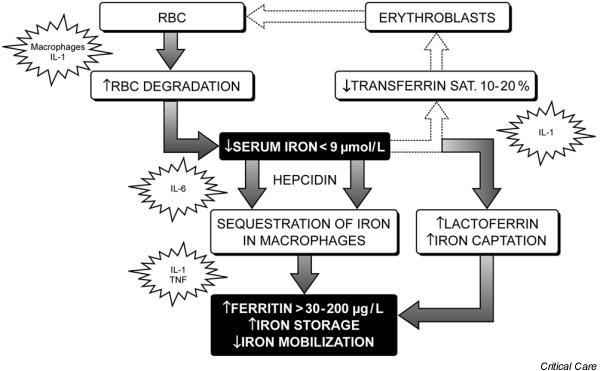
Critically ill patients frequently develop anemia due to several factors. Iron-withholding mechanisms caused by inflammation contribute to this anemia. The iron metabolism imbalances described or reported in all intensive care studies are similar to the values observed in anemia of inflammation. The administration of iron could be useful in the optimization of recombinant human erythropoietin activity, but this could be at the expense of bacterial proliferation. Since there is a lack of evidence to support either oral or intravenous iron administration in intensive care patients, further studies are necessary to determine the efficacy and safety of iron supplementation in conjunction with recombinant human erythropoietin in critically ill patients. We review the mechanisms leading to iron sequestration in the presence of inflammation. The present article also reviews the literature describing the iron status in critically ill patients and explores the role of iron supplementation in this setting.
危重症患者常因多种因素而发生贫血。炎症导致的铁扣留机制是造成这种贫血的原因之一。所有重症监护研究中描述或报道的铁代谢失衡情况与炎症性贫血中观察到的值相似。补充铁剂可能有助于优化重组人促红细胞生成素的活性,但这可能以细菌增殖为代价。由于缺乏证据支持在重症监护患者中口服或静脉注射铁剂,因此有必要进一步研究以确定在危重症患者中补充铁剂联合重组人促红细胞生成素的疗效和安全性。我们综述了炎症状态下导致铁螯合的机制。本文还综述了描述危重症患者铁状态的文献,并探讨了在这种情况下补充铁剂的作用。