Butchart Stuart H M, Stattersfield Alison J, Bennun Leon A, Shutes Sue M, Akçakaya H Resit, Baillie Jonathan E M, Stuart Simon N, Hilton-Taylor Craig, Mace Georgina M
BirdLife International, Cambridge, United Kingdom.
PLoS Biol. 2004 Dec;2(12):e383. doi: 10.1371/journal.pbio.0020383. Epub 2004 Oct 26.
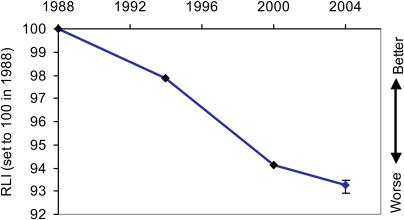
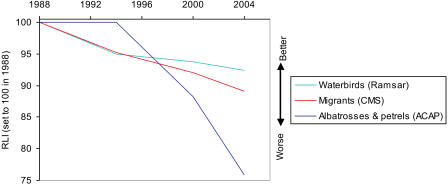
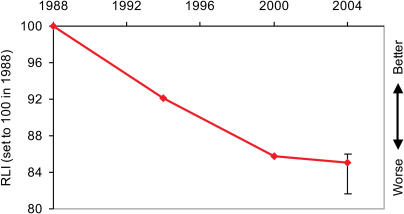
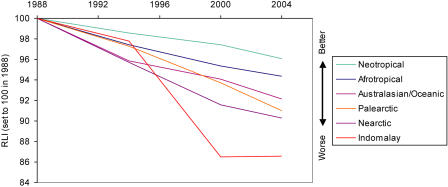
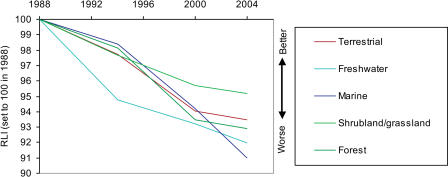
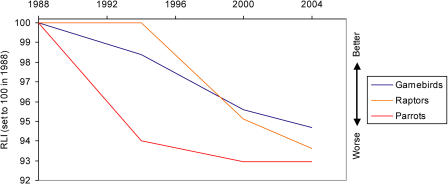
The rapid destruction of the planet's biodiversity has prompted the nations of the world to set a target of achieving a significant reduction in the rate of loss of biodiversity by 2010. However, we do not yet have an adequate way of monitoring progress towards achieving this target. Here we present a method for producing indices based on the IUCN Red List to chart the overall threat status (projected relative extinction risk) of all the world's bird species from 1988 to 2004. Red List Indices (RLIs) are based on the number of species in each Red List category, and on the number changing categories between assessments as a result of genuine improvement or deterioration in status. The RLI for all bird species shows that their overall threat status has continued to deteriorate since 1988. Disaggregated indices show that deteriorations have occurred worldwide and in all major ecosystems, but with particularly steep declines in the indices for Indo-Malayan birds (driven by intensifying deforestation of the Sundaic lowlands) and for albatrosses and petrels (driven by incidental mortality in commercial longline fisheries). RLIs complement indicators based on species population trends and habitat extent for quantifying global trends in the status of biodiversity. Their main weaknesses are that the resolution of status changes is fairly coarse and that delays may occur before some status changes are detected. Their greatest strength is that they are based on information from nearly all species in a taxonomic group worldwide, rather than a potentially biased subset. At present, suitable data are only available for birds, but indices for other taxonomic groups are in development, as is a sampled index based on a stratified sample from all major taxonomic groups.
地球生物多样性的迅速破坏促使世界各国设定了一个目标,即到2010年大幅降低生物多样性丧失的速度。然而,我们目前还没有一种适当的方法来监测在实现这一目标方面取得的进展。在此,我们提出一种基于世界自然保护联盟(IUCN)红色名录编制指数的方法,以描绘1988年至2004年期间世界所有鸟类物种的总体受威胁状况(预计的相对灭绝风险)。红色名录指数(RLIs)基于每个红色名录类别中的物种数量,以及由于物种状况真正改善或恶化而在评估之间改变类别的物种数量。所有鸟类物种的红色名录指数表明,自1988年以来它们的总体受威胁状况持续恶化。分类指数显示,全球范围内以及所有主要生态系统中都出现了恶化情况,但印度-马来亚地区鸟类(受巽他低地森林砍伐加剧的驱动)以及信天翁和海燕(受商业延绳钓渔业中的意外死亡驱动)的指数下降尤为显著。红色名录指数补充了基于物种种群趋势和栖息地范围的指标,用于量化生物多样性状况的全球趋势。它们的主要弱点是,状况变化的分辨率相当粗略,而且在检测到某些状况变化之前可能会出现延迟。它们最大的优势在于,它们基于全球一个分类群中几乎所有物种的信息,而不是一个可能有偏差的子集。目前,仅鸟类有合适的数据,但其他分类群的指数正在编制中,基于所有主要分类群分层样本的抽样指数也在编制中。