Butchart Stuart H M, Akçakaya H Resit, Berryman Alex J, Brooks Thomas M, Burfield Ian J, Chanson Janice, Dias Maria P, Donaldson John S, Hermes Claudia, Hilton-Taylor Craig, Hoffmann Mike, Luedtke Jennifer A, Martin Rob, McDougall Amy, Neam Kelsey, Polidoro Beth, Raimondo Domitilla, Rodrigues Ana S L, Rondinini Carlo, Rutherford Claire, Scott Tom, Simkins Ashley T, Stuart Simon N, Vine Jemma
BirdLife International, David Attenborough Building, Pembroke Street, Cambridge CB2 3QZ, UK.
Department of Zoology, University of Cambridge, Downing Street, Cambridge CB2 3EJ, UK.
Philos Trans R Soc Lond B Biol Sci. 2025 Jan 9;380(1917):20230206. doi: 10.1098/rstb.2023.0206.
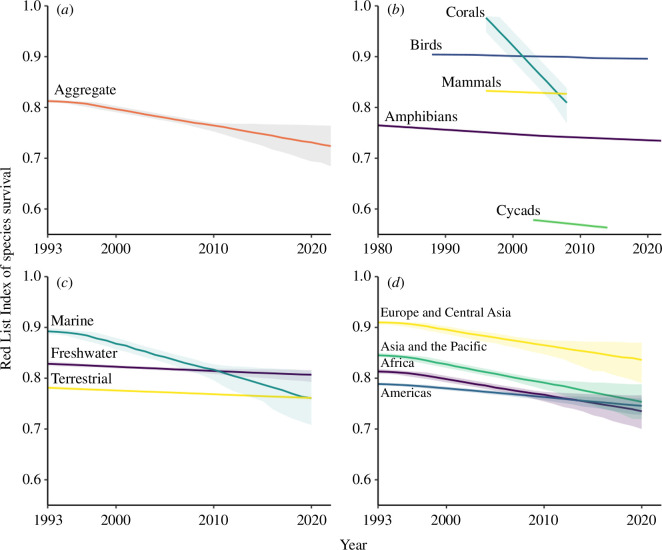
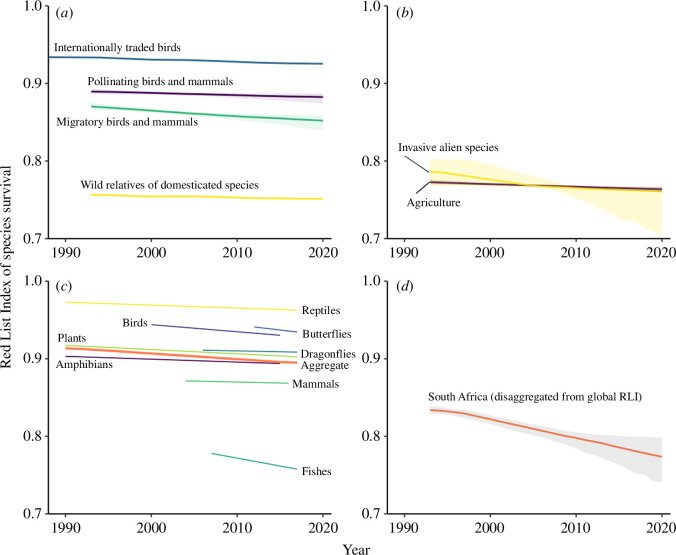
The Red List Index (RLI) is an indicator of the average extinction risk of groups of species and reflects trends in this through time. It is calculated from the number of species in each category on the IUCN Red List of Threatened Species, with trends influenced by the number moving between categories when reassessed owing to genuine improvement or deterioration in status. The global RLI is aggregated across multiple taxonomic groups and can be disaggregated to show trends for subsets of species (e.g. migratory species), or driven by particular factors (e.g. international trade). National RLIs have been generated through either repeated assessments of national extinction risk in each country or through disaggregating the global index and weighting each species by the proportion of its range in each country. The RLI has achieved wide policy uptake, including by the Convention on Biological Diversity and the United Nations Sustainable Development Goals. Future priorities include expanding its taxonomic coverage, applying the RLI to the goals and targets of the Kunming-Montreal Global Biodiversity Framework, incorporating uncertainty in the underlying Red List assessments, integrating into national RLIs the impact of a country on species' extinction risk abroad, and improving analysis of the factors driving trends.This article is part of the discussion theme issue 'Bending the curve towards nature recovery: building on Georgina Mace's legacy for a biodiverse future'.
红色名录指数(RLI)是物种群体平均灭绝风险的一个指标,并反映其随时间的变化趋势。它根据国际自然保护联盟濒危物种红色名录中每个类别的物种数量计算得出,其趋势受到因物种状况真正改善或恶化而在重新评估时类别变动数量的影响。全球RLI是跨多个分类群汇总得出的,并且可以细分以显示物种子集(如迁徙物种)的趋势,或由特定因素(如国际贸易)驱动的趋势。各国的RLI是通过对每个国家的国家灭绝风险进行反复评估,或通过细分全球指数并按每个物种在每个国家的分布比例对其进行加权计算得出的。RLI已在广泛的政策中得到采用,包括《生物多样性公约》和联合国可持续发展目标。未来的优先事项包括扩大其分类覆盖范围,将RLI应用于《昆明-蒙特利尔全球生物多样性框架》的目标和指标,纳入基础红色名录评估中的不确定性,将一个国家对国外物种灭绝风险的影响纳入国家RLI,并改进对驱动趋势因素的分析。本文是讨论主题“朝着自然恢复弯曲曲线:基于乔治娜·梅斯的遗产迈向生物多样的未来”的一部分。