Bressler Neil M, Bressler Susan B, Childs Ashley L, Haller Julia A, Hawkins Barbara S, Lewis Hilel, MacCumber Mathew W, Marsh Marta J, Redford Maryann, Sternberg Paul, Thomas Matthew A, Williams George A
SST Coordinating Center, Wilmer Clinical Trials and Biometry, 550 North Broadway, 9th Floor, Baltimore, MD 21205-2010, USA.
Ophthalmology. 2004 Nov;111(11):1993-2006. doi: 10.1016/j.ophtha.2004.07.023.
To present best-corrected visual acuity (BCVA) findings and other clinical outcomes from eyes of patients enrolled in one of the Submacular Surgery Trials (SST) evaluating surgical removal versus observation of predominantly hemorrhagic subfoveal choroidal neovascularization (CNV) associated with age-related macular degeneration.
Randomized clinical trial (SST Group B Trial).
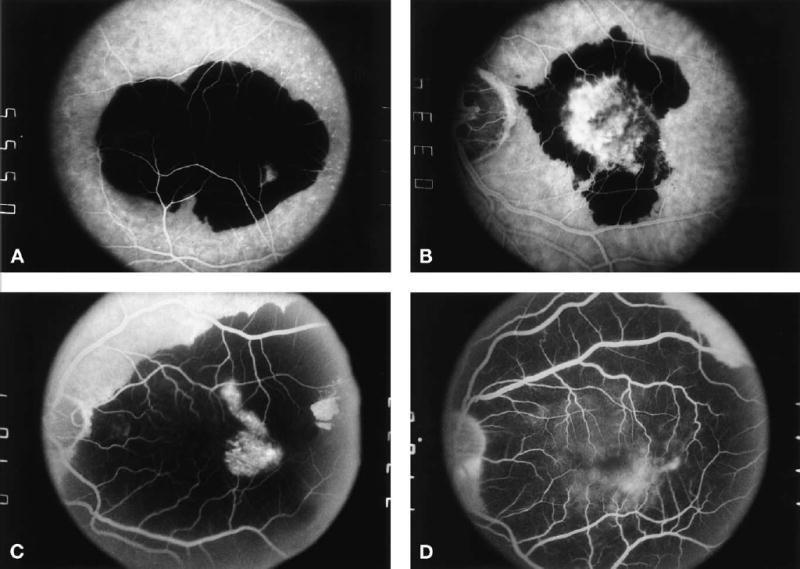
Eligible patients had subfoveal choroidal neovascular lesions greater than 3.5 disk areas (8.9 mm2) composed of at least 50% blood (either blood or CNV underlying the center of the foveal avascular zone) and BCVA of 20/100 to light perception in the study eye.
Patients were assigned randomly at time of enrollment to observation or surgical removal of blood and any associated CNV.
A successful outcome was defined a priori as either improvement in visual acuity (VA), no change in VA, or a decline in VA of no more than 1 line (7 letters) from baseline to the 24-month examination based on an intent-to-treat analysis.
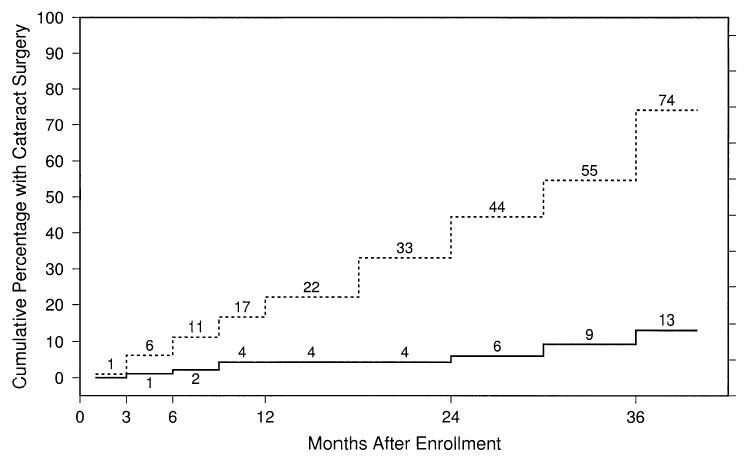
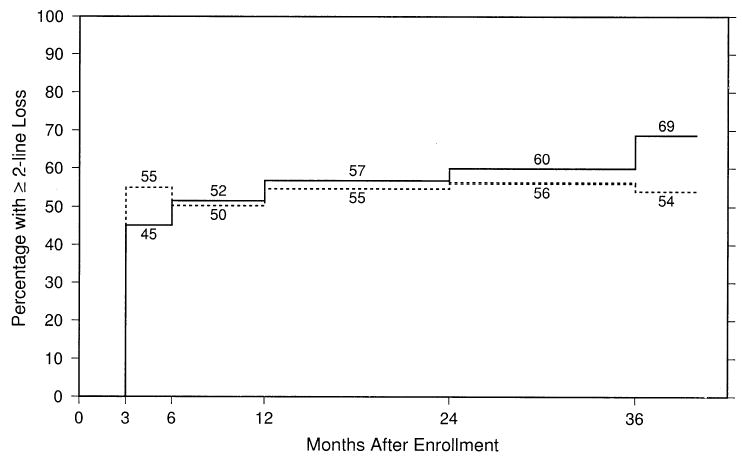
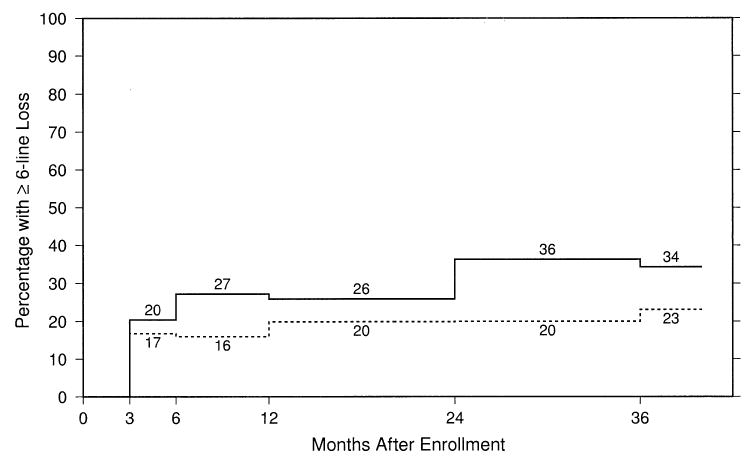
Of 336 patients enrolled, 168 were assigned to each treatment arm; treatment arms were balanced by baseline characteristics. Of 1501 expected examinations 3 months through 36 months after baseline, 1370 (91%) were performed. Loss of > or =2 lines (> or =8 letters) of VA occurred in 56% of surgery eyes, versus 59% of observation eyes examined at 24 months. Although severe loss of VA was not the primary outcome of interest, surgery more often prevented such loss: 36% in the observation arm versus 21% in the surgery arm at the 24-month examination (chi2 P = 0.004). Of initially phakic eyes, the cumulative percentage that had undergone cataract surgery by 24 months was 44% in the surgery arm, compared with 6% in the observation arm. Twenty-seven eyes (16%) in the surgical arm, compared with 3 eyes (2%) in the observation arm, had a rhegmatogenous retinal detachment (RD).
Submacular surgery as performed in the SST Group B Trial did not increase the chance of stable or improved VA (the primary outcome of interest) and was associated with a high risk of rhegmatogenous RD, but did reduce the risk of severe VA loss in comparison with observation. This article contains additional online-only material available at http://www.ophsource.com/periodicals/ophtha.
呈现参与黄斑下手术试验(SST)之一的患者眼睛的最佳矫正视力(BCVA)结果及其他临床结局,该试验评估了手术切除与观察主要为出血性黄斑下脉络膜新生血管(CNV)(与年龄相关性黄斑变性相关)的效果。
随机临床试验(SST B组试验)。
符合条件的患者黄斑下脉络膜新生血管病变面积大于3.5个视盘面积(8.9平方毫米),其中至少50%为血液(位于黄斑无血管区中心下方的血液或CNV),且研究眼的BCVA为20/100至光感。
患者在入组时被随机分配至观察组或手术切除血液及任何相关的CNV。
基于意向性分析,预先将成功结局定义为视力(VA)改善、VA无变化或从基线到24个月检查时VA下降不超过1行(7个字母)。
在336例入组患者中,每个治疗组各分配168例;治疗组在基线特征方面保持平衡。在基线后3个月至36个月预期的1501次检查中,共进行了1370次(91%)。在24个月时,手术组中有56%的眼睛VA下降≥2行(≥8个字母),观察组中这一比例为59%。虽然严重视力丧失并非主要关注的结局,但手术更常能预防这种情况的发生:在24个月检查时,观察组为36%,手术组为21%(χ²检验P = 0.004)。在初始有晶状体眼的患者中,到24个月时手术组累计有44%的患者接受了白内障手术,而观察组为6%。手术组有27只眼(16%)发生了孔源性视网膜脱离(RD),观察组有3只眼(2%)发生了RD。
SST B组试验中所进行的黄斑下手术并未增加视力稳定或改善(主要关注的结局)的可能性,且与孔源性RD的高风险相关,但与观察相比,确实降低了严重视力丧失的风险。本文包含额外的仅在线提供的材料,可在http://www.ophsource.com/periodicals/ophtha获取。