Manning Brendan D
Department of Genetics and Complex Diseases, Harvard School of Public Health, Boston, MA 02115, USA.
J Cell Biol. 2004 Nov 8;167(3):399-403. doi: 10.1083/jcb.200408161.
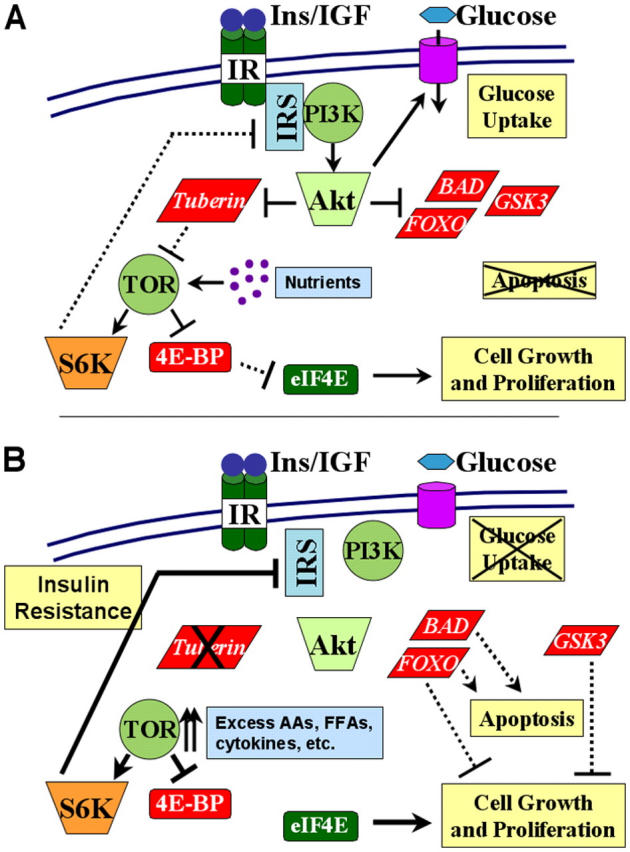
Proper regulation of the phosphoinositide 3-kinase-Akt pathway is critical for the prevention of both insulin resistance and tumorigenesis. Many recent studies have characterized a negative feedback loop in which components of one downstream branch of this pathway, composed of the mammalian target of rapamycin and ribosomal S6 kinase, block further activation of the pathway through inhibition of insulin receptor substrate function. These findings form a novel basis for improved understanding of the pathophysiology of metabolic diseases (e.g., diabetes and obesity), tumor syndromes (e.g., tuberous sclerosis complex and Peutz-Jegher's syndrome), and human cancers.
磷酸肌醇3-激酶-蛋白激酶B信号通路的适当调节对于预防胰岛素抵抗和肿瘤发生至关重要。最近的许多研究都描述了一个负反馈回路,在这个回路中,该信号通路一个下游分支的组成部分,即雷帕霉素哺乳动物靶蛋白和核糖体S6激酶,通过抑制胰岛素受体底物功能来阻断该信号通路的进一步激活。这些发现为更好地理解代谢性疾病(如糖尿病和肥胖症)、肿瘤综合征(如结节性硬化症复合体和黑斑息肉综合征)以及人类癌症的病理生理学提供了新的基础。