Wang Sho-Ya, Mitchell Jane, Moczydlowski Edward, Wang Ging Kuo
Department of Biology, State University of New York at Albany, NY 12222, USA.
J Gen Physiol. 2004 Dec;124(6):691-701. doi: 10.1085/jgp.200409128. Epub 2004 Nov 15.
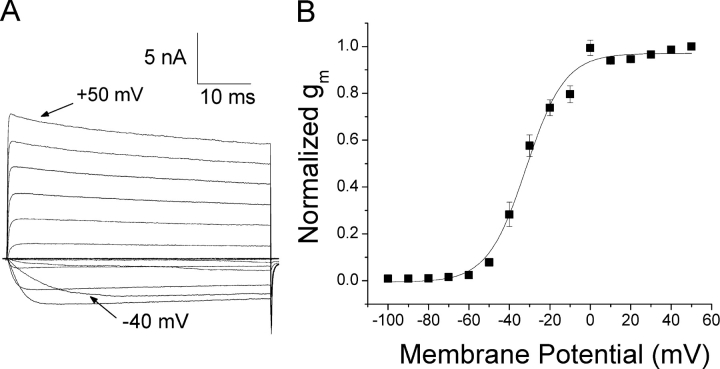
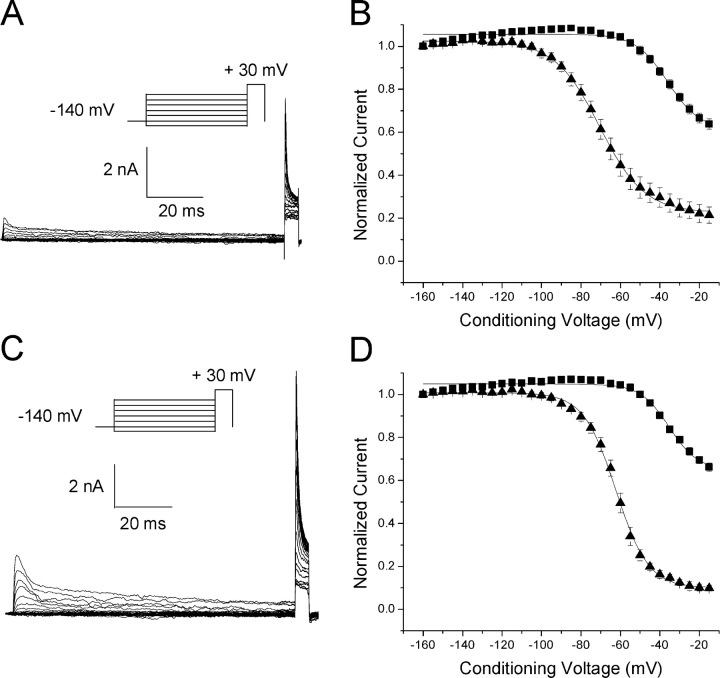
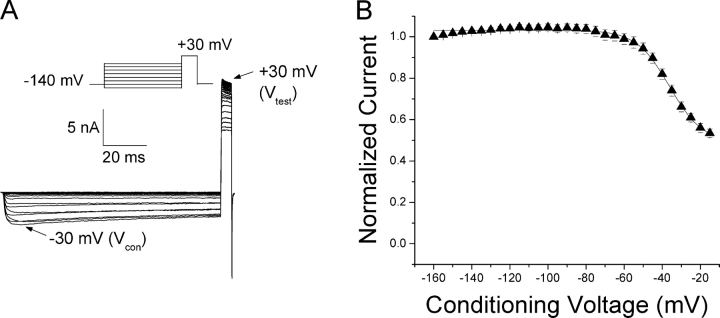
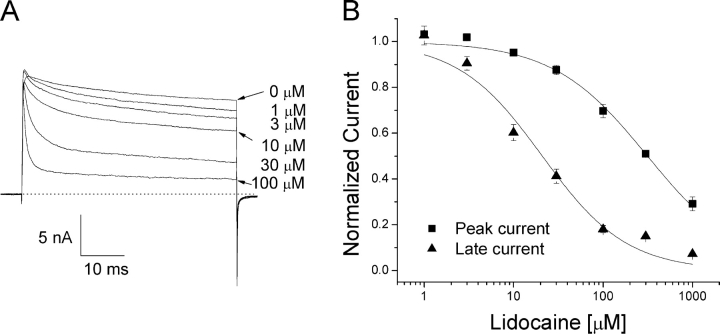
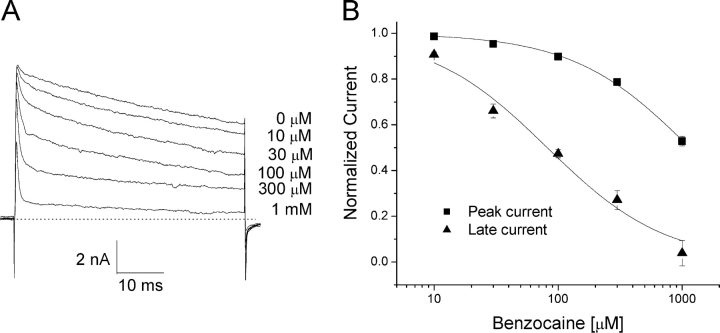
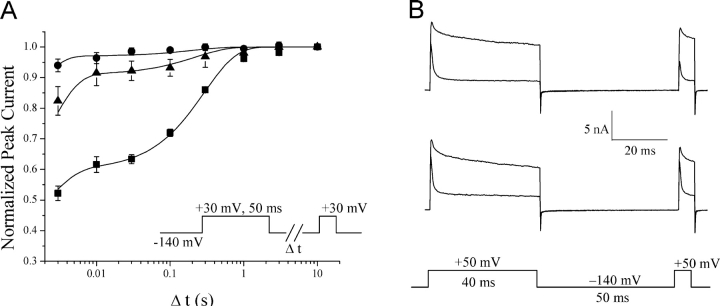
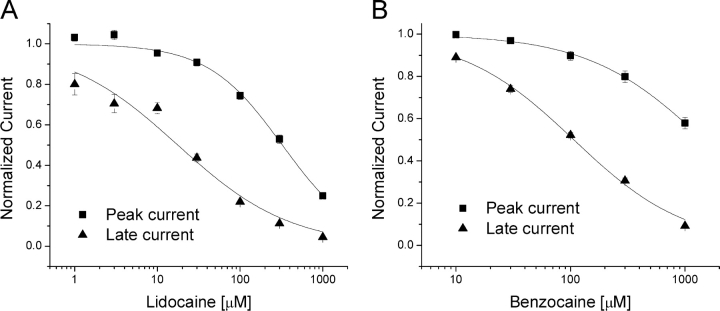
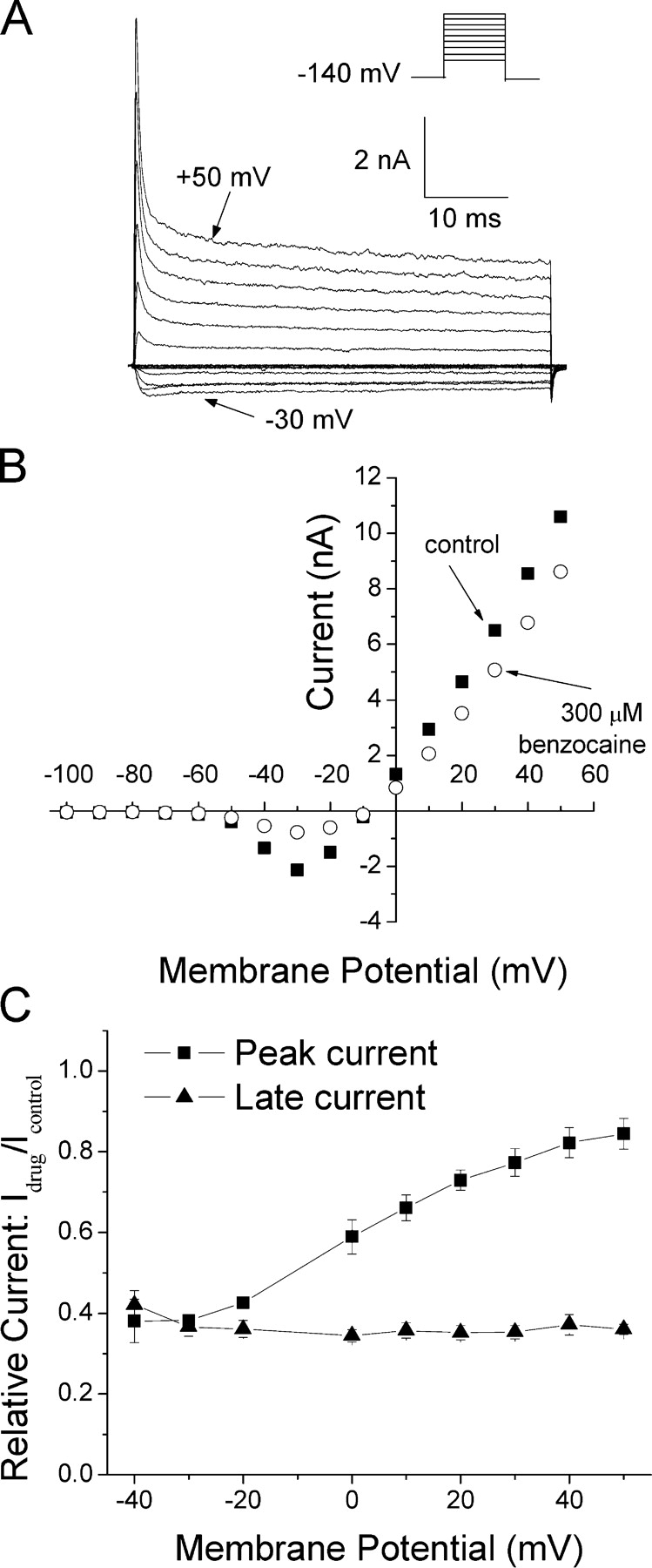
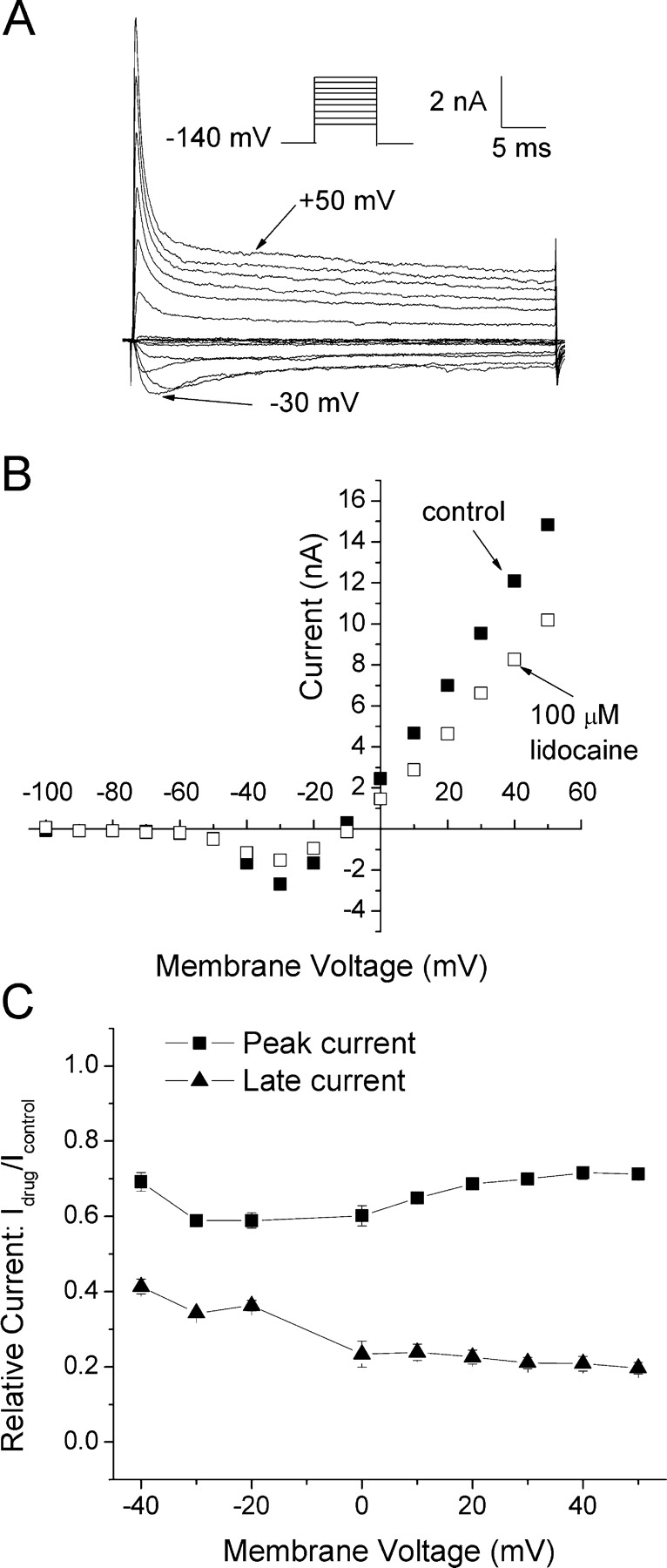
According to the classic modulated receptor hypothesis, local anesthetics (LAs) such as benzocaine and lidocaine bind preferentially to fast-inactivated Na(+) channels with higher affinities. However, an alternative view suggests that activation of Na(+) channels plays a crucial role in promoting high-affinity LA binding and that fast inactivation per se is not a prerequisite for LA preferential binding. We investigated the role of activation in LA action in inactivation-deficient rat muscle Na(+) channels (rNav1.4-L435W/L437C/A438W) expressed in stably transfected Hek293 cells. The 50% inhibitory concentrations (IC(50)) for the open-channel block at +30 mV by lidocaine and benzocaine were 20.9 +/- 3.3 microM (n = 5) and 81.7 +/- 10.6 microM (n = 5), respectively; both were comparable to inactivated-channel affinities. In comparison, IC(50) values for resting-channel block at -140 mV were >12-fold higher than those for open-channel block. With 300 microM benzocaine, rapid time-dependent block (tau approximately 0.8 ms) of inactivation-deficient Na(+) currents occurred at +30 mV, but such a rapid time-dependent block was not evident at -30 mV. The peak current at -30 mV, however, was reduced more severely than that at +30 mV. This phenomenon suggested that the LA block of intermediate closed states took place notably when channel activation was slow. Such closed-channel block also readily accounted for the LA-induced hyperpolarizing shift in the conventional steady-state inactivation measurement. Our data together illustrate that the Na(+) channel activation pathway, including most, if not all, transient intermediate closed states and the final open state, promotes high-affinity LA binding.
根据经典的调制受体假说,诸如苯佐卡因和利多卡因之类的局部麻醉药(LAs)优先以更高的亲和力与快速失活的Na(+)通道结合。然而,另一种观点认为,Na(+)通道的激活在促进高亲和力LA结合中起关键作用,而快速失活本身并非LA优先结合的先决条件。我们研究了激活在稳定转染的Hek293细胞中表达的失活缺陷型大鼠肌肉Na(+)通道(rNav1.4-L435W/L437C/A438W)的LA作用中的作用。利多卡因和苯佐卡因在+30 mV时对开放通道阻滞的50%抑制浓度(IC(50))分别为20.9±3.3 microM(n = 5)和81.7±10.6 microM(n = 5);两者均与失活通道亲和力相当。相比之下,在-140 mV时对静息通道阻滞的IC(50)值比对开放通道阻滞的IC(50)值高>12倍。使用300 microM苯佐卡因时,在+30 mV时失活缺陷型Na(+)电流出现快速的时间依赖性阻滞(τ约为0.8 ms),但在-30 mV时这种快速的时间依赖性阻滞并不明显。然而,-30 mV时的峰值电流比+30 mV时的峰值电流降低得更严重。这种现象表明,当通道激活缓慢时,LA对中间关闭状态的阻滞尤为明显。这种关闭通道阻滞也很容易解释传统稳态失活测量中LA诱导的超极化偏移。我们的数据共同表明,Na(+)通道激活途径,包括大多数(如果不是全部)短暂的中间关闭状态和最终的开放状态,促进了高亲和力LA结合。