Smith R Theodore, Chan Jackie K, Nagasaki Takayuki, Ahmad Umer F, Barbazetto Irene, Sparrow Janet, Figueroa Marta, Merriam Joanna
Edward S. Harkness Eye Institute, New York Presbyterian Medical Center, New York, NY 10032, USA.
Arch Ophthalmol. 2005 Feb;123(2):200-6. doi: 10.1001/archopht.123.2.200.
Age-related macular degeneration (ARMD) is the most prevalent cause of visual loss in patients older than 60 years in the United States. Observation of drusen is the hallmark finding in the clinical evaluation of ARMD.
To segment and quantify drusen found in patients with ARMD using image analysis and to compare the efficacy of image analysis segmentation with that of stereoscopic manual grading of drusen.
Retrospective study.
University referral center.Patients Photographs were randomly selected from an available database of patients with known ARMD in the ongoing Columbia University Macular Genetics Study. All patients were white and older than 60 years.
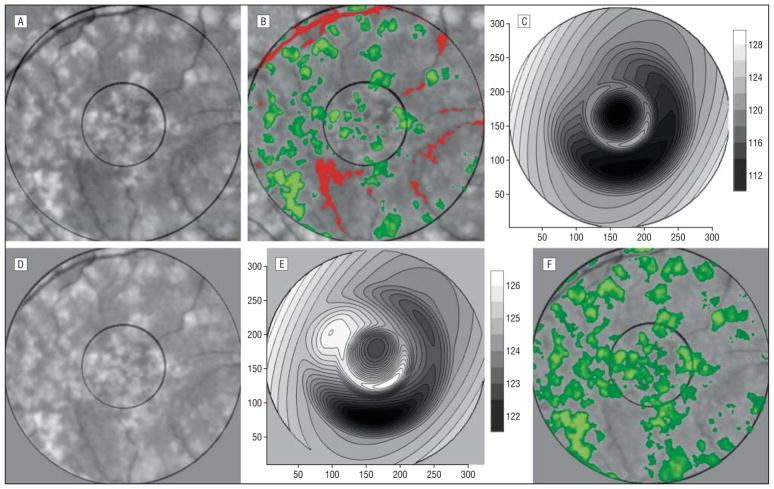
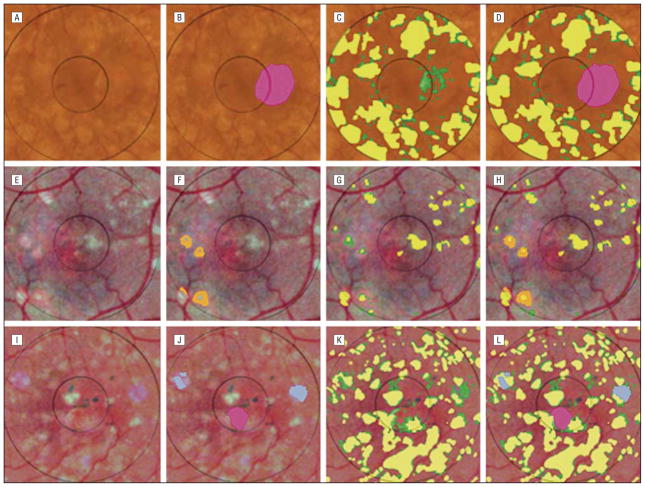
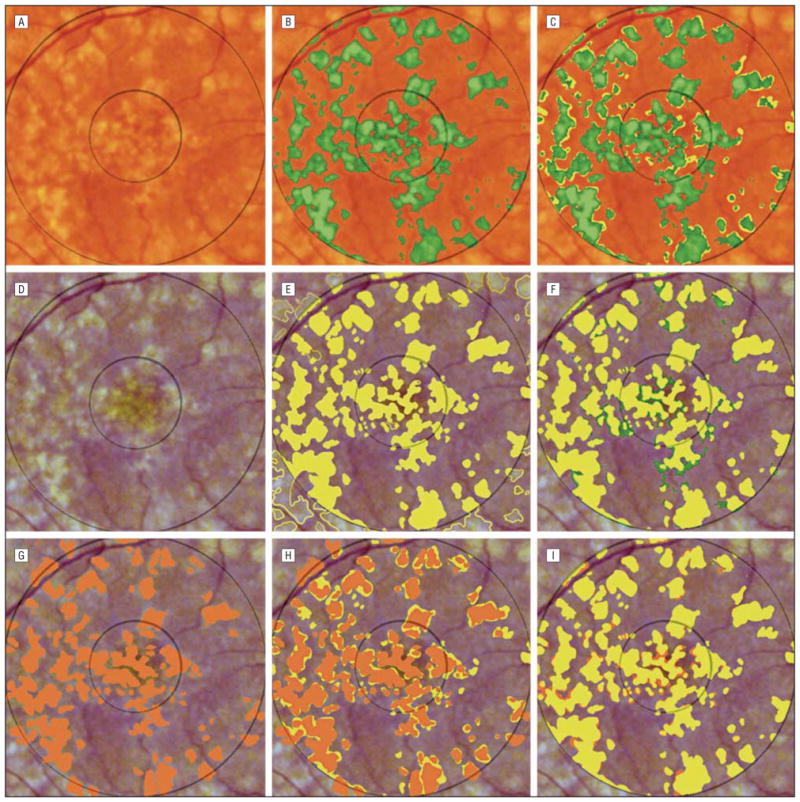
Twenty images from 17 patients were selected as representative of common manifestations of drusen. Image preprocessing included automated color balancing and, where necessary, manual segmentation of confounding lesions such as geographic atrophy (3 images). The operator then chose among 3 automated processing options suggested by predominant drusen type. Automated processing consisted of elimination of background variability by a mathematical model and subsequent histogram-based threshold selection. A retinal specialist using a graphic tablet while viewing stereo pairs constructed digital drusen drawings for each image.
The sensitivity and specificity of drusen segmentation using the automated method with respect to manual stereoscopic drusen drawings were calculated on a rigorous pixel-by-pixel basis.
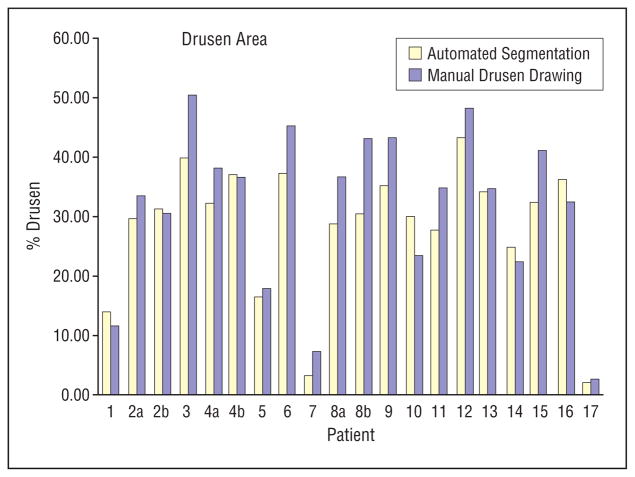
The median sensitivity and specificity of automated segmentation were 70% and 81%, respectively. After preprocessing and option choice, reproducibility of automated drusen segmentation was necessarily 100%.
Automated drusen segmentation can be reliably performed on digital fundus photographs and result in successful quantification of drusen in a more precise manner than is traditionally possible with manual stereoscopic grading of drusen. With only minor preprocessing requirements, this automated detection technique may dramatically improve our ability to monitor drusen in ARMD.
年龄相关性黄斑变性(ARMD)是美国60岁以上患者视力丧失的最常见原因。在ARMD的临床评估中,观察玻璃膜疣是标志性发现。
使用图像分析对ARMD患者的玻璃膜疣进行分割和量化,并比较图像分析分割与玻璃膜疣立体手工分级的效果。
回顾性研究。
大学转诊中心。患者照片从正在进行的哥伦比亚大学黄斑遗传学研究中已知患有ARMD的患者的可用数据库中随机选择。所有患者均为白人且年龄超过60岁。
从17例患者中选择20张图像作为玻璃膜疣常见表现的代表。图像预处理包括自动颜色平衡,必要时对手动分割混杂病变,如地图样萎缩(3张图像)。然后,操作员从主要玻璃膜疣类型建议的3种自动处理选项中进行选择。自动处理包括通过数学模型消除背景变异性,以及随后基于直方图的阈值选择。一名视网膜专家在查看立体图像对时使用数位板为每张图像构建数字玻璃膜疣图。
在严格的逐像素基础上计算使用自动方法进行玻璃膜疣分割相对于手动立体玻璃膜疣图的敏感性和特异性。
自动分割的中位敏感性和特异性分别为70%和81%。经过预处理和选项选择后,自动玻璃膜疣分割的可重复性必然为100%。
自动玻璃膜疣分割可以在数字眼底照片上可靠地进行,并能以比传统手动立体分级更精确的方式成功量化玻璃膜疣。由于仅需少量预处理要求,这种自动检测技术可能会显著提高我们监测ARMD中玻璃膜疣的能力。