Salzburger Walter, Mack Tanja, Verheyen Erik, Meyer Axel
Lehrstuhl für Zoologie und Evolutionsbiologie, Department of Biology, University of Konstanz, 78467 Konstanz, Germany.
BMC Evol Biol. 2005 Feb 21;5:17. doi: 10.1186/1471-2148-5-17.
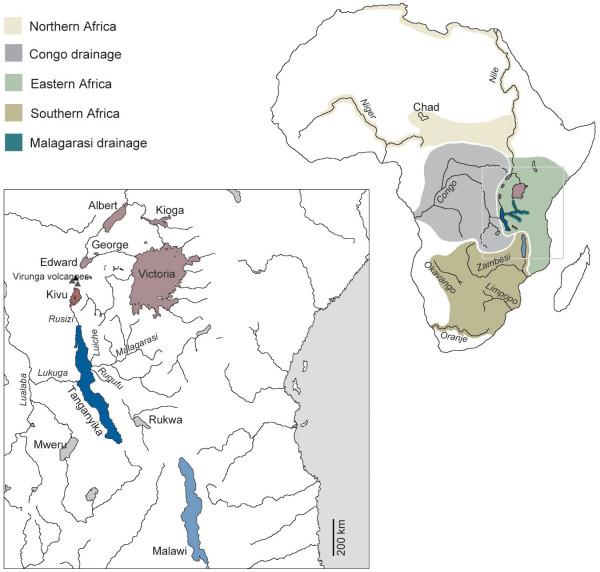
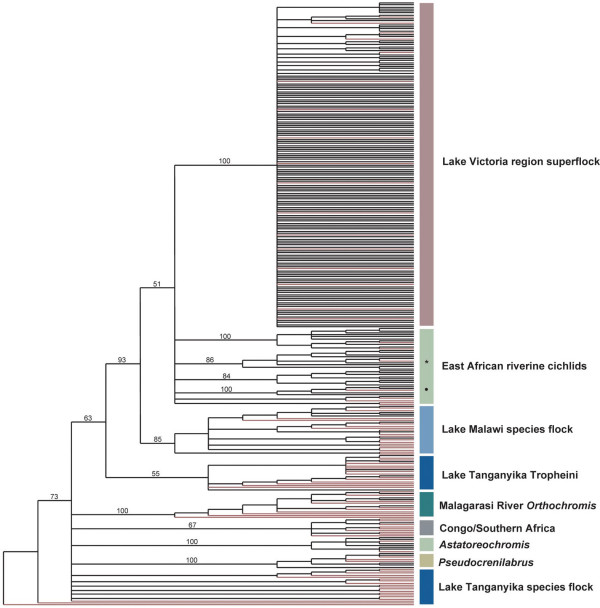
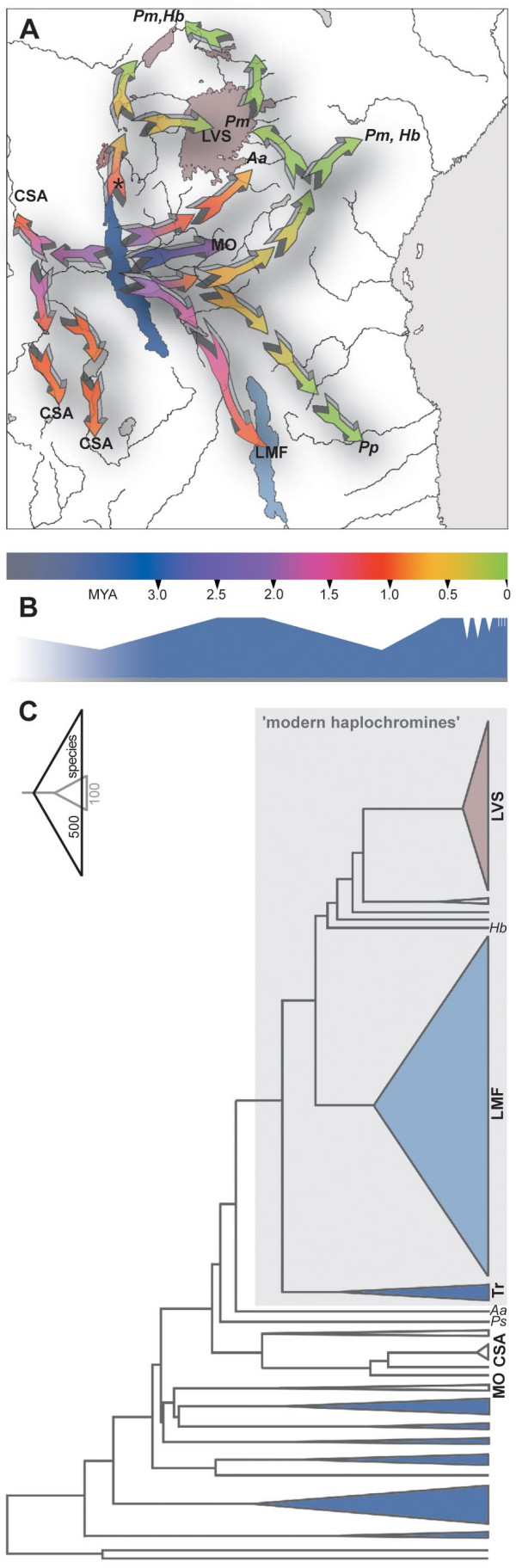
The adaptive radiations of cichlid fishes in East Africa are well known for their spectacular diversity and their astonishingly fast rates of speciation. About 80% of all 2,500 cichlid species in East Africa, and virtually all cichlid species from Lakes Victoria (approximately 500 species) and Malawi (approximately 1,000 species) are haplochromines. Here, we present the most extensive phylogenetic and phylogeographic analysis so far that includes about 100 species and is based on about 2,000 bp of the mitochondrial DNA.
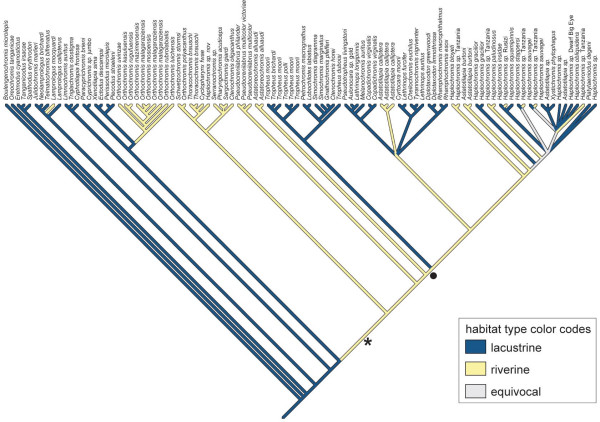
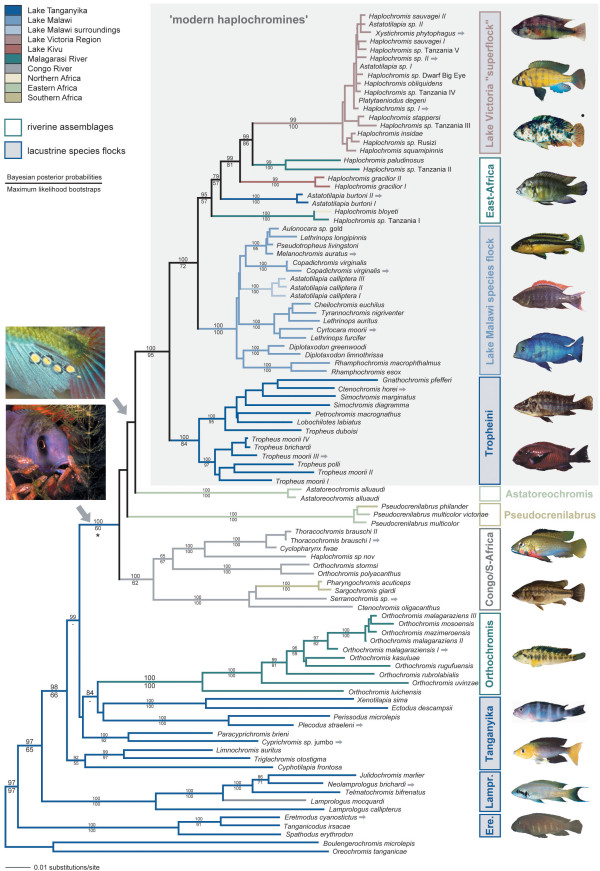
Our analyses revealed that all haplochromine lineages are ultimately derived from Lake Tanganyika endemics. We find that the three most ancestral lineages of the haplochromines sensu lato are relatively species poor, albeit widely distributed in Africa, whereas a fourth newly defined lineage - the 'modern haplochromines' - contains an unparalleled diversity that makes up more than 7% of the worlds' approximately 25,000 teleost species. The modern haplochromines' ancestor, most likely a riverine generalist, repeatedly gave rise to similar ecomorphs now found in several of the species flocks. Also, the Tanganyikan Tropheini are derived from that riverine ancestor suggesting that they successfully re-colonized Lake Tanganyika and speciated in parallel to an already established cichlid adaptive radiation. In contrast to most other known examples of adaptive radiations, these generalist ancestors were derived from highly diverse and specialized endemics from Lake Tanganyika. A reconstruction of life-history traits revealed that in an ancestral lineage leading to the modern haplochromines the characteristic egg-spots on anal fins of male individuals evolved.
We conclude that Lake Tanganyika is the geographic and genetic cradle of all haplochromine lineages. In the ancestors of the replicate adaptive radiations of the 'modern haplochromines', behavioral (maternal mouthbrooding), morphological (egg-spots) and sexually selected (color polymorphism) key-innovations arose. These might be - together with the ecological opportunity that the habitat diversity of the large lakes provides - responsible for their evolutionary success and their propensity for explosive speciation.
东非丽鱼科鱼类的适应性辐射以其惊人的多样性和极快的物种形成速度而闻名。东非2500种丽鱼科鱼类中约80%,以及维多利亚湖(约500种)和马拉维湖(约1000种)几乎所有的丽鱼科物种都是帚齿丽鱼属鱼类。在此,我们展示了迄今为止最广泛的系统发育和系统地理学分析,该分析涵盖约100个物种,并基于约2000个碱基对的线粒体DNA。
我们的分析表明,所有帚齿丽鱼属谱系最终都源自坦噶尼喀湖的特有物种。我们发现,广义帚齿丽鱼属的三个最原始谱系物种相对较少,尽管在非洲分布广泛,而第四个新定义的谱系——“现代帚齿丽鱼属”——包含了无与伦比的多样性,占世界约25000种硬骨鱼物种的7%以上。现代帚齿丽鱼属的祖先很可能是一种河流泛化种,它多次产生了现在在几个物种群中发现的类似生态形态。此外,坦噶尼喀湖的缨丽鱼属源自那个河流祖先,这表明它们成功地重新定殖于坦噶尼喀湖,并与已经存在的丽鱼科适应性辐射平行进化出物种。与大多数其他已知的适应性辐射例子不同,这些泛化祖先源自坦噶尼喀湖高度多样和特化的特有物种。对生活史特征的重建表明,在导致现代帚齿丽鱼属的一个祖先谱系中,雄性个体臀鳍上特有的卵斑进化出来。
我们得出结论,坦噶尼喀湖是所有帚齿丽鱼属谱系的地理和基因摇篮。在“现代帚齿丽鱼属”重复适应性辐射的祖先中,出现了行为(母性口育)、形态(卵斑)和性选择(颜色多态性)方面的关键创新。这些创新可能与大湖栖息地多样性提供的生态机会一起,促成了它们的进化成功及其爆发式物种形成的倾向。