Iacoboni Marco, Molnar-Szakacs Istvan, Gallese Vittorio, Buccino Giovanni, Mazziotta John C, Rizzolatti Giacomo
Ahmanson-Lovelace Brain Mapping Center, Neuropsychiatric Institute, David Geffen School of Medicine, University of California, Los Angeles, California, USA.
PLoS Biol. 2005 Mar;3(3):e79. doi: 10.1371/journal.pbio.0030079. Epub 2005 Feb 22.
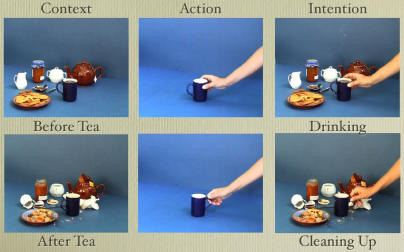
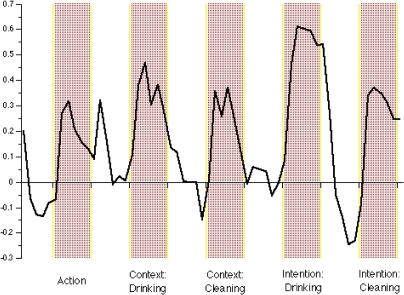
Understanding the intentions of others while watching their actions is a fundamental building block of social behavior. The neural and functional mechanisms underlying this ability are still poorly understood. To investigate these mechanisms we used functional magnetic resonance imaging. Twenty-three subjects watched three kinds of stimuli: grasping hand actions without a context, context only (scenes containing objects), and grasping hand actions performed in two different contexts. In the latter condition the context suggested the intention associated with the grasping action (either drinking or cleaning). Actions embedded in contexts, compared with the other two conditions, yielded a significant signal increase in the posterior part of the inferior frontal gyrus and the adjacent sector of the ventral premotor cortex where hand actions are represented. Thus, premotor mirror neuron areas-areas active during the execution and the observation of an action-previously thought to be involved only in action recognition are actually also involved in understanding the intentions of others. To ascribe an intention is to infer a forthcoming new goal, and this is an operation that the motor system does automatically.
在观察他人行为时理解其意图是社会行为的一个基本组成部分。这种能力背后的神经和功能机制仍未得到充分理解。为了研究这些机制,我们使用了功能磁共振成像。23名受试者观看了三种刺激:无情境的抓握手部动作、仅有情境(包含物体的场景)以及在两种不同情境中执行的抓握手部动作。在后一种情况下,情境暗示了与抓握动作相关的意图(要么是喝水要么是清洁)。与其他两种情况相比,嵌入情境中的动作在下额回后部和腹侧运动前皮层的相邻区域产生了显著的信号增强,这些区域代表手部动作。因此,运动前镜像神经元区域——在执行和观察动作时活跃的区域——以前被认为仅参与动作识别,实际上也参与理解他人的意图。归因意图就是推断即将出现的新目标,而这是运动系统自动进行的一项操作。