Gaudreault Nathaly, Arsenault A Bertrand, Larivière Christian, DeSerres Sophie J, Rivard Charles-Hilaire
CRIR, Montreal Rehabilitation Institute, Montreal, Quebec, H3S 2J4, Canada.
BMC Musculoskelet Disord. 2005 Mar 10;6:14. doi: 10.1186/1471-2474-6-14.
It is known that the back muscles of scoliotic subjects present abnormalities in their fiber type composition. Some researchers have hypothesized that abnormal fiber composition can lead to paraspinal muscle dysfunction such as poor neuromuscular efficiency and muscle fatigue. EMG parameters were used to evaluate these impairments. The purpose of the present study was to examine the clinical potential of different EMG parameters such as amplitude (RMS) and median frequency (MF) of the power spectrum in order to assess the back muscles of patients presenting idiopathic scoliosis in terms of their neuromuscular efficiency and their muscular fatigue.
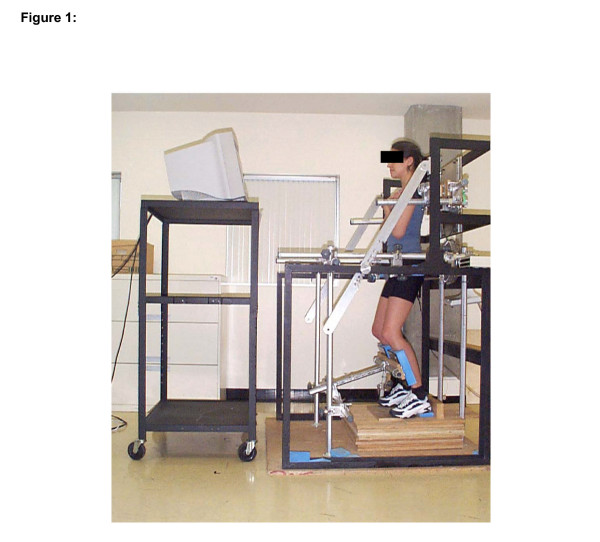
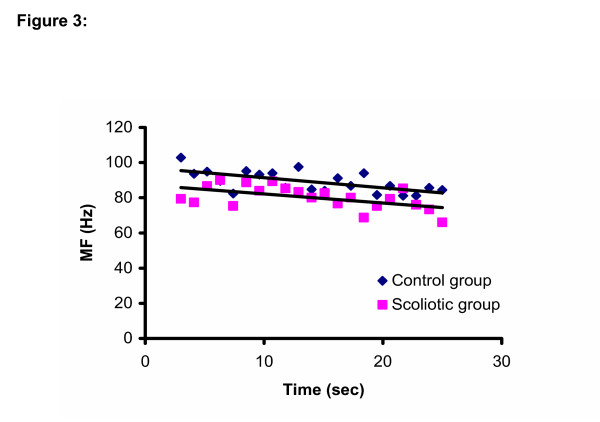
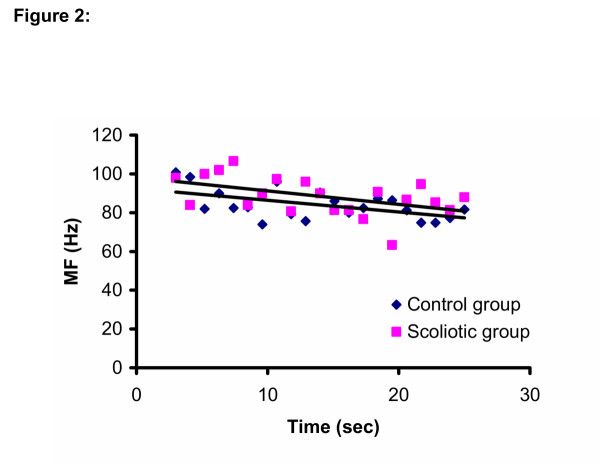
L5/S1 moments during isometric efforts in extension were measured in six subjects with idiopathic scoliosis and ten healthy controls. The subjects performed three 7 s ramp contractions ranging from 0 to 100% maximum voluntary contraction (MVC) and one 30 s sustained contraction at 75% MVC. Surface EMG activity was recorded bilaterally from the paraspinal muscles at L5, L3, L1 and T10. The slope of the EMG RMS/force (neuromuscular efficiency) and MF/force (muscle composition) relationships were computed during the ramp contractions while the slope of the EMG RMS/time and MF/time relationships (muscle fatigue) were computed during the sustained contraction. Comparisons were performed between the two groups and between the left and right sides for the EMG parameters.
No significant group or side differences between the slopes of the different measures used were found at the level of the apex (around T10) of the major curve of the spine. However, a significant side difference was seen at a lower level (L3, p = 0.01) for the MF/time parameter.
The EMG parameters used in this study could not discriminate between the back muscles of scoliotic subjects and those of control subject regarding fiber type composition, neuromuscular efficiency and muscle fatigue at the level of the apex. The results of this pilot study indicate that compensatory strategies are potentially seen at lower level of the spine with these EMG parameters.
已知脊柱侧弯患者的背部肌肉在纤维类型组成上存在异常。一些研究人员推测,异常的纤维组成会导致椎旁肌功能障碍,如神经肌肉效率低下和肌肉疲劳。肌电图(EMG)参数被用于评估这些损伤。本研究的目的是检查不同EMG参数(如功率谱的幅度(均方根,RMS)和中位频率(MF))的临床潜力,以便从神经肌肉效率和肌肉疲劳方面评估特发性脊柱侧弯患者的背部肌肉。
在六名特发性脊柱侧弯患者和十名健康对照者进行等长伸展用力时,测量L5/S1节段的力矩。受试者进行三次7秒的斜坡收缩,收缩强度从0到最大自主收缩(MVC)的100%,以及一次在75%MVC下持续30秒的收缩。从L5、L3、L1和T10水平的双侧椎旁肌记录表面肌电图活动。在斜坡收缩期间计算肌电图RMS/力(神经肌肉效率)和MF/力(肌肉组成)关系的斜率,而在持续收缩期间计算肌电图RMS/时间和MF/时间关系(肌肉疲劳)的斜率。对两组之间以及肌电图参数的左右两侧进行比较。
在脊柱主曲线顶点(约T10)水平,所使用的不同测量指标的斜率在组间或两侧均未发现显著差异。然而,对于MF/时间参数,在较低水平(L3,p = 0.01)观察到显著的两侧差异。
本研究中使用的肌电图参数在顶点水平无法区分脊柱侧弯患者和对照者的背部肌肉在纤维类型组成、神经肌肉效率和肌肉疲劳方面的差异。这项初步研究的结果表明,使用这些肌电图参数可能在脊柱较低水平观察到代偿策略。