Yoshino Kaori, Inagawa Mieko, Oshima Miyuki, Yokota Kimiko, Umesawa Mitsumasa, Enbo Ma, Yamagishi Kazumasa, Tanigawa Takeshi, Sato Shinichi, Shimamoto Takashi, Iso Hiroyasu
Department of Public Health Medicine, Doctoral Program in Social and Environmental Medicine, Graduate School of Comprehensive Human Sciences, University of Tsukuba, Ibaraki 305-8575, Japan.
J Epidemiol. 2005 Mar;15(2):29-37. doi: 10.2188/jea.15.29.
The 5th edition of the Japanese food composition table enables us to evaluate intakes of folate and vitamins B6 and B12, which are associated with risk of chronic diseases.
We investigated long-term trends in dietary intake of those nutrients in two rural communities; Ikawa from1974 through 2000, and Kyowa from 1982 through 2001. The 24-hour recall method was adopted. Intake of green tea interviewed from 1994 was used to examine food sources for these nutrients in the latest period, but not to evaluate long-term trends. Reduced intakes of nutrients due to cooking were not taken into account.
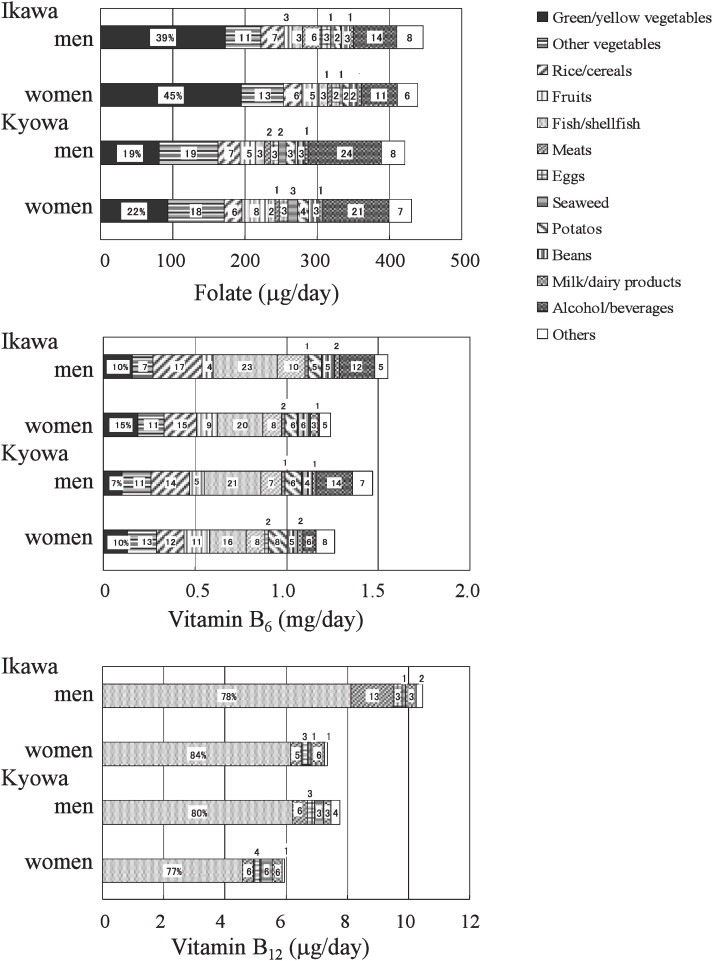
Age-adjusted mean folate intake increased by 30% in Ikawa between the 1970's and 1980's, and then leveled off to the latest survey, while that in Kyowa did not change throughout the survey periods. The increased folate intake was primarily due to green/yellow vegetables. Mean vitamin B6 intake did not change except that it increased for Ikawa women in the 1980's and decreased for Kyowa men in the latest period. No secular trend was found for mean vitamin B12 intake. The largest source for folate intake was total vegetables (38-58% of total intake) and the second largest source was alcohol/beverages including green tea (11-24%). Fish/shellfish was the largest source for vitamins B6 (16-23%) and B12 (77-84%).
Dietary intakes of folate, vitamins B6 and B12 showed no notable long-term trend, except for an increased folate intake between the 1970's and 1980's due to an increased intake of green/yellow vegetables.
日本食品成分表第5版使我们能够评估与慢性病风险相关的叶酸、维生素B6和维生素B12的摄入量。
我们调查了两个农村社区这些营养素的长期膳食摄入趋势;一个是1974年至2000年的井田社区,另一个是1982年至2001年的协和社区。采用24小时回忆法。1994年访谈的绿茶摄入量用于研究最近时期这些营养素的食物来源,但不用于评估长期趋势。未考虑烹饪导致的营养素摄入量减少。
在井田社区,年龄调整后的叶酸平均摄入量在20世纪70年代至80年代增加了30%,然后在最近一次调查中趋于平稳,而在协和社区,整个调查期间该摄入量没有变化。叶酸摄入量的增加主要归因于绿色/黄色蔬菜。除了20世纪80年代井田社区女性的维生素B6摄入量增加以及最近时期协和社区男性的维生素B6摄入量减少外,维生素B6的平均摄入量没有变化。维生素B12的平均摄入量未发现长期趋势。叶酸摄入的最大来源是蔬菜总量(占总摄入量的38 - 58%),第二大来源是包括绿茶在内的酒精/饮料(11 - 24%)。鱼类/贝类是维生素B6(16 - 23%)和维生素B12(77 - 84%)的最大来源。
除了20世纪70年代至80年代因绿色/黄色蔬菜摄入量增加导致叶酸摄入量增加外,叶酸、维生素B6和维生素B12的膳食摄入量没有显著的长期趋势。