Shirk Andrew J, Kuver Rahul
Department of Medicine, University of Washington School of Medicine, and The Puget Sound Veterans Administration Health Care System, Seattle, Washington, USA.
BMC Gastroenterol. 2005 Mar 31;5:12. doi: 10.1186/1471-230X-5-12.
Pancreatic adenocarcinoma is a highly invasive neoplasm. Epidermal growth factor (EGF) and its receptor are over expressed in pancreatic cancer, and expression correlates with invasion and metastasis. We hypothesized that EGF receptor and integrin signalling pathways interact in mediating cellular adhesion and invasion in pancreatic cancer, and that invasiveness correlates temporally with detachment from extracellular matrix.
We tested this hypothesis by investigating the role of EGF in mediating adhesion to and invasion through collagen I and Matrigel in the metastatic pancreatic adenocarcinoma cell line Capan-1. Adhesion and invasion were measured using in vitro assays of fluorescently-labeled cells. Adhesion and invasion assays were also performed in the primary pancreatic adenocarcinoma cell line MIA PaCa-2.
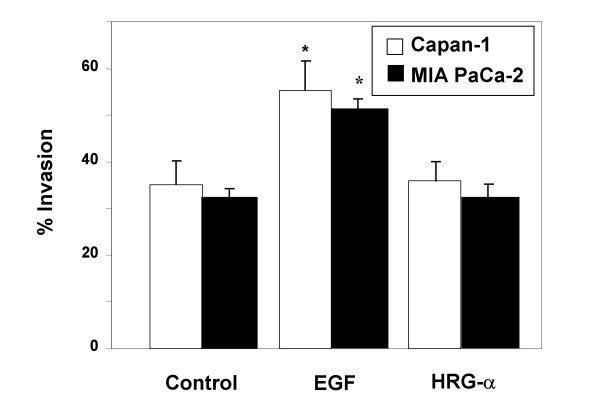
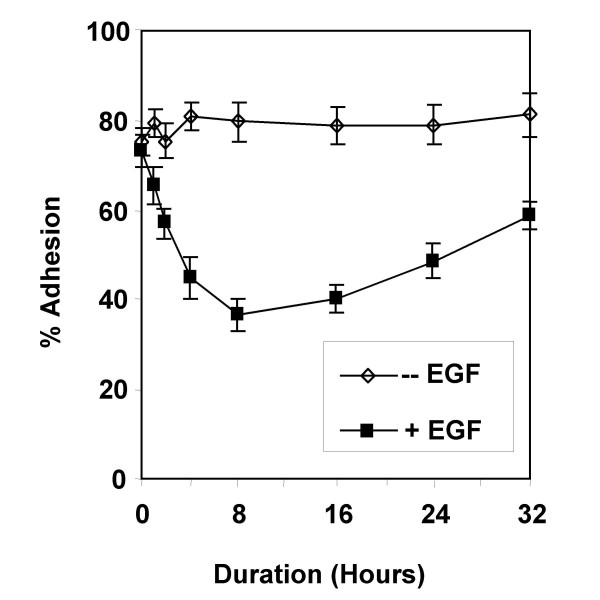
EGF inhibited adhesion to collagen I and Matrigel in Capan-1 cells. The loss of adhesion was reversed by AG825, an inhibitor of erbB2 receptor signalling and by wortmannin, a PI3K inhibitor, but not by the protein synthesis inhibitor cycloheximide. EGF stimulated invasion through collagen I and Matrigel at concentrations and time courses similar to those mediating detachment from these extracellular matrix components. Adhesion to collagen I was different in MIA PaCa-2 cells, with no significant change elicited following EGF treatment, whereas treatment with the EGF family member heregulin-alpha elicited a marked increase in adhesion. Invasion through Matrigel in response to EGF, however, was similar to that observed in Capan-1 cells.
An inverse relationship exists between adhesion and invasion capabilities in Capan-1 cells but not in MIA PaCa-2 cells. EGF receptor signalling involving the erbB2 and PI3K pathways plays a role in mediating these events in Capan-1 cells.
胰腺腺癌是一种具有高度侵袭性的肿瘤。表皮生长因子(EGF)及其受体在胰腺癌中过度表达,且其表达与侵袭和转移相关。我们推测,EGF受体和整合素信号通路在介导胰腺癌细胞的黏附和侵袭过程中相互作用,并且侵袭性与从细胞外基质脱离在时间上相关。
我们通过研究EGF在转移性胰腺腺癌细胞系Capan-1中介导对I型胶原和基质胶的黏附及侵袭中的作用来验证这一假设。使用荧光标记细胞的体外试验来测量黏附和侵袭。在原发性胰腺腺癌细胞系MIA PaCa-2中也进行了黏附和侵袭试验。
EGF抑制Capan-1细胞对I型胶原和基质胶的黏附。erbB2受体信号抑制剂AG825和PI3K抑制剂渥曼青霉素可逆转黏附丧失,但蛋白质合成抑制剂放线菌酮不能。EGF在与介导从这些细胞外基质成分脱离相似的浓度和时间进程下刺激通过I型胶原和基质胶的侵袭。MIA PaCa-2细胞对I型胶原的黏附不同,EGF处理后无显著变化,而EGF家族成员这里格列宁-α处理后黏附显著增加。然而,MIA PaCa-2细胞对EGF刺激通过基质胶的侵袭与Capan-1细胞中观察到的相似。
Capan-1细胞的黏附和侵袭能力之间存在负相关关系,而MIA PaCa-2细胞中不存在这种关系。涉及erbB2和PI3K途径的EGF受体信号在介导Capan-1细胞的这些事件中起作用。