Kikovska Ema, Brännvall Mathias, Kufel Joanna, Kirsebom Leif A
Department of Cell and Molecular Biology Box 596, Biomedical Centre, SE-751 24 Uppsala, Sweden.
Nucleic Acids Res. 2005 Apr 7;33(6):2012-21. doi: 10.1093/nar/gki344. Print 2005.
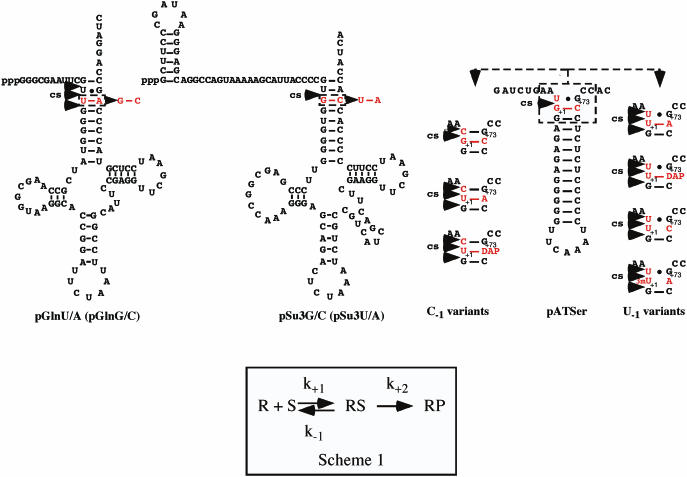
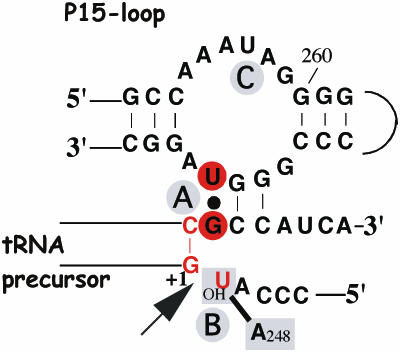
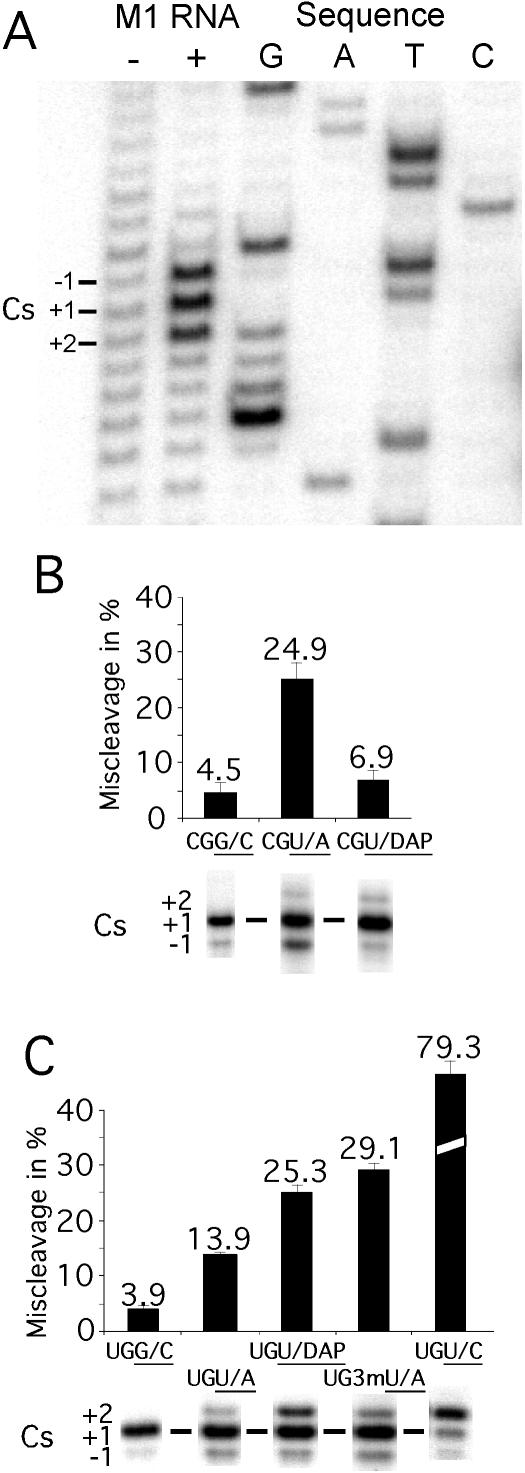
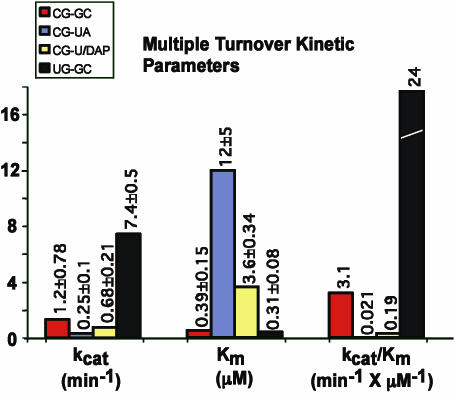
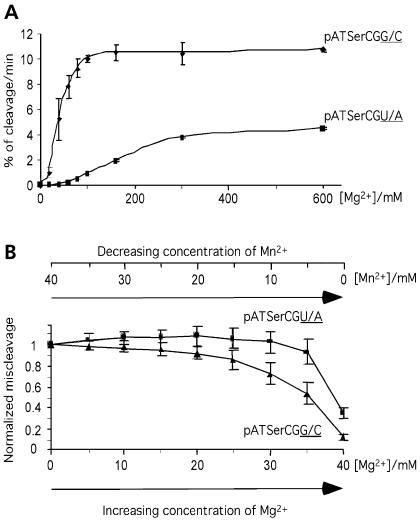
Like the translational elongation factor EF-Tu, RNase P interacts with a large number of substrates where RNase P with its RNA subunit generates tRNAs with matured 5' termini by cleaving tRNA precursors immediately 5' of the residue at +1, i.e. at the position that corresponds to the first residue in tRNA. Most tRNAs carry a G+1C+72 base pair at the end of the aminoacyl acceptor-stem whereas in tRNA(Gln) G+1C+72 is replaced with U+1A+72. Here, we investigated RNase P RNA-mediated cleavage as a function of having G+1C+72 versus U+1A+72 in various substrate backgrounds, two full-size tRNA precursors (pre-tRNA(Gln) and pre-tRNA(Tyr)Su3) and a model RNA hairpin substrate (pATSer). Our data showed that replacement of G+1C+72 with U+1A+72 influenced ground state binding, cleavage efficiency under multiple and single turnover conditions in a substrate-dependent manner. Interestingly, we observed differences both in ground state binding and rate of cleavage comparing two full-size tRNA precursors, pre-tRNA(Gln) and pre-tRNA(Tyr)Su3. These findings provide evidence for substrate discrimination in RNase P RNA-mediated cleavage both at the level of binding, as previously observed for EF-Tu, as well as at the catalytic step. In our experiments where we used model substrate derivatives further indicated the importance of the +1/+72 base pair in substrate discrimination by RNase P RNA. Finally, we provide evidence that the structural architecture influences Mg2+ binding, most likely in its vicinity.
与翻译延伸因子EF-Tu一样,核糖核酸酶P与大量底物相互作用,核糖核酸酶P及其RNA亚基通过在tRNA前体的 +1 位(即对应于tRNA中第一个残基的位置)的残基紧邻 5' 端处切割tRNA前体,产生具有成熟 5' 末端的tRNA。大多数tRNA在氨酰基受体茎末端携带G+1C+72碱基对,而在tRNA(Gln)中,G+1C+72被U+1A+72取代。在这里,我们研究了在各种底物背景下,核糖核酸酶P RNA介导的切割作为具有G+1C+72与U+1A+72的函数,包括两个全长tRNA前体(pre-tRNA(Gln)和pre-tRNA(Tyr)Su3)以及一个模型RNA发夹底物(pATSer)。我们的数据表明,用U+1A+72取代G+1C+72以底物依赖的方式影响基态结合、多轮和单轮条件下的切割效率。有趣的是,比较两个全长tRNA前体pre-tRNA(Gln)和pre-tRNA(Tyr)Su3,我们在基态结合和切割速率上都观察到了差异。这些发现为核糖核酸酶P RNA介导的切割在结合水平(如先前对EF-Tu所观察到的)以及催化步骤中底物识别提供了证据。在我们使用模型底物衍生物的实验中,进一步表明了 +1/+72碱基对在核糖核酸酶P RNA底物识别中的重要性。最后,我们提供证据表明结构架构影响Mg2+结合,很可能是在其附近。