Flendrie Marcel, Vissers Wynand H P M, Creemers Marjonne C W, de Jong Elke M G J, van de Kerkhof Peter C M, van Riel Piet L C M
Department of Rheumatology, Radboud University Nijmegen Medical Centre, Nijmegen, the Netherlands.
Arthritis Res Ther. 2005;7(3):R666-76. doi: 10.1186/ar1724. Epub 2005 Apr 4.
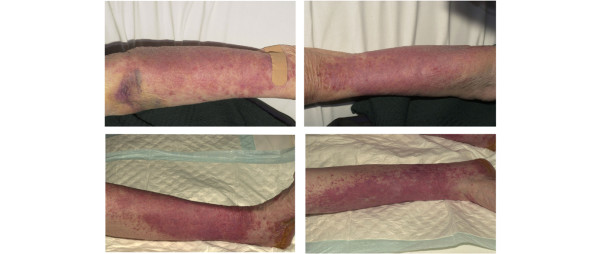
Various dermatological conditions have been reported during tumor necrosis factor (TNF)-alpha-blocking therapy, but until now no prospective studies have been focused on this aspect. The present study was set up to investigate the number and nature of clinically important dermatological conditions during TNF-alpha-blocking therapy in patients with rheumatoid arthritis (RA). RA patients starting on TNF-alpha-blocking therapy were prospectively followed up. The numbers and natures of dermatological events giving rise to a dermatological consultation were recorded. The patients with a dermatological event were compared with a group of prospectively followed up RA control patients, naive to TNF-alpha-blocking therapy and matched for follow-up period. 289 RA patients started TNF-alpha-blocking therapy. 128 dermatological events were recorded in 72 patients (25%) during 911 patient-years of follow-up. TNF-alpha-blocking therapy was stopped in 19 (26%) of these 72 patients because of the dermatological event. More of the RA patients given TNF-alpha-blocking therapy (25%) than of the anti-TNF-alpha-naive patients (13%) visited a dermatologist during follow-up (P < 0.0005). Events were recorded more often during active treatment (0.16 events per patient-year) than during the period of withdrawal of TNF-alpha-blocking therapy (0.09 events per patient-year, P < 0.0005). The events recorded most frequently were skin infections (n = 33), eczema (n = 20), and drug-related eruptions (n = 15). Other events with a possible relation to TNF-alpha-blocking therapy included vasculitis, psoriasis, drug-induced systemic lupus erythematosus, dermatomyositis, and a lymphomatoid-papulosis-like eruption. This study is the first large prospective study focusing on dermatological conditions during TNF-alpha-blocking therapy. It shows that dermatological conditions are a significant and clinically important problem in RA patients receiving TNF-alpha-blocking therapy.
在肿瘤坏死因子(TNF)-α阻断治疗期间已报告了多种皮肤病,但迄今为止尚无前瞻性研究关注这一方面。本研究旨在调查类风湿关节炎(RA)患者在TNF-α阻断治疗期间具有临床重要意义的皮肤病的数量和性质。对开始接受TNF-α阻断治疗的RA患者进行前瞻性随访。记录引起皮肤科会诊的皮肤事件的数量和性质。将发生皮肤事件的患者与一组前瞻性随访的RA对照患者进行比较,这些对照患者未接受过TNF-α阻断治疗且随访期匹配。289例RA患者开始TNF-α阻断治疗。在911患者年的随访期间,72例患者(25%)记录到128例皮肤事件。由于皮肤事件,这72例患者中有19例(26%)停止了TNF-α阻断治疗。接受TNF-α阻断治疗的RA患者在随访期间看皮肤科医生的比例(25%)高于未接受过抗TNF-α治疗的患者(13%)(P<0.0005)。与TNF-α阻断治疗停药期相比,在积极治疗期间记录到的事件更频繁(每位患者每年0.16例事件)(每位患者每年0.09例事件,P<0.0005)。记录最频繁的事件是皮肤感染(n=33)、湿疹(n=20)和药物相关皮疹(n=15)。其他可能与TNF-α阻断治疗有关的事件包括血管炎、银屑病、药物性系统性红斑狼疮、皮肌炎和类淋巴瘤样丘疹病样皮疹。本研究是第一项关注TNF-α阻断治疗期间皮肤病的大型前瞻性研究。它表明,皮肤病在接受TNF-α阻断治疗的RA患者中是一个重大且具有临床重要性的问题。