Yafe Anat, Etzioni Shulamit, Weisman-Shomer Pnina, Fry Michael
Department of Biochemistry, Rappaport Faculty of Medicine, Technion-Israel Institute of Technology PO Box 9649 Bat Galim, Haifa 31096, Israel.
Nucleic Acids Res. 2005 May 20;33(9):2887-900. doi: 10.1093/nar/gki606. Print 2005.
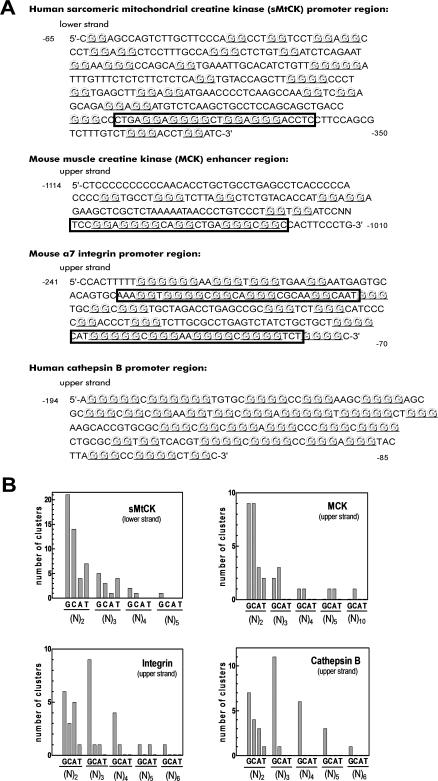
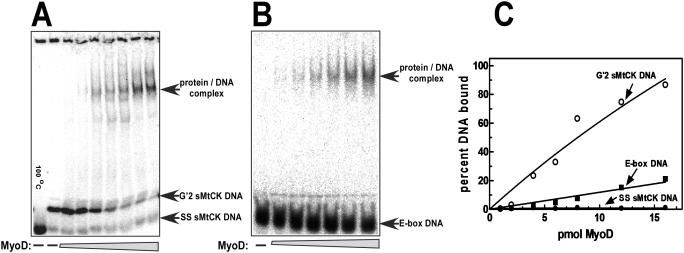
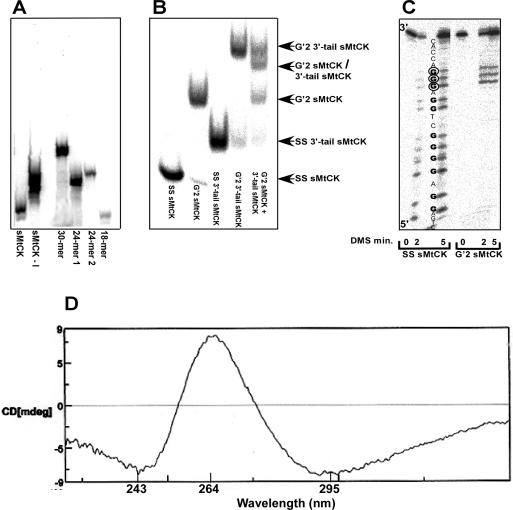
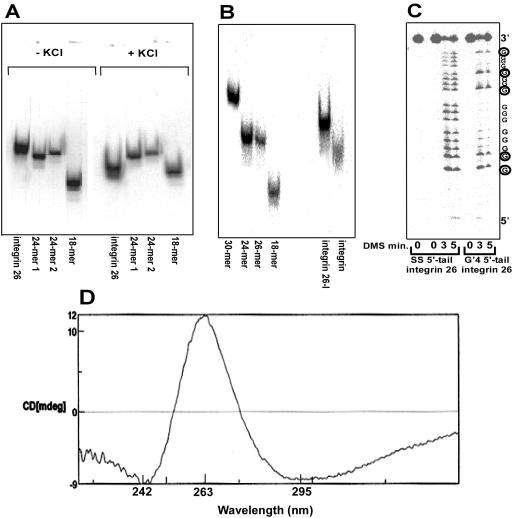
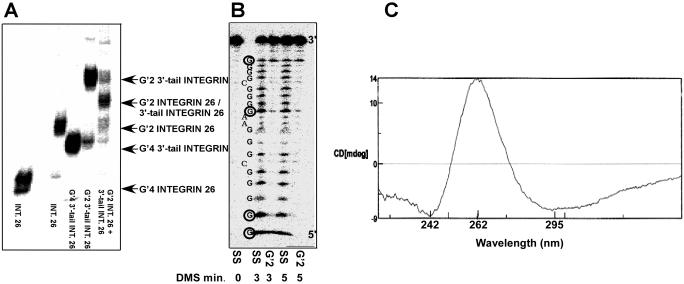
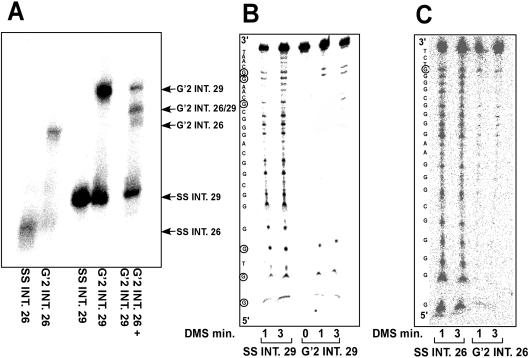
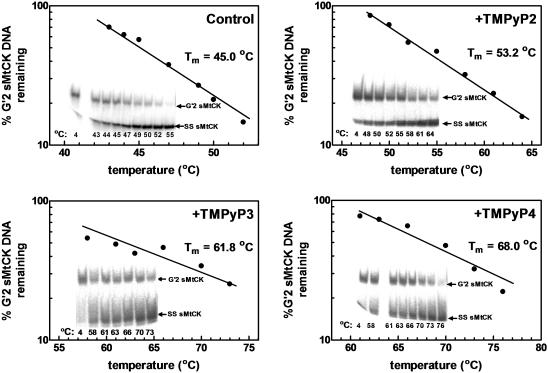
Clustered guanine residues in DNA readily generate hairpin or a variety of tetrahelical structures. The myogenic determination protein MyoD was reported to bind to a tetrahelical structure of guanine-rich enhancer sequence of muscle creatine kinase (MCK) more tightly than to its target E-box motif [K. Walsh and A. Gualberto (1992) J. Biol. Chem., 267, 13714-13718], suggesting that tetraplex structures of regulatory sequences of muscle-specific genes could contribute to transcriptional regulation. In the current study we show that promoter or enhancer sequences of various muscle-specific genes display a disproportionately high incidence of guanine clusters. The sequences derived from the guanine-rich promoter or enhancer regions of three muscle-specific genes, human sarcomeric mitochondrial creatine kinase (sMtCK), mouse MCK and alpha7 integrin formed diverse secondary structures. The sMtCK sequence folded into a hairpin structure; the alpha7 integrin oligonucleotide generated a unimolecular tetraplex; and sequences from all three genes associated to generate bimolecular tetraplexes. Furthermore, two neighboring non-contiguous guanine-rich tracts in the alpha7 integrin promoter region also paired to form a tetraplex structure. We also show that homodimeric MyoD bound bimolecular tetraplex structures of muscle-specific regulatory sequences more efficiently than its target E-box motif. These results are consistent with a role of tetrahelical structures of DNA in the regulation of muscle-specific gene expression.
DNA中成簇的鸟嘌呤残基很容易形成发夹结构或多种四链结构。据报道,生肌决定蛋白MyoD与肌肉肌酸激酶(MCK)富含鸟嘌呤的增强子序列的四链结构结合比与它的靶标E-box基序结合更紧密[K. Walsh和A. Gualberto(1992年)《生物化学杂志》,267卷,13714 - 13718页],这表明肌肉特异性基因调控序列的四链结构可能有助于转录调控。在本研究中,我们发现各种肌肉特异性基因的启动子或增强子序列中鸟嘌呤簇的发生率异常高。来自三个肌肉特异性基因,即人类肌节线粒体肌酸激酶(sMtCK)、小鼠MCK和α7整合素的富含鸟嘌呤的启动子或增强子区域的序列形成了不同的二级结构。sMtCK序列折叠成发夹结构;α7整合素寡核苷酸形成单分子四链体;并且来自所有三个基因的序列相互作用形成双分子四链体。此外,α7整合素启动子区域中两个相邻的非连续富含鸟嘌呤的片段也配对形成四链结构。我们还表明,同二聚体MyoD与肌肉特异性调控序列的双分子四链结构结合比与它的靶标E-box基序结合更有效。这些结果与DNA的四链结构在肌肉特异性基因表达调控中的作用一致。