Yang Danzhou
Department of Medicinal Chemistry and Molecular Pharmacology, College of Pharmacy, Purdue University, West Lafayette, IN, USA.
Purdue Center for Cancer Research, West Lafayette, IN, USA.
Methods Mol Biol. 2019;2035:1-24. doi: 10.1007/978-1-4939-9666-7_1.
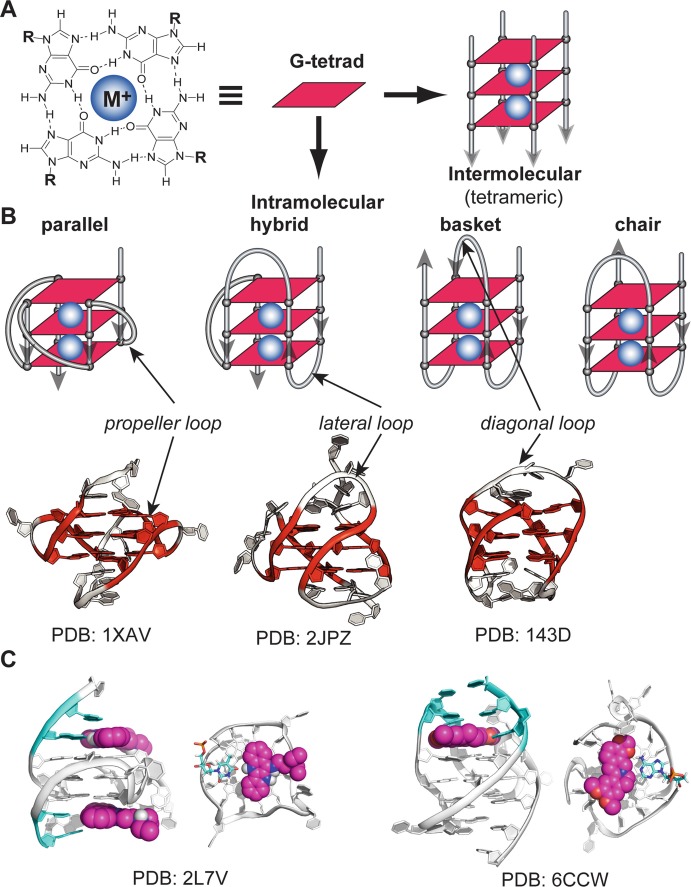
G-quadruplexes (G4s) have become one of the most exciting nucleic acid secondary structures. A noncanonical, four-stranded structure formed in guanine-rich DNA and RNA sequences, G-quadruplexes can readily form under physiologically relevant conditions and are globularly folded structures. DNA is widely recognized as a double-helical structure essential in genetic information storage. However, only ~3% of the human genome is expressed in protein; RNA and DNA may form noncanonical secondary structures that are functionally important. G-quadruplexes are one such example which have gained considerable attention for their formation and regulatory roles in biologically significant regions, such as human telomeres, oncogene-promoter regions, replication initiation sites, and 5'- and 3'-untranslated region (UTR) of mRNA. They are shown to be a regulatory motif in a number of critical cellular processes including gene transcription, translation, replication, and genomic stability. G-quadruplexes are also found in nonhuman genomes, particularly those of human pathogens. Therefore, G-quadruplexes have emerged as a new class of molecular targets for drug development. In addition, there is considerable interest in the use of G-quadruplexes for biomaterials, biosensors, and biocatalysts. The First International Meeting on Quadruplex DNA was held in 2007, and the G-quadruplex field has been growing dramatically over the last decade. The methods used to study G-quadruplexes have been essential to the rapid progress in our understanding of this exciting nucleic acid secondary structure.
G-四链体(G4s)已成为最令人关注的核酸二级结构之一。G-四链体是在富含鸟嘌呤的DNA和RNA序列中形成的一种非经典四链结构,能在生理相关条件下轻易形成,且为球状折叠结构。DNA被广泛认为是遗传信息存储中必不可少的双螺旋结构。然而,人类基因组中只有约3%会表达为蛋白质;RNA和DNA可能形成具有重要功能的非经典二级结构。G-四链体就是这样一个例子,因其在人类端粒、癌基因启动子区域、复制起始位点以及mRNA的5'和3'非翻译区(UTR)等生物学重要区域的形成及调控作用而备受关注。它们在包括基因转录、翻译、复制和基因组稳定性在内的许多关键细胞过程中被证明是一种调控基序。在非人类基因组中也发现了G-四链体,尤其是人类病原体的基因组。因此,G-四链体已成为药物开发的一类新分子靶点。此外,人们对将G-四链体用于生物材料、生物传感器和生物催化剂也有浓厚兴趣。第一届四链体DNA国际会议于2007年召开,在过去十年中,G-四链体领域发展迅速。用于研究G-四链体的方法对于我们快速深入了解这种令人兴奋的核酸二级结构至关重要。