Lochmeyer C, Koch J, Fuchs G
Angewandte Mikrobiologie, University of Ulm, Germany.
J Bacteriol. 1992 Jun;174(11):3621-8. doi: 10.1128/jb.174.11.3621-3628.1992.
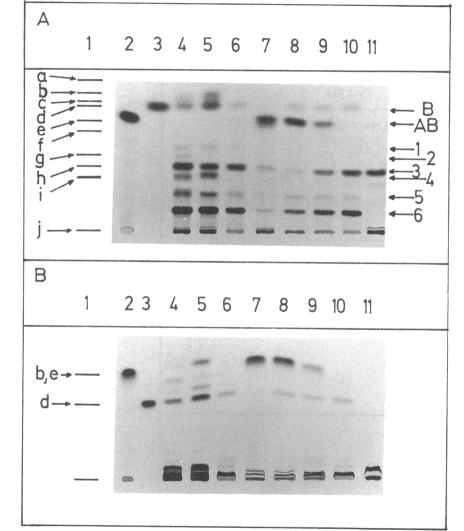
The enzymes catalyzing the initial reactions in the anaerobic degradation of 2-aminobenzoic acid (anthranilic acid) were studied with a denitrifying Pseudomonas sp. anaerobically grown with 2-aminobenzoate and nitrate as the sole carbon and energy sources. Cells grown on 2-aminobenzoate are simultaneously adapted to growth with benzoate, whereas cells grown on benzoate degrade 2-aminobenzoate several times less efficiently than benzoate. Evidence for a new reductive pathway of aromatic metabolism and for four enzymes catalyzing the initial steps is presented. The organism contains 2-aminobenzoate-coenzyme A ligase (2-aminobenzoate-CoA ligase), which forms 2-aminobenzoyl-CoA. 2-Aminobenzoyl-CoA is then reductively deaminated to benzoyl-CoA by an oxygen-sensitive enzyme, 2-aminobenzoyl-CoA reductase (deaminating), which requires a low potential reductant [Ti(III)]. The specific activity is 15 nmol of 2-aminobenzoyl-CoA reduced min-1 mg-1 of protein at an optimal pH of 7. The two enzymes are induced by the substrate under anaerobic conditions only. Benzoyl-CoA is further converted in vitro by reduction with Ti(III) to six products; the same products are formed when benzoyl-CoA or 2-aminobenzoyl-CoA is incubated under reducing conditions. Two of them were identified preliminarily. One product is cyclohex-1-enecarboxyl-CoA, the other is trans-2-hydroxycyclohexane-carboxyl-CoA. The complex transformation of benzoyl-CoA is ascribed to at least two enzymes, benzoyl-CoA reductase (aromatic ring reducing) and cyclohex-1-enecarboxyl-CoA hydratase. The reduction of benzoyl-CoA to alicyclic compounds is catalyzed by extracts from cells grown anaerobically on either 2-aminobenzoate or benzoate at almost the same rate (10 to 15 nmol min-1 mg-1 of protein). In contrast, extracts from cells grown anaerobically on acetate or grown aerobically on benzoate or 2-aminobenzoate are inactive. This suggests a sequential induction of the enzymes.
利用以2-氨基苯甲酸和硝酸盐作为唯一碳源和能源进行厌氧培养的反硝化假单胞菌,对催化2-氨基苯甲酸(邻氨基苯甲酸)厌氧降解初始反应的酶进行了研究。在2-氨基苯甲酸上生长的细胞同时适应于在苯甲酸上生长,而在苯甲酸上生长的细胞降解2-氨基苯甲酸的效率比苯甲酸低几倍。本文提供了芳香族代谢新还原途径以及催化初始步骤的四种酶的证据。该生物体含有2-氨基苯甲酸辅酶A连接酶(2-氨基苯甲酸-CoA连接酶),它能形成2-氨基苯甲酰-CoA。然后,2-氨基苯甲酰-CoA被一种对氧敏感的酶——2-氨基苯甲酰-CoA还原酶(脱氨基)还原脱氨基生成苯甲酰-CoA,该酶需要一种低电位还原剂[Ti(III)]。在最适pH值为7时,比活性为每分钟每毫克蛋白质还原15 nmol的2-氨基苯甲酰-CoA。这两种酶仅在厌氧条件下由底物诱导产生。在体外,苯甲酰-CoA通过用Ti(III)还原可进一步转化为六种产物;当苯甲酰-CoA或2-氨基苯甲酰-CoA在还原条件下孵育时,会形成相同的产物。其中两种产物已初步鉴定。一种产物是环己-1-烯羧酸-CoA,另一种是反式-2-羟基环己烷羧酸-CoA。苯甲酰-CoA的复杂转化归因于至少两种酶,即苯甲酰-CoA还原酶(芳香环还原)和环己-1-烯羧酸-CoA水合酶。在以2-氨基苯甲酸或苯甲酸进行厌氧生长的细胞提取物中,苯甲酰-CoA还原为脂环族化合物的催化速率几乎相同(每分钟每毫克蛋白质10至15 nmol)。相比之下,在乙酸盐上厌氧生长或在苯甲酸或2-氨基苯甲酸上需氧生长的细胞提取物则无活性。这表明这些酶是顺序诱导产生的。