Holcman David, Korenbrot Juan I
Keck Center for Theoretical Neurobiology and Department of Physiology, School of Medicine, University of California at San Francisco, 94143, USA.
J Gen Physiol. 2005 Jun;125(6):641-60. doi: 10.1085/jgp.200509277.
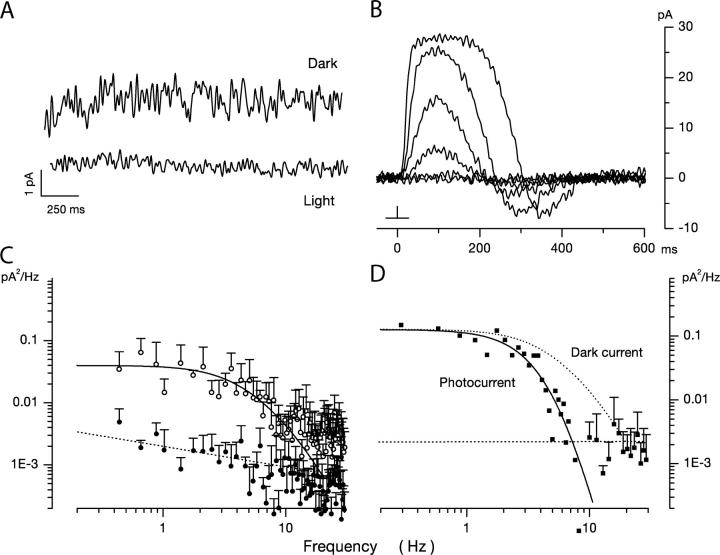
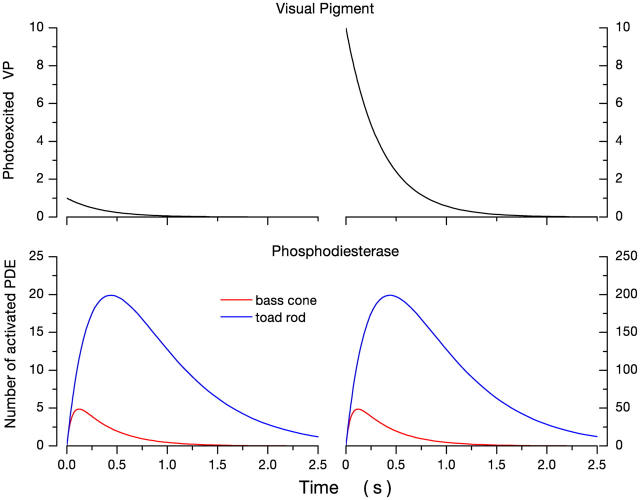
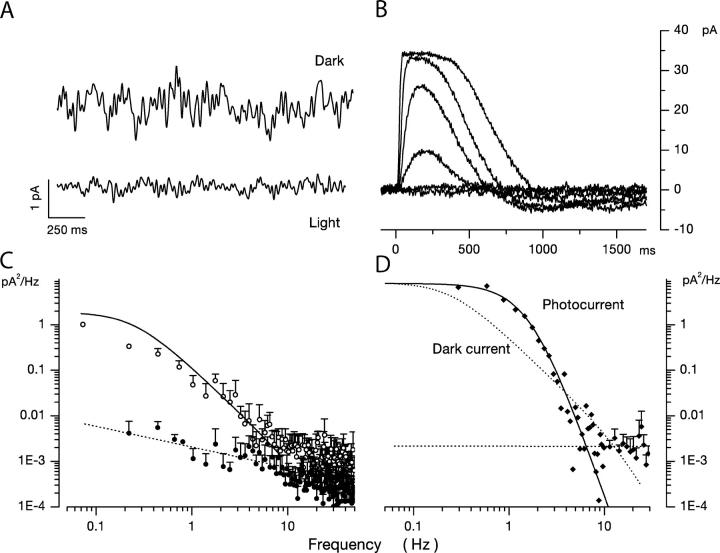
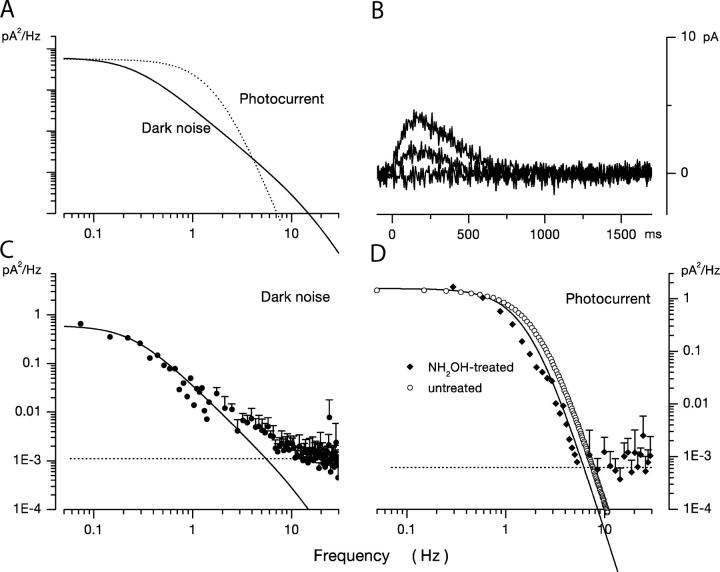
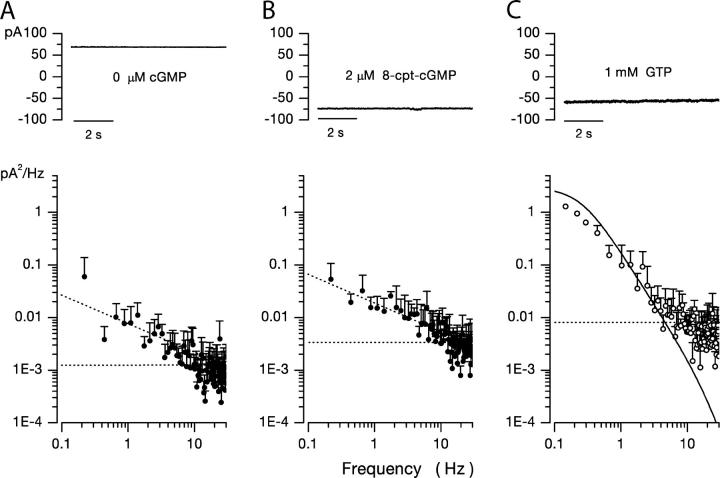
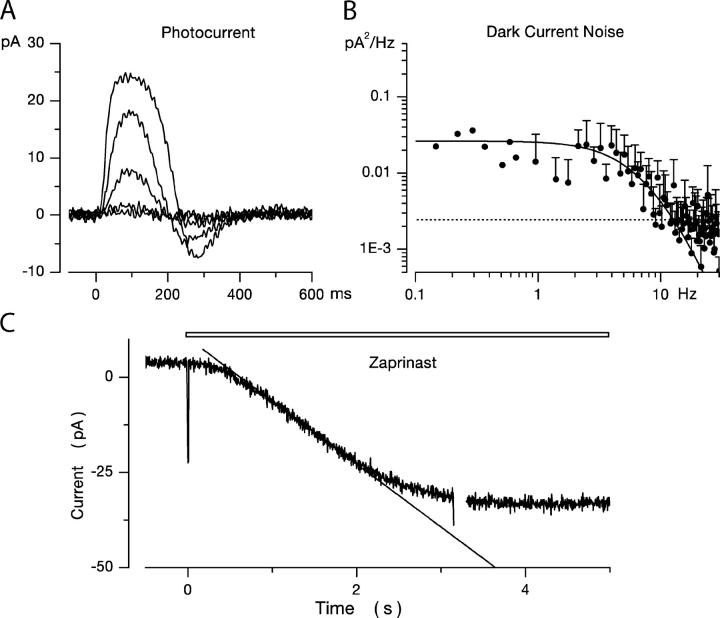
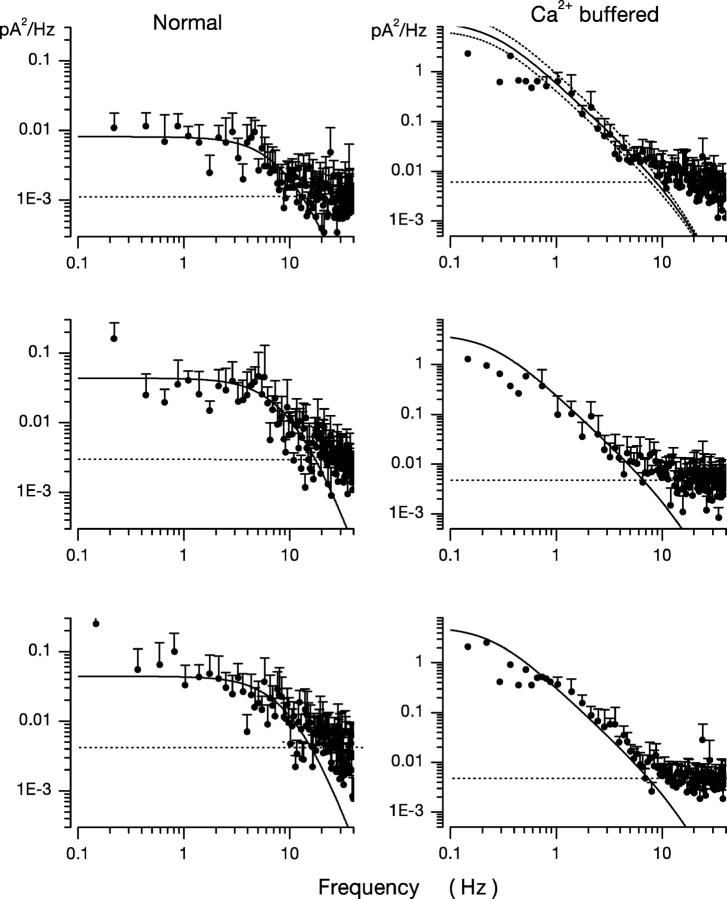
Detection threshold in cone photoreceptors requires the simultaneous absorption of several photons because single photon photocurrent is small in amplitude and does not exceed intrinsic fluctuations in the outer segment dark current (dark noise). To understand the mechanisms that limit light sensitivity, we characterized the molecular origin of dark noise in intact, isolated bass single cones. Dark noise is caused by continuous fluctuations in the cytoplasmic concentrations of both cGMP and Ca(2+) that arise from the activity in darkness of both guanylate cyclase (GC), the enzyme that synthesizes cGMP, and phosphodiesterase (PDE), the enzyme that hydrolyzes it. In cones loaded with high concentration Ca(2+) buffering agents, we demonstrate that variation in cGMP levels arise from fluctuations in the mean PDE enzymatic activity. The rates of PDE activation and inactivation determine the quantitative characteristics of the dark noise power density spectrum. We developed a mathematical model based on the dynamics of PDE activity that accurately predicts this power spectrum. Analysis of the experimental data with the theoretical model allows us to determine the rates of PDE activation and deactivation in the intact photoreceptor. In fish cones, the mean lifetime of active PDE at room temperature is approximately 55 ms. In nonmammalian rods, in contrast, active PDE lifetime is approximately 555 ms. This remarkable difference helps explain why cones are noisier than rods and why cone photocurrents are smaller in peak amplitude and faster in time course than those in rods. Both these features make cones less light sensitive than rods.
视锥光感受器中的检测阈值需要同时吸收多个光子,因为单个光子产生的光电流幅度很小,且不超过外段暗电流(暗噪声)的固有波动。为了理解限制光敏感度的机制,我们对完整的、分离的鲈鱼单个视锥中暗噪声的分子起源进行了表征。暗噪声是由环鸟苷酸(cGMP)和钙离子(Ca(2+))的细胞质浓度持续波动引起的,这些波动源于合成cGMP的鸟苷酸环化酶(GC)和水解cGMP的磷酸二酯酶(PDE)在黑暗中的活性。在加载了高浓度Ca(2+)缓冲剂的视锥中,我们证明cGMP水平的变化源于平均PDE酶活性的波动。PDE激活和失活的速率决定了暗噪声功率密度谱的定量特征。我们基于PDE活性动力学开发了一个数学模型,该模型能准确预测此功率谱。用理论模型分析实验数据使我们能够确定完整光感受器中PDE激活和失活的速率。在鱼类视锥中,室温下活性PDE的平均寿命约为55毫秒。相比之下,在非哺乳动物的视杆中,活性PDE的寿命约为555毫秒。这一显著差异有助于解释为什么视锥比视杆更易产生噪声,以及为什么视锥光电流的峰值幅度更小且时间进程更快。这两个特征都使得视锥比视杆对光的敏感度更低。