Rabbani Zahid N, Anscher Mitchell S, Folz Rodney J, Archer Emerald, Huang Hong, Chen Liguang, Golson Maria L, Samulski Thaddeus S, Dewhirst Mark W, Vujaskovic Zeljko
Department of Radiation Oncology, Duke University Medical Center, Durham, North Carolina, USA.
BMC Cancer. 2005 Jun 10;5:59. doi: 10.1186/1471-2407-5-59.
Acute RT-induced damage to the lung is characterized by inflammatory changes, which proceed to the development of fibrotic lesions in the late phase of injury. Ultimately, complete structural ablation will ensue, if the source of inflammatory/fibrogenic mediators and oxidative stress is not removed or attenuated. Therefore, the purpose of this study is to determine whether overexpression of extracellular superoxide dismutase (EC-SOD) in mice ameliorates acute radiation induced injury by inhibiting activation of TGFbeta1 and downregulating the Smad 3 arm of its signal transduction pathway.
Whole thorax radiation (single dose, 15 Gy) was delivered to EC-SOD overexpressing transgenic (XRT-TG) and wild-type (XRT-WT) animals. Mice were sacrificed at 1 day, 1 week, 3, 6, 10 and 14 weeks. Breathing rates, right lung weights, total/differential leukocyte count, activated TGFbeta1 and components of its signal transduction pathway (Smad 3 and p-Smad 2/3) were assessed to determine lung injury.
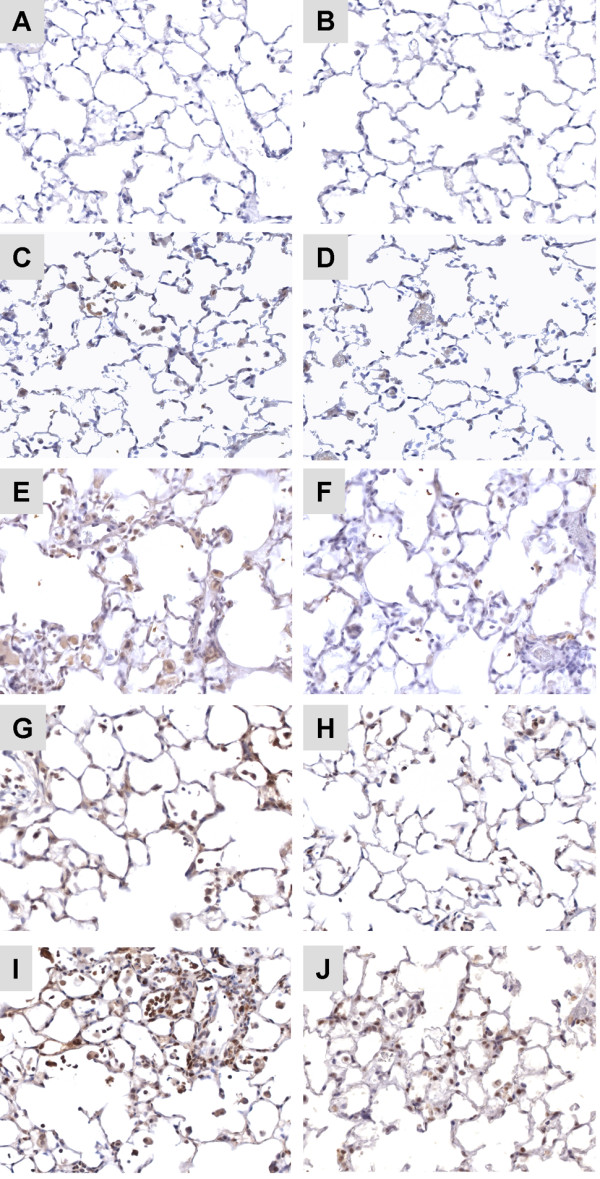
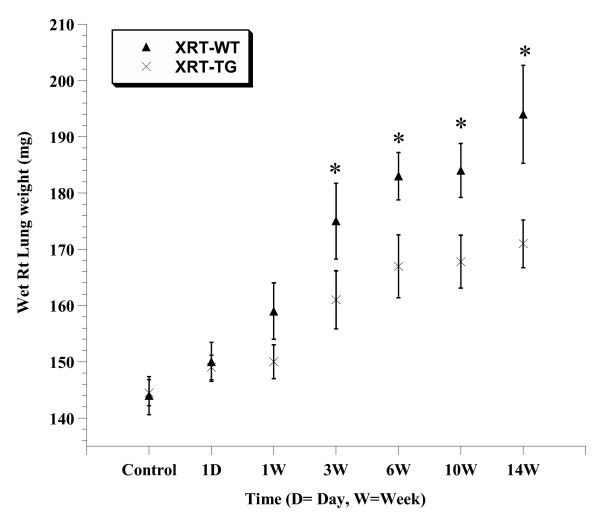
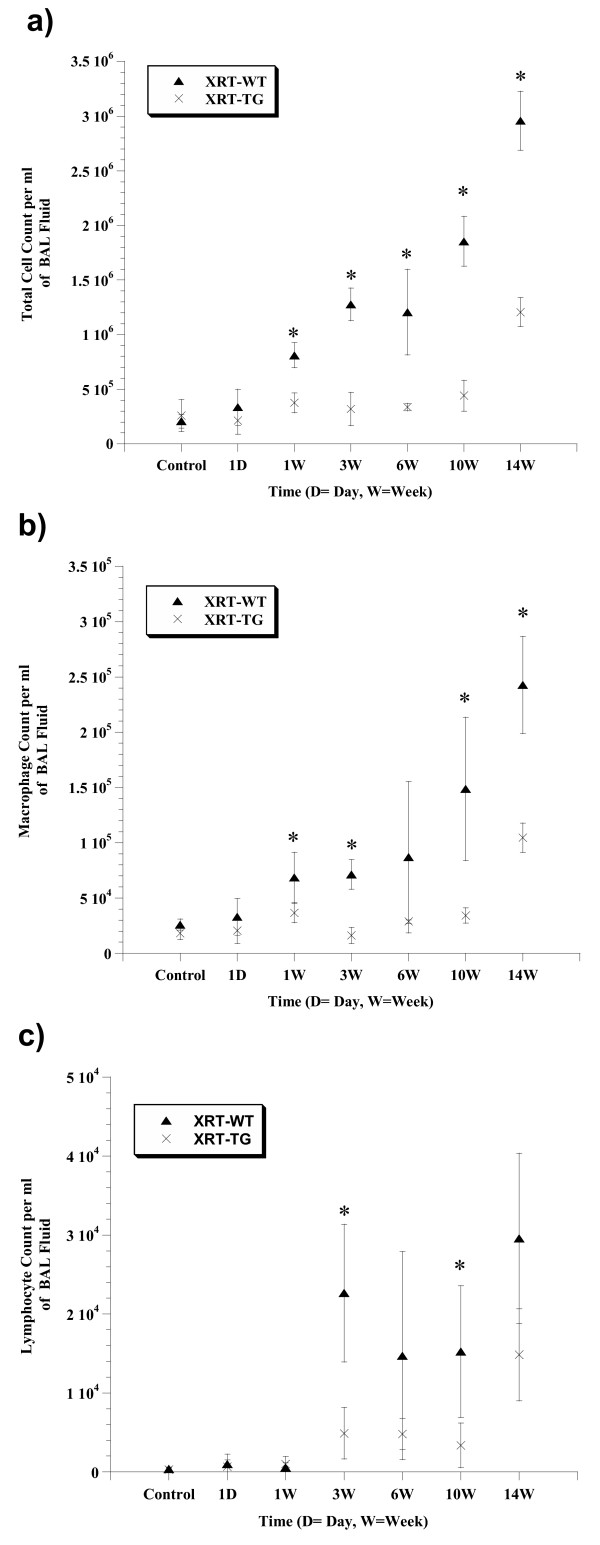
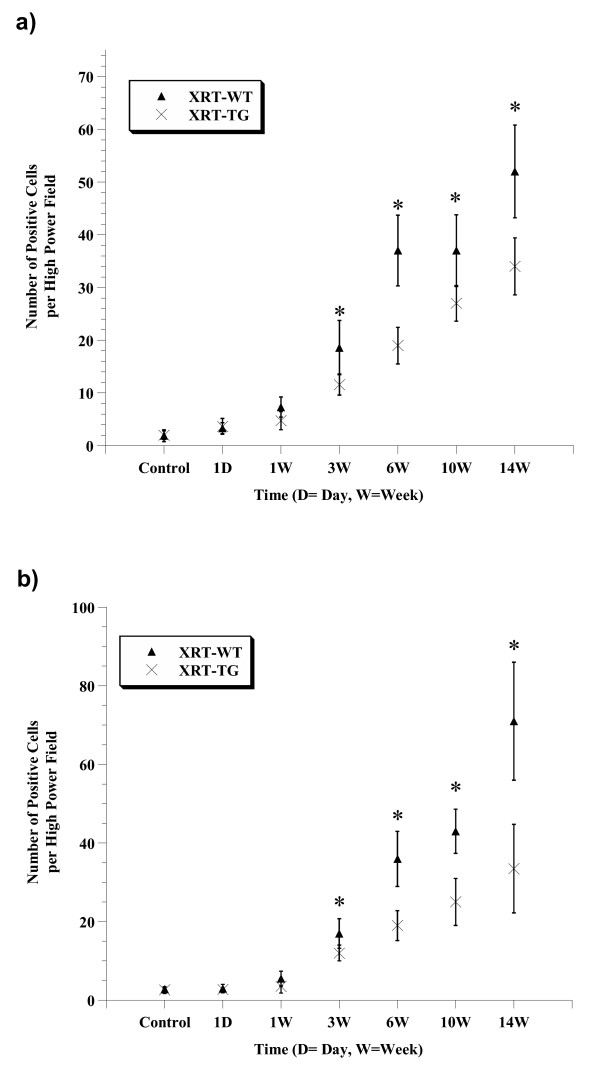
Irradiated wild-type (XRT-WT) animals exhibited time dependent increase in breathing rates and right lung weights, whereas these parameters were significantly less increased (p < 0.05) at 3, 6, 10 and 14 weeks in irradiated transgenic (XRT-TG) mice. An inflammatory response characterized predominantly by macrophage infiltration was pronounced in XRT-WT mice. This acute inflammation was significantly attenuated (p < 0.05) in XRT-TG animals at 1, 3, 6 and 14 weeks. Expression of activated TGFbeta1 and components of its signal transduction pathway were significantly reduced (p < 0.05) at later time-points in XRT-TG vs. XRT-WT.
This study shows that overexpression of EC-SOD confers protection against RT-induced acute lung injury. EC-SOD appears to work, in part, via an attenuation of the macrophage response and also decreases TGFbeta1 activation with a subsequent downregulation of the profibrotic TGFbeta pathway.
急性放疗引起的肺损伤以炎症变化为特征,在损伤后期会发展为纤维化病变。最终,如果炎症/纤维化介质和氧化应激的来源不被消除或减弱,将会导致完全的结构破坏。因此,本研究的目的是确定小鼠细胞外超氧化物歧化酶(EC-SOD)的过表达是否通过抑制TGFβ1的激活和下调其信号转导途径的Smad 3分支来改善急性辐射诱导的损伤。
对过表达EC-SOD的转基因(XRT-TG)和野生型(XRT-WT)动物进行全胸照射(单剂量,15 Gy)。在1天、1周、3周、6周、10周和14周处死小鼠。评估呼吸频率、右肺重量、总白细胞/分类白细胞计数、活化的TGFβ1及其信号转导途径的成分(Smad 3和p-Smad 2/3)以确定肺损伤情况。
受照射的野生型(XRT-WT)动物的呼吸频率和右肺重量呈时间依赖性增加,而在受照射的转基因(XRT-TG)小鼠中,这些参数在3周、6周、10周和14周时的增加明显较少(p < 0.05)。在XRT-WT小鼠中,以巨噬细胞浸润为主的炎症反应明显。在1周、3周、6周和14周时,XRT-TG动物的这种急性炎症明显减轻(p < 0.05)。与XRT-WT相比,在后期时间点,XRT-TG中活化的TGFβ1及其信号转导途径成分的表达明显降低(p < 0.05)。
本研究表明,EC-SOD的过表达可对放疗诱导的急性肺损伤起到保护作用。EC-SOD似乎部分通过减弱巨噬细胞反应起作用,还可降低TGFβ1的激活,随后下调促纤维化的TGFβ途径。