Albuquerque Edilma M V, de Faria Eliana C, Oliveira Helena C F, Magro Daniela O, Castilho Lucia N
Departamento de Patologia Clinica, Faculdade de Ciências Médicas, Universidade Estadual de Campinas- UNICAMP- Campinas, SP, Brazil.
BMC Infect Dis. 2005 Jun 14;5:47. doi: 10.1186/1471-2334-5-47.
Human immunodeficiency virus (HIV) infection is very prevalent in Brazil. HIV therapy has been recently associated with coronary heart disease (CHD). Dyslipidemia is a major risk factor for CHD that is frequently described in HIV positive patients, but very few studies have been conducted in Brazilian patients evaluating their lipid profiles.
In the present work, we evaluated the frequency and severity of dyslipidemia in 257 Brazilian HIV positive patients. Two hundred and thirty-eight (93%) were submitted to antiretroviral therapy (224 treated with protease inhibitors plus nucleoside reverse transcriptase inhibitors, 14 treated only with the latter, 12 naive and 7 had no records of treatment). The average time on drug treatment with antiretroviral therapy was 20 months. None of the patients was under lipid lowering drugs. Cholesterol, triglyceride, phospholipid and free fatty acids were determined by enzymatic colorimetric methods. Lipoprotein profile was estimated by the Friedewald formula and Fredrickson's phenotyping was obtained by serum electrophoresis on agarose. Apolipoprotein B and AI and lipoprotein "a" were measured by nephelometry.
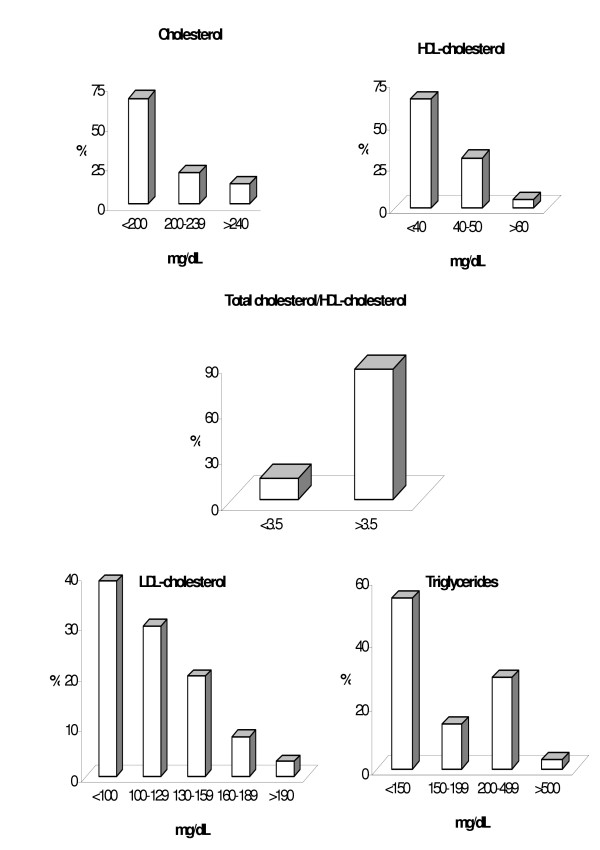
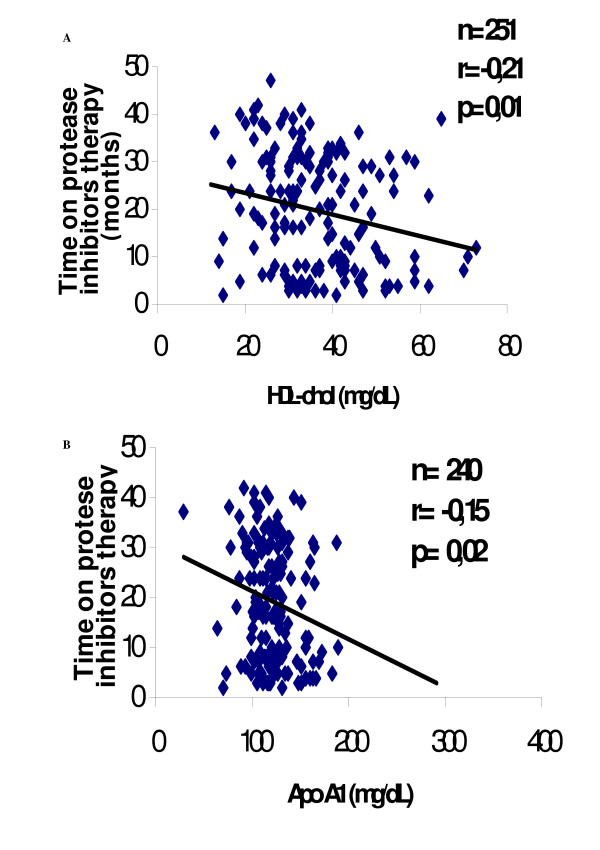
The Fredrickson phenotypes were: type IIb (51%), IV (41%), IIa (7%). In addition one patient was type III and another type V. Thirty-three percent of all HIV+ patients presented serum cholesterol levels >or= 200 mg/dL, 61% LDL-cholesterol >or= 100 mg/dL, 65% HDL-cholesterol below 40 mg/dL, 46% triglycerides >or= 150 mg/dL and 10% have all these parameters above the limits. Eighty-six percent of patients had cholesterol/HDL-cholesterol ratio >or= 3.5, 22% increased lipoprotein "a", 79% increased free fatty acids and 9% increased phospholipids. The treatment with protease inhibitors plus nucleoside reverse transcriptase inhibitors increased the levels of cholesterol and triglycerides in these patients when compared with naïve patients. The HDL-cholesterol (p = 0.01) and apolipoprotein A1 (p = 0.02) levels were inversely correlated with the time of protease inhibitor therapy while total cholesterol levels had a trend to correlate with antiretroviral therapy (p = 0.09).
The highly varied and prevalent types of dyslipidemia found in Brazilian HIV positive patients on antiretroviral therapies indicate the urgent need for their early diagnosis, the identification of the risk factors for CHD and, when needed, the prompt intervention on their lifestyle and/or with drug treatment.
人类免疫缺陷病毒(HIV)感染在巴西非常普遍。HIV治疗最近与冠心病(CHD)相关。血脂异常是冠心病的主要危险因素,在HIV阳性患者中经常出现,但在巴西患者中评估其血脂谱的研究很少。
在本研究中,我们评估了257名巴西HIV阳性患者血脂异常的频率和严重程度。238名(93%)患者接受了抗逆转录病毒治疗(224名接受蛋白酶抑制剂加核苷类逆转录酶抑制剂治疗,14名仅接受后者治疗,12名初治患者,7名无治疗记录)。抗逆转录病毒治疗的平均用药时间为20个月。所有患者均未使用降脂药物。胆固醇、甘油三酯、磷脂和游离脂肪酸通过酶比色法测定。脂蛋白谱通过Friedewald公式估算,Fredrickson分型通过琼脂糖血清电泳获得。载脂蛋白B、A1和脂蛋白“a”通过散射比浊法测定。
Fredrickson分型为:IIb型(51%)、IV型(41%)、IIa型(7%)。此外,一名患者为III型,另一名为V型。所有HIV+患者中,33%的血清胆固醇水平≥200mg/dL,61%的低密度脂蛋白胆固醇≥100mg/dL,65%的高密度脂蛋白胆固醇低于40mg/dL,46%的甘油三酯≥150mg/dL,10%的患者所有这些参数均高于正常范围。86%的患者胆固醇/高密度脂蛋白胆固醇比值≥3.5,22%的患者脂蛋白“a”升高,79%的患者游离脂肪酸升高,9%的患者磷脂升高。与初治患者相比,蛋白酶抑制剂加核苷类逆转录酶抑制剂治疗使这些患者的胆固醇和甘油三酯水平升高。高密度脂蛋白胆固醇(p = 0.01)和载脂蛋白A1(p = 0.02)水平与蛋白酶抑制剂治疗时间呈负相关,而总胆固醇水平与抗逆转录病毒治疗有相关趋势(p = 0.09)。
在接受抗逆转录病毒治疗的巴西HIV阳性患者中发现的血脂异常类型高度多样且普遍,这表明迫切需要对其进行早期诊断,识别冠心病的危险因素,并在必要时及时对其生活方式和/或药物治疗进行干预。