Formerly School of Health Sciences, Cardiff Metropolitan University, Cardiff, Wales, U.K.
Biosci Rep. 2020 Oct 30;40(10). doi: 10.1042/BSR20202856.
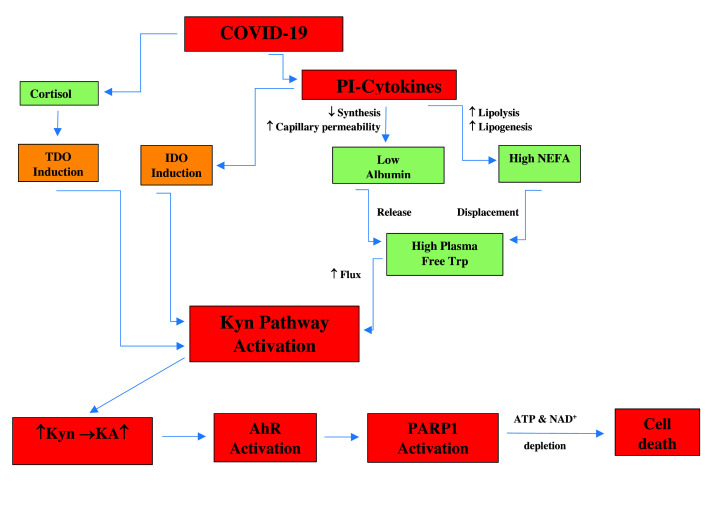
COVID-19 induces a proinflammatory environment that is stronger in patients requiring intensive care. The cytokine components of this environment may determine efficacy or otherwise of glucocorticoid therapy. The immunity modulators, the aryl hydrocarbon receptor (AhR) and the nuclear NAD+-consuming enzyme poly (ADP-ribose) polymerase 1 (PARP 1) may play a critical role in COVID-19 pathophysiology. The AhR is overexpressed in coronaviruses, including COVID-19 and, as it regulates PARP gene expression, the latter is likely to be activated in COVID-19. PARP 1 activation leads to cell death mainly by depletion of NAD+ and adenosine triphosphate (ATP), especially when availability of these energy mediators is compromised. PARP expression is enhanced in other lung conditions: the pneumovirus respiratory syncytial virus (RSV) and chronic obstructive pulmonary disease (COPD). I propose that PARP 1 activation is the terminal point in a sequence of events culminating in patient mortality and should be the focus of COVID-19 immunotherapy. Potent PARP 1 inhibitors are undergoing trials in cancer, but a readily available inhibitor, nicotinamide (NAM), which possesses a highly desirable biochemical and activity profile, merits exploration. It conserves NAD+ and prevents ATP depletion by PARP 1 and Sirtuin 1 (silent mating type information regulation 2 homologue 1) inhibition, enhances NAD+ synthesis, and hence that of NADP+ which is a stronger PARP inhibitor, reverses lung injury caused by ischaemia/reperfusion, inhibits proinflammatory cytokines and is effective against HIV infection. These properties qualify NAM for therapeutic use initially in conjunction with standard clinical care or combined with other agents, and subsequently as an adjunct to stronger PARP 1 inhibitors or other drugs.
COVID-19 会引发促炎环境,在需要重症监护的患者中更为明显。这种环境中的细胞因子成分可能决定了糖皮质激素治疗的疗效。免疫调节剂,芳基烃受体(AhR)和核 NAD+消耗酶聚(ADP-核糖)聚合酶 1(PARP 1)可能在 COVID-19 病理生理学中发挥关键作用。AhR 在冠状病毒中过度表达,包括 COVID-19,并且由于它调节 PARP 基因表达,后者在 COVID-19 中可能被激活。PARP 1 的激活导致细胞死亡主要是通过 NAD+和三磷酸腺苷(ATP)的耗竭,特别是当这些能量介质的可用性受到损害时。PARP 的表达在其他肺部疾病中增强:肺病毒呼吸道合胞病毒(RSV)和慢性阻塞性肺疾病(COPD)。我提出 PARP 1 的激活是导致患者死亡的一系列事件的终点,应该是 COVID-19 免疫治疗的重点。强效的 PARP 1 抑制剂正在癌症中进行试验,但一种易于获得的抑制剂烟酰胺(NAM)具有理想的生化和活性特征,值得探索。它可以通过抑制 PARP 1 和 Sirtuin 1(沉默交配型信息调节 2 同源物 1)来保存 NAD+并防止 ATP 的消耗,增强 NAD+的合成,从而增加 NADP+的合成,后者是一种更强的 PARP 抑制剂,可以逆转缺血/再灌注引起的肺损伤,抑制促炎细胞因子,并且对 HIV 感染有效。这些特性使 NAM 有资格首先与标准临床护理联合使用,或与其他药物联合使用,随后作为更强的 PARP 1 抑制剂或其他药物的辅助治疗。