Kehr Julia, Buhtz Anja, Giavalisco Patrick
Department Lothar Willmitzer, Max-Planck-Institute of Molecular Plant Physiology, 14424 Potsdam, Germany.
BMC Plant Biol. 2005 Jun 21;5:11. doi: 10.1186/1471-2229-5-11.
Substance transport in higher land plants is mediated by vascular bundles, consisting of phloem and xylem strands that interconnect all plant organs. While the phloem mainly allocates photoassimilates, the role of the xylem is the transport of water and inorganic nutrients from roots to all aerial plant parts. Only recently it was noticed that in addition to mineral salts, xylem sap contains organic nutrients and even proteins. Although these proteins might have important impact on the performance of above-ground organs, only a few of them have been identified so far and their physiological functions are still unclear.
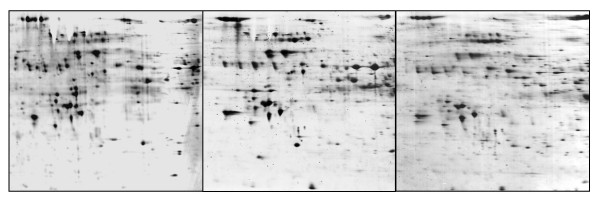
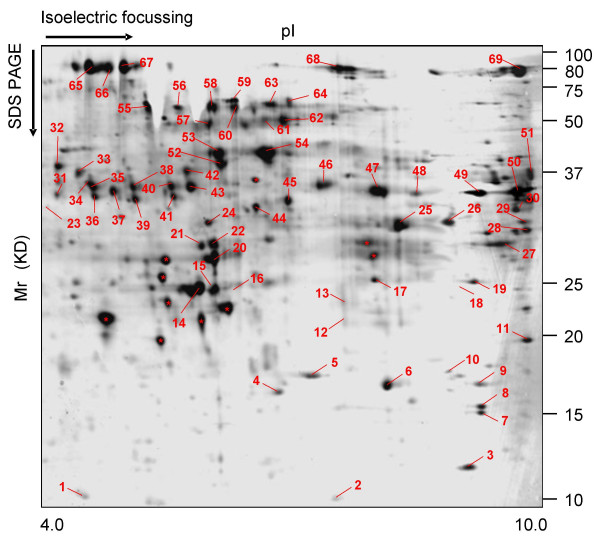
We used root-pressure xylem exudate, collected from cut Brassica napus stems, to extract total proteins. These protein preparations were then separated by high-resolution two-dimensional gel electrophoresis (2-DE). After individual tryptic digests of the most abundant coomassie-stained protein spots, partial peptide sequence information was deduced from tandem mass spectrometric (MS/MS) fragmentation spectra and subsequently used for protein identifications by database searches. This approach resulted in the identification of 69 proteins. These identifications include different proteins potentially involved in defence-related reactions and cell wall metabolism.
This study provides a comprehensive overview of the most abundant proteins present in xylem sap of Brassica napus. A number of 69 proteins could be identified from which many previously were not known to be localized to this compartment in any other plant species. Since Brassica napus, a close relative of the fully sequenced model plant Arabidopsis thaliana, was used as the experimental system, our results provide a large number of candidate proteins for directed molecular and biochemical analyses of the physiological functions of the xylem under different environmental and developmental conditions. This approach will allow exploiting many of the already established functional genomic resources, like i.e. the large mutant collections, that are available for Arabidopsis.
高等陆生植物中的物质运输由维管束介导,维管束由连接所有植物器官的韧皮部和木质部束组成。韧皮部主要分配光合产物,而木质部的作用是将水和无机养分从根部运输到植物地上部分的所有部位。直到最近人们才注意到,除了矿物盐外,木质部汁液还含有有机养分甚至蛋白质。尽管这些蛋白质可能对地上器官的性能有重要影响,但到目前为止仅鉴定出其中少数几种,其生理功能仍不清楚。
我们使用从切割的甘蓝型油菜茎中收集的根压木质部渗出液来提取总蛋白。然后通过高分辨率二维凝胶电泳(2-DE)分离这些蛋白质制剂。对考马斯亮蓝染色最丰富的蛋白质斑点进行单独的胰蛋白酶消化后,从串联质谱(MS/MS)碎裂谱中推导部分肽序列信息,随后用于通过数据库搜索进行蛋白质鉴定。这种方法鉴定出了69种蛋白质。这些鉴定包括可能参与防御相关反应和细胞壁代谢的不同蛋白质。
本研究全面概述了甘蓝型油菜木质部汁液中最丰富的蛋白质。可以鉴定出69种蛋白质,其中许多以前在任何其他植物物种中都未知定位于此区室。由于使用了与完全测序的模式植物拟南芥亲缘关系密切的甘蓝型油菜作为实验系统,我们的结果为在不同环境和发育条件下对木质部生理功能进行定向分子和生化分析提供了大量候选蛋白质。这种方法将允许利用许多已建立的功能基因组资源,例如可用于拟南芥研究的大型突变体库。