Vanasse Alain, Dagenais Pierre, Niyonsenga Théophile, Grégoire Jean-Pierre, Courteau Josiane, Hemiari Abbas
Department of Family Medicine, Faculty of Medicine, Université de Sherbrooke, 3001 12th Avenue North, Sherbrooke (QC), J1H 5N4, Canada.
BMC Musculoskelet Disord. 2005 Jun 21;6:33. doi: 10.1186/1471-2474-6-33.
Osteoporosis (OP) is a skeletal disorder characterized by reduced bone strength and predisposition to increased risk of fracture, with consequent increased risk of morbidity and mortality. It is therefore an important public health problem. International and Canadian associations have issued clinical guidelines for the diagnosis and treatment of OP. In this study, we identified potential predictors of bone mineral density (BMD) testing and OP treatment, which include place of residence.
Our study was a retrospective population-based cohort study using data from the Quebec Health Insurance Board. The studied population consisted of all individuals 65 years and older for whom a physician claimed a consultation for a low velocity vertebral, hip, wrist, or humerus fracture in 1999 and 2000. Individuals were considered to have undergone BMD testing if there was a claim for such a procedure within two years following a fracture. They were considered to have received an OP treatment if there was at least one claim to Quebec's health insurance plan (RAMQ) for OP treatment within one year following a fracture. We performed descriptive analyses and logistic regressions by gender. Predictors included age, site of fracture, social status, comorbidity index, prior BMD testing, prior OP treatment, long-term glucocorticoid use, and physical distance to BMD device.
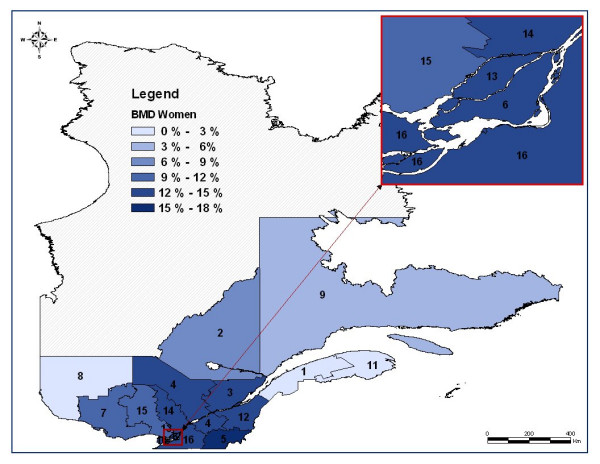
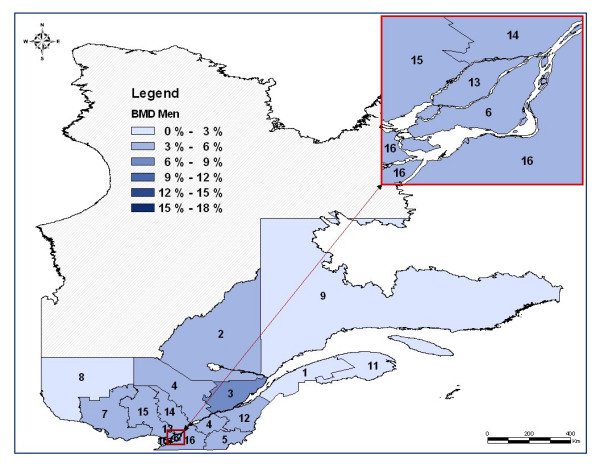
The cohort, 77% of which was female, consisted of 25,852 individuals with fragility fractures. BMD testing and OP treatment rates were low and gender dependent (BMD: men 4.6%; women 13.1%; OP treatment: men 9.9%; women 29.7%). There was an obvious regional variation, particularly in BMD testing, ranging from 0 to 16%. Logistic regressions demonstrate that individuals living in long term care facilities received less BMD testing. Patients who had suffered from vertebral fractures, or who had received prior OP treatment or BMD testing, regardless of gender, subsequently received more BMD testing and OP treatments. Furthermore, increasing the distance between a patient's residence and BMD facility precluded likelihood of BMD testing.
BMD testing rate was extremely low but not completely explained by reduced physical access; gender, age, social status, prior BMD testing and OP treatment were all important predictors for future BMD testing and OP treatment.
骨质疏松症(OP)是一种骨骼疾病,其特征是骨强度降低,骨折风险增加,进而导致发病和死亡风险上升。因此,它是一个重要的公共卫生问题。国际和加拿大的协会已发布了OP诊断和治疗的临床指南。在本研究中,我们确定了骨密度(BMD)检测和OP治疗的潜在预测因素,其中包括居住地。
我们的研究是一项基于人群的回顾性队列研究,使用了魁北克医疗保险委员会的数据。研究人群包括1999年和2000年因医生诊断为低能量椎体、髋部、腕部或肱骨骨折而就诊的所有65岁及以上个体。如果在骨折后两年内有BMD检测的记录,则认为该个体接受了BMD检测。如果在骨折后一年内至少有一次向魁北克医疗保险计划(RAMQ)申请OP治疗的记录,则认为该个体接受了OP治疗。我们按性别进行了描述性分析和逻辑回归。预测因素包括年龄、骨折部位、社会地位、合并症指数、既往BMD检测、既往OP治疗、长期使用糖皮质激素以及到BMD检测设备的实际距离。
该队列包括25,852名脆性骨折患者,其中77%为女性。BMD检测率和OP治疗率较低且存在性别差异(BMD检测:男性为4.6%;女性为13.1%;OP治疗:男性为9.9%;女性为29.7%)。存在明显地区差异,特别是在BMD检测方面,范围从0到16%。逻辑回归表明,居住在长期护理机构的个体接受BMD检测较少。无论性别,曾发生椎体骨折、或曾接受过OP治疗或BMD检测的患者,随后接受BMD检测和OP治疗的更多。此外,患者居住地与BMD检测机构之间距离的增加会降低BMD检测的可能性。
BMD检测率极低,但身体不便并非唯一原因;性别、年龄、社会地位、既往BMD检测和OP治疗都是未来BMD检测和OP治疗的重要预测因素。