Wu Feng, Burns Fredric J, Zhang Ronghe, Uddin Ahmed N, Rossman Toby G
New York University School of Medicine, Nelson Institute of Environmental Medicine, and New York University Cancer Institute, Tuxedo, New York 10987, USA.
Environ Health Perspect. 2005 Aug;113(8):983-6. doi: 10.1289/ehp.7846.
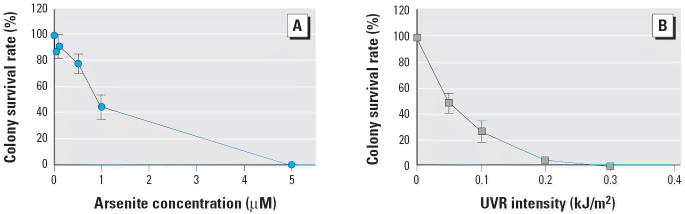
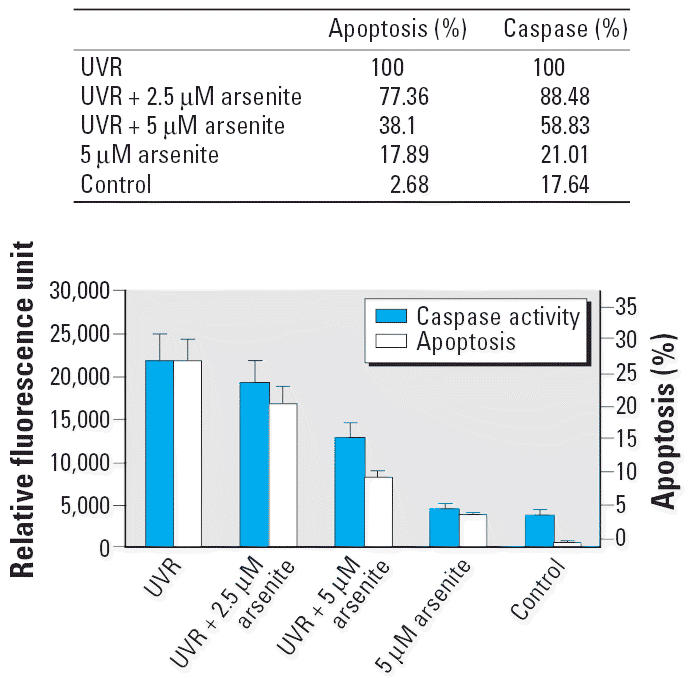
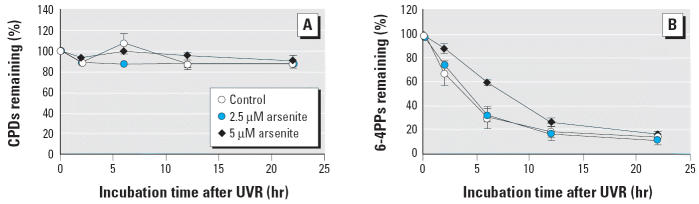
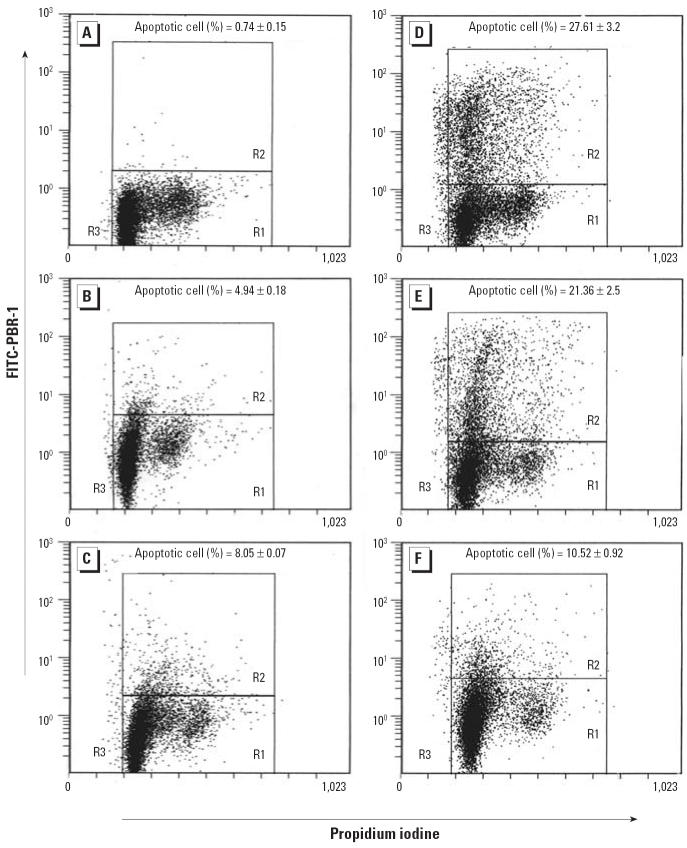
Our laboratory has shown that arsenite markedly increased the cancer rate caused by solar-simulation ultraviolet radiation (UVR) in the hairless mouse skin model. In the present study, we investigated how arsenite affected DNA photodamage repair and apoptosis after solar-simulation UVR in the mouse keratinocyte cell line 291.03C. The keratinocytes were treated with different concentrations of sodium arsenite (0.0, 2.5, 5.0 microM) for 24 hr and then were immediately irradiated with a single dose of 0.30 kJ/m2 UVR. At 24 hr after UVR, DNA photoproducts [cyclobutane pyrimidine dimers (CPDs) and 6-4 photoproducts (6-4PPs)] and apoptosis were measured using the enzyme-linked immunosorbent assay and the two-color TUNEL (terminal deoxynucleotide transferase dUTP nick end labeling) assay, respectively. The results showed that arsenite reduced the repair rate of 6-4PPs by about a factor of 2 at 5.0 microM and had no effect at 2.5 microM. UVR-induced apoptosis at 24 hr was decreased by 22.64% at 2.5 microM arsenite and by 61.90% at 5.0 microM arsenite. Arsenite decreased the UVR-induced caspase-3/7 activity in parallel with the inhibition of apoptosis. Colony survival assays of the 291.03C cells demonstrate a median lethal concentration (LC50) of arsenite of 0.9 microM and a median lethal dose (LD50) of UVR of 0.05 kJ/m2. If the present results are applicable in vivo, inhibition of UVR-induced apoptosis may contribute to arsenite's enhancement of UVR-induced skin carcinogenesis.
我们实验室已表明,亚砷酸盐显著提高了无毛小鼠皮肤模型中由模拟太阳紫外线辐射(UVR)引起的癌症发生率。在本研究中,我们调查了亚砷酸盐如何影响小鼠角质形成细胞系291.03C在模拟太阳UVR照射后的DNA光损伤修复和细胞凋亡。角质形成细胞用不同浓度的亚砷酸钠(0.0、2.5、5.0微摩尔)处理24小时,然后立即用0.30千焦/平方米的单剂量UVR照射。在UVR照射后24小时,分别使用酶联免疫吸附测定法和双色TUNEL(末端脱氧核苷酸转移酶dUTP缺口末端标记)测定法测量DNA光产物[环丁烷嘧啶二聚体(CPD)和6-4光产物(6-4PP)]和细胞凋亡。结果表明,在5.0微摩尔时,亚砷酸盐使6-4PP的修复率降低了约2倍,而在2.5微摩尔时没有影响。在2.5微摩尔亚砷酸盐时,UVR诱导的24小时细胞凋亡减少了22.64%,在5.0微摩尔亚砷酸盐时减少了61.90%。亚砷酸盐降低了UVR诱导的caspase-3/7活性,同时抑制了细胞凋亡。291.03C细胞集落存活试验表明,亚砷酸盐的半数致死浓度(LC50)为0.9微摩尔,UVR的半数致死剂量(LD50)为0.05千焦/平方米。如果目前的结果适用于体内,抑制UVR诱导的细胞凋亡可能有助于亚砷酸盐增强UVR诱导的皮肤致癌作用。