Knutson Gary A
Chiropr Osteopat. 2005 Jul 20;13:12. doi: 10.1186/1746-1340-13-12.
Part II of this review examines the functional "short leg" or unloaded leg length alignment asymmetry, including the relationship between an anatomic and functional leg-length inequality. Based on the reviewed evidence, an outline for clinical decision making regarding functional and anatomic leg-length inequality will be provided.
Online databases: Medline, CINAHL and Mantis. Plus library searches for the time frame of 1970-2005 were done using the term "leg-length inequality".
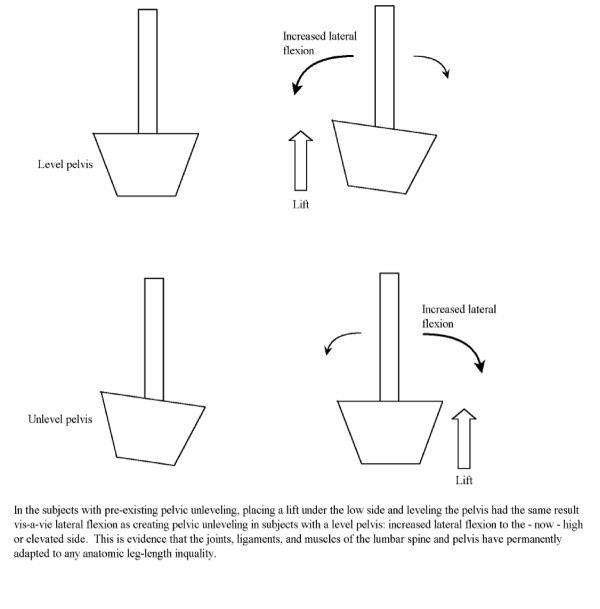
The evidence suggests that an unloaded leg-length asymmetry is a different phenomenon than an anatomic leg-length inequality, and may be due to suprapelvic muscle hypertonicity. Anatomic leg-length inequality and unloaded functional or leg-length alignment asymmetry may interact in a loaded (standing) posture, but not in an unloaded (prone/supine) posture.
The unloaded, functional leg-length alignment asymmetry is a likely phenomenon, although more research regarding reliability of the measurement procedure and validity relative to spinal dysfunction is needed. Functional leg-length alignment asymmetry should be eliminated before any necessary treatment of anatomic LLI.
本综述的第二部分探讨功能性“短腿”或非负重腿长度对线不对称,包括解剖学和功能性腿长不等之间的关系。基于所综述的证据,将提供关于功能性和解剖学腿长不等的临床决策大纲。
在线数据库:医学文献数据库(Medline)、护理学与健康领域数据库(CINAHL)和螳螂数据库(Mantis)。另外,在1970年至2005年的时间范围内,使用“腿长不等”一词进行了图书馆检索。
证据表明,非负重腿长不对称与解剖学腿长不等是不同的现象,可能是由于骨盆上肌肉张力亢进所致。解剖学腿长不等与非负重功能性或腿长对线不对称在负重(站立)姿势下可能相互影响,但在非负重(俯卧/仰卧)姿势下则不会。
非负重功能性腿长对线不对称是一种可能存在的现象,尽管需要更多关于测量程序可靠性以及与脊柱功能障碍相关性有效性的研究。在对解剖学腿长不等进行任何必要治疗之前,应消除功能性腿长对线不对称。