Shang Bo, Wang Xiao-Yi, Yuan Jian-Wei, Vabret Astrid, Wu Xiao-Dong, Yang Rui-Fu, Tian Lin, Ji Yong-Yong, Deubel Vincent, Sun Bing
Laboratory of Molecular Cell Biology, Institute of Biochemistry and Cell Biology, Shanghai Institute of Biological Sciences, Chinese Academy of Sciences, 320 Yue-Yang Road, Shanghai 200031, China.
Biochem Biophys Res Commun. 2005 Oct 14;336(1):110-7. doi: 10.1016/j.bbrc.2005.08.032.
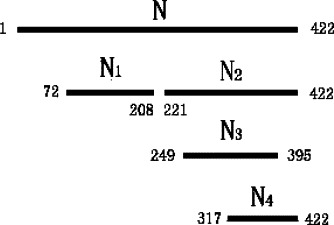
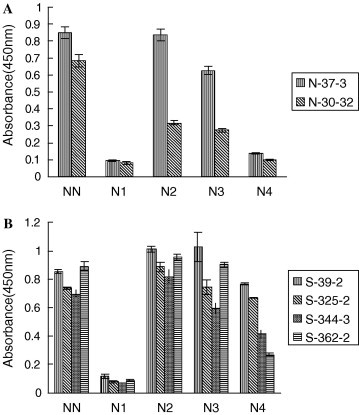
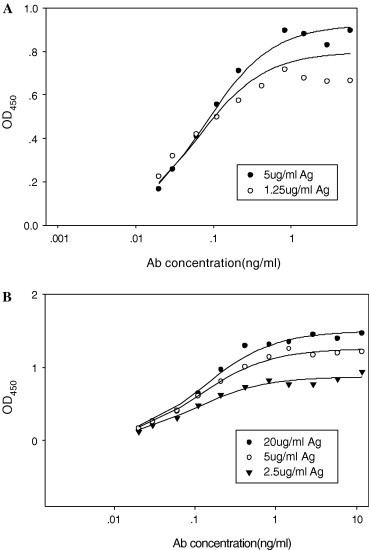
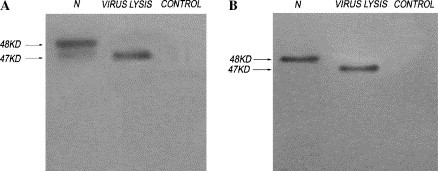
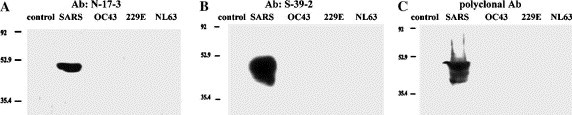
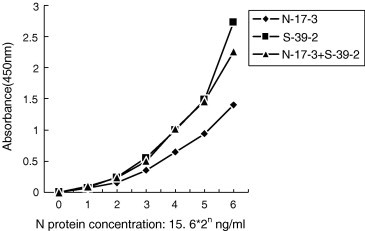
Severe acute respiratory syndrome-coronavirus (SARS-CoV) causes an infectious disease through respiratory route. Diagnosing the disease effectively and accurately at early stage is essential for preventing the disease transmission and performing antiviral treatment. In this study, we raised monoclonal antibodies (mAbs) against the nucleocapsid (N) protein of SARS-CoV and mapped epitopes by using different truncated N protein fragments. The mapping of those epitopes was valuable for constructing pair-Abs used in serological diagnosis. The results showed that all of the six raised mAbs were divided into two groups recognizing the region of amino acids 249-317 (A group) or 317-395 (B group). This region spanning amino acids 249-395 contains predominant B cell epitopes located at the C-terminus of N protein. One pair-Abs, consisting of N protein-specific rabbit polyclonal antibody and SARS-CoV N protein-specific mAb, was selected to construct a sandwich ELISA-kit. The kit was able to specifically detect SARS-CoV N proteins in serum samples.
严重急性呼吸综合征冠状病毒(SARS-CoV)通过呼吸道引起传染病。在早期有效且准确地诊断该疾病对于预防疾病传播和进行抗病毒治疗至关重要。在本研究中,我们制备了针对SARS-CoV核衣壳(N)蛋白的单克隆抗体(mAb),并使用不同的截短N蛋白片段绘制表位图谱。这些表位的图谱对于构建用于血清学诊断的配对抗体很有价值。结果表明,所制备的六种mAb全部分为两组,分别识别氨基酸249 - 317区域(A组)或317 - 395区域(B组)。这个跨越氨基酸249 - 395的区域包含位于N蛋白C末端的主要B细胞表位。选择由N蛋白特异性兔多克隆抗体和SARS-CoV N蛋白特异性mAb组成的一对抗体来构建夹心ELISA试剂盒。该试剂盒能够特异性检测血清样本中的SARS-CoV N蛋白。