Deijen Jan Berend, Arwert Lucia I, Witlox Joost, Drent Madeleine L
Department of Clinical Neuropsychology, Free University, van der Boechorststraat 1, 1081 BT Amsterdam, The Netherlands.
Health Qual Life Outcomes. 2005 Oct 19;3:63. doi: 10.1186/1477-7525-3-63.
Patients with growth hormone deficiency (GHD) frequently report to suffer from an impaired Quality of Life (QoL) and growth hormone (GH) substitution is found to improve this. However, the same test may be used for measuring QoL, well-being or health status in different studies. QoL has been defined as the subjective appraisal of one's current life based primarily on psychological function. The most important in the appraisal of well-being is mental function and concerning health status patients evaluate physical function as most important. To differentiate the effects of GH replacement on psychological variables in patients with GHD we carried out a number of meta-analyses, classifying questionnaires into instruments measuring QoL, psychological well-being and health status.
We searched the electronic databases PUBMED and PiCarta from 1985 to 2004. Studies were included that evaluated the effect of GH on patient-reported outcomes in adults with GHD (aged 18 years and above). According to generally accepted definitions we classified the questionnaires as instruments measuring QoL, well-being and health status. By means of meta-analyses the average effect size (d) for QoL, well-being and health status was calculated.
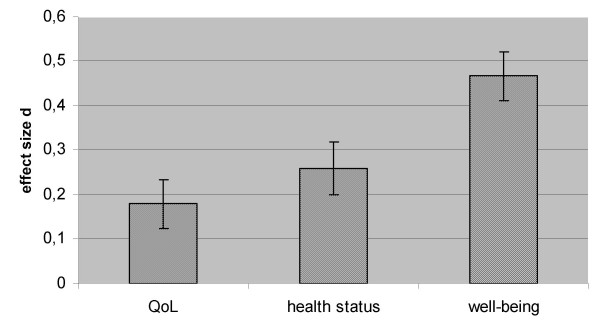
Based on open studies GH replacement is found to improve QoL with a small effect size (d = 0.18), well-being with a medium effect size (d = 0.47) and health status with a small effect size (d = 0.26). As the effect size of well-being is most pronounced the generally reported effects of GH replacement on QoL may be overestimated and actually reflect the effect on well-being.
To get more insight in the specific psychological effects of GH treatment it is recommended that instruments selected for these studies should be more consistently classified as instruments measuring QoL, well-being or health status.
生长激素缺乏症(GHD)患者经常报告生活质量(QoL)受损,而生长激素(GH)替代治疗可改善这一情况。然而,在不同研究中,可能使用相同的测试来测量生活质量、幸福感或健康状况。生活质量被定义为主要基于心理功能对个人当前生活的主观评价。在幸福感评估中,最重要的是心理功能,而在健康状况方面,患者认为身体功能最为重要。为了区分GH替代治疗对GHD患者心理变量的影响,我们进行了多项荟萃分析,将问卷分为测量生活质量、心理幸福感和健康状况的工具。
我们检索了1985年至2004年的电子数据库PUBMED和PiCarta。纳入的研究评估了GH对成年GHD患者(18岁及以上)报告的结局的影响。根据普遍接受的定义,我们将问卷分类为测量生活质量、幸福感和健康状况的工具。通过荟萃分析计算生活质量、幸福感和健康状况的平均效应大小(d)。
基于开放性研究,发现GH替代治疗可改善生活质量,效应大小较小(d = 0.18),改善幸福感的效应大小中等(d = 0.47),改善健康状况的效应大小较小(d = 0.26)。由于幸福感的效应大小最为明显,因此通常报道的GH替代治疗对生活质量的影响可能被高估,实际上反映的是对幸福感的影响。
为了更深入了解GH治疗的特定心理效应,建议为这些研究选择的工具应更一致地分类为测量生活质量、幸福感或健康状况的工具。