Wu H X, Andonov A, Giulivi A, Goedhuis N J, Baptiste B, Furseth J, Poliquin D, Chan J I P, Bolesnikov G, Moffat B, Paton S, Wu J
Blood Safety Surveillance and Health Care Acquired Infection Division, Centre for Infectious Disease Prevention and Control, Public Health Agency of Canada, Ottawa, ON, Canada.
Int J Med Sci. 2005;2(4):143-6. doi: 10.7150/ijms.2.143. Epub 2005 Oct 1.
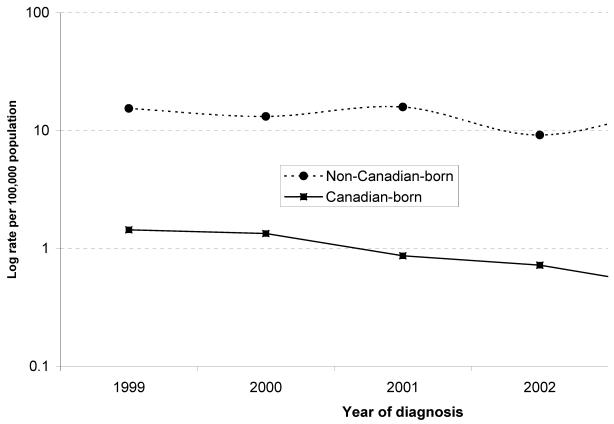
Since hepatitis B virus (HBV) infection can have serious sequelae, especially if infection occurs during childhood, there is a continuing need to examine its epidemiology so as to inform control measures. We analyzed trends in disease incidence and patterns of hepatitis B virus (HBV) transmission in both Canadian-born and non-Canadian-born children from 1999 to 2003, through the Enhanced Hepatitis Strain Surveillance System. Amongst Canadian-born children, the incidence of newly identified HBV infection per 100,000 declined significantly during the study period from 1.4 in 1999, to 0.5 in 2003 (RR, 0.75 per year; 95% CI, 0.60-0.95). Amongst non-Canadian-born children, the incidence of HBV infection per 100,000 ranged from 9.4 to 16.3, during the study period (linear trend test, p=0.69). Poisson regression analysis revealed that non-Canadian-born children were more likely to have HBV infection (RR, 12.3; 95% CI, 7.6 to 19.8), than Canadian-born children. HBV infection was found to be more common among children emigrating from high endemic area, than among Canadian-born children. Current Canadian immunization policy should take into consideration the protection of all children against HBV infection, including those coming from countries where mass hepatitis B vaccination programs have still not been launched.
由于乙型肝炎病毒(HBV)感染可导致严重的后遗症,尤其是在儿童期感染时,因此持续需要对其流行病学进行研究,以为防控措施提供依据。我们通过强化肝炎毒株监测系统,分析了1999年至2003年在加拿大出生和非加拿大出生儿童中疾病发病率趋势以及乙型肝炎病毒(HBV)传播模式。在加拿大出生的儿童中,每10万人中新确诊的HBV感染发病率在研究期间显著下降,从1999年的1.4降至2003年的0.5(相对危险度,每年0.75;95%可信区间,0.60 - 0.95)。在非加拿大出生的儿童中,每10万人中HBV感染发病率在研究期间为9.4至16.3(线性趋势检验,p = 0.69)。泊松回归分析显示,非加拿大出生的儿童比加拿大出生的儿童更易感染HBV(相对危险度,12.3;95%可信区间,7.6至19.8)。研究发现,从高流行地区移民来的儿童比加拿大出生的儿童更易感染HBV。加拿大当前的免疫政策应考虑保护所有儿童免受HBV感染,包括那些来自尚未开展大规模乙肝疫苗接种计划国家的儿童。