Gupta R S, Singh B
Department of Biochemistry, McMaster University, Hamilton, Ontario, Canada.
J Bacteriol. 1992 Jul;174(14):4594-605. doi: 10.1128/jb.174.14.4594-4605.1992.
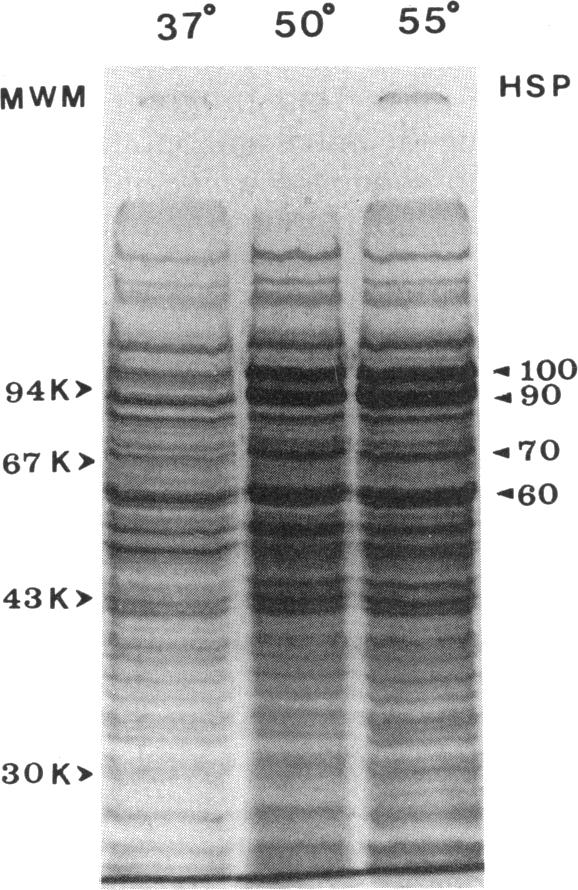
Heat shock induces the synthesis of a set of proteins in Halobacterium marismortui whose molecular sizes correspond to the known major heat shock proteins. By using the polymerase chain reaction and degenerate oligonucleotide primers for conserved regions of the 70-kDa heat shock protein (HSP70) family, we have successfully cloned and sequenced a gene fragment containing the entire coding sequence for HSP70 from H. marismortui. HSP70 from H. marismortui shows between 44 and 47% amino acid identity with various eukaryotic HSP70s and between 51 and 58% identity with its eubacterial and archaebacterial homologs. On the basis of a comparison of all available HSP70 sequences, we have identified a number of unique sequence signatures in this protein family that provide a clear distinction between eukaryotic organisms and prokaryotic organisms (archaebacteria and eubacteria). The archaebacterial (viz., H. marismortui and Methanosarcina mazei) HSP70s have been found to contain all of the signature sequences characteristic of eubacteria (particularly the gram-positive bacteria), which suggests a close evolutionary relationship between these groups. In addition, detailed analyses of HSP70 sequences that we have carried out have revealed a number of additional novel features of the HSP70 protein family. These include (i) the presence of an insertion of about 25 to 27 amino acids in the N-terminal quadrants of all known eukaryotic and prokaryotic HSP70s except those from archaebacteria and the gram-positive group of bacteria, (ii) significant sequence similarity in HSP70 regions comprising its first and second quadrants from organisms lacking the above insertion, (iii) highly significant similarity between a protein, MreB, of Escherichia coli and the N-terminal half of HSP70s, (iv) significant sequence similarity between the N-terminal quadrant of HSP70 (from gram-positive bacteria and archaebacteria) and the m-type thioredoxin of plant chloroplasts. To account for these and other observations, a model for the evolution of HSP70 proteins involving gene duplication is proposed. The model proposes that HSP70 from archaebacteria (H. marismortui and M. mazei) and the gram-positive group of bacteria constitutes the ancestral form of the protein and that all other HSP70s (viz., other eubacteria as well as eukaryotes) containing the insert have evolved from this ancient protein.
热休克诱导嗜盐菌合成一组蛋白质,其分子大小与已知的主要热休克蛋白相对应。通过使用聚合酶链反应和针对70 kDa热休克蛋白(HSP70)家族保守区域的简并寡核苷酸引物,我们成功地从嗜盐菌中克隆并测序了一个包含HSP70完整编码序列的基因片段。嗜盐菌的HSP70与各种真核生物HSP70的氨基酸同一性在44%至47%之间,与其真细菌和古细菌同源物的同一性在51%至58%之间。基于对所有可用HSP70序列的比较,我们在这个蛋白质家族中鉴定出了许多独特的序列特征,这些特征在真核生物和原核生物(古细菌和真细菌)之间提供了明确的区分。已发现古细菌(即嗜盐菌和马氏甲烷八叠球菌)的HSP70包含所有真细菌(特别是革兰氏阳性细菌)特有的特征序列,这表明这些群体之间存在密切的进化关系。此外,我们对HSP70序列进行的详细分析揭示了HSP70蛋白质家族的许多其他新特征。这些特征包括:(i)除古细菌和革兰氏阳性细菌组外,所有已知真核生物和原核生物HSP70的N端象限中存在约25至27个氨基酸的插入;(ii)来自缺乏上述插入的生物体的HSP70区域中,其第一和第二象限具有显著的序列相似性;(iii)大肠杆菌的一种蛋白质MreB与HSP70的N端一半具有高度显著的相似性;(iv)HSP70(来自革兰氏阳性细菌和古细菌)的N端象限与植物叶绿体的m型硫氧还蛋白具有显著的序列相似性。为了解释这些及其他观察结果,提出了一个涉及基因复制的HSP70蛋白质进化模型。该模型提出,古细菌(嗜盐菌和马氏甲烷八叠球菌)和革兰氏阳性细菌组的HSP70构成了该蛋白质的祖先形式,而所有其他含有插入序列的HSP70(即其他真细菌以及真核生物)均从这种古老的蛋白质进化而来。