Chin John J, Mantell Joanne, Weiss Linda, Bhagavan Mamatha, Luo Xiaoting
Office of Special Populations, New York Academy of Medicine, 1216 Fifth Avenue, New York, NY 10029, USA.
AIDS Educ Prev. 2005 Oct;17(5):484-502. doi: 10.1521/aeap.2005.17.5.484.
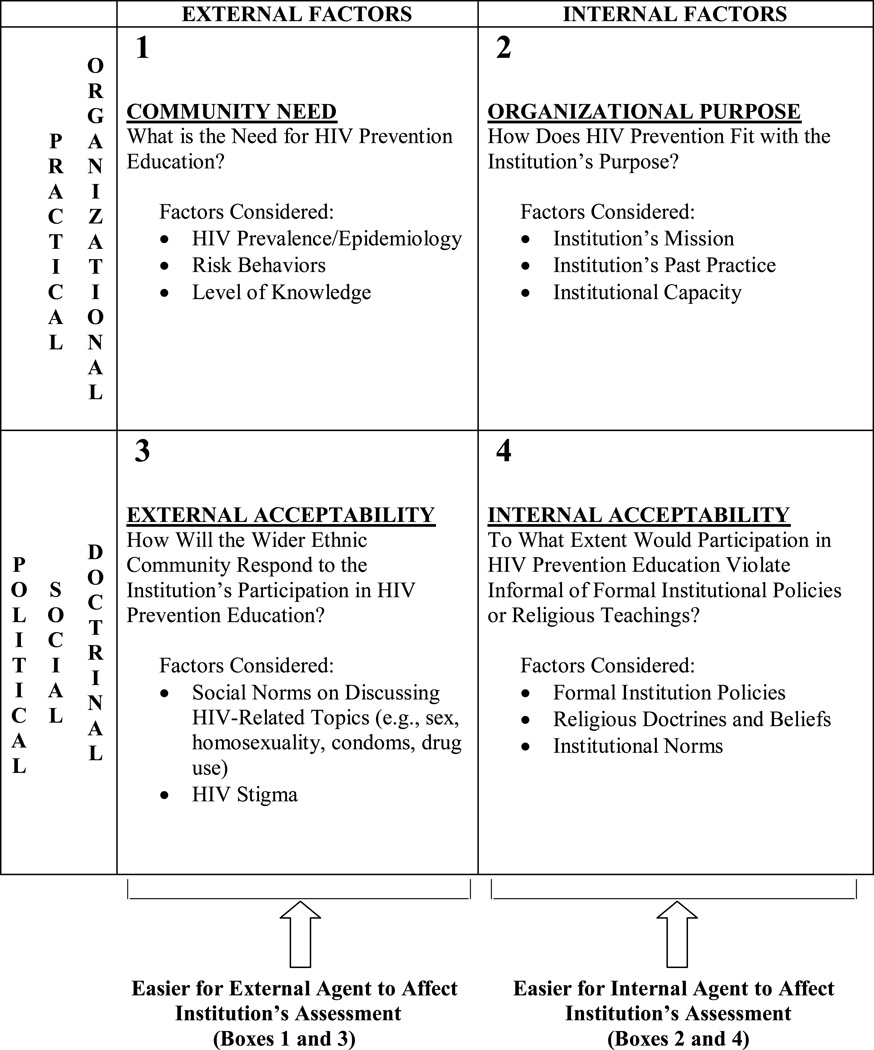
Religious institutions in Asian immigrant communities are in a unique position to confront the challenges of the HIV epidemic for the populations they serve. However, there has been little research on whether these institutions are willing or able to take a role in HIV prevention. This article reports on findings from a qualitative study of three Asian immigrant religious institutions in New York City (a Buddhist temple, a Hindu temple, an Islamic center/mosque) that are part of a larger study of Asian immigrant community institutions and their response to the HIV epidemic. Several prominent themes arose that formed the basis of a preliminary theoretical framework describing the way Asian immigrant religious institutions may evaluate their role in HIV prevention. The interview data indicate that the institutions take a stance of "conservative innovation," weighing their role as keepers of morality and religious tradition against the changing needs of their communities and then adjusting their practices or positions incrementally (to varying degrees) to stay responsive and relevant.
亚洲移民社区的宗教机构在应对其所服务人群面临的艾滋病流行挑战方面处于独特地位。然而,关于这些机构是否愿意或能够在艾滋病预防中发挥作用的研究却很少。本文报告了一项对纽约市三个亚洲移民宗教机构(一座佛教寺庙、一座印度教寺庙、一个伊斯兰中心/清真寺)的定性研究结果,这些机构是对亚洲移民社区机构及其对艾滋病流行反应的一项更大规模研究的一部分。出现了几个突出的主题,这些主题构成了一个初步理论框架的基础,该框架描述了亚洲移民宗教机构评估其在艾滋病预防中作用的方式。访谈数据表明,这些机构采取“保守创新”的立场,权衡其作为道德和宗教传统守护者的角色与社区不断变化的需求,然后逐步(在不同程度上)调整其做法或立场,以保持响应能力和相关性。