Kwiek Jesse J, Mwapasa Victor, Milner Danny A, Alker Alisa P, Miller William C, Tadesse Eyob, Molyneux Malcolm E, Rogerson Stephen J, Meshnick Steven R
Department of Epidemiology, University of North Carolina, Chapel Hill, North Carolina, USA.
PLoS Med. 2006 Jan;3(1):e10. doi: 10.1371/journal.pmed.0030010. Epub 2005 Nov 22.
Between 25% and 35% of infants born to HIV-infected mothers become HIV-1 infected. One potential route of mother-to-child transmission (MTCT) could be through a breakdown in the placental barrier (i.e., maternal-fetal microtransfusions).
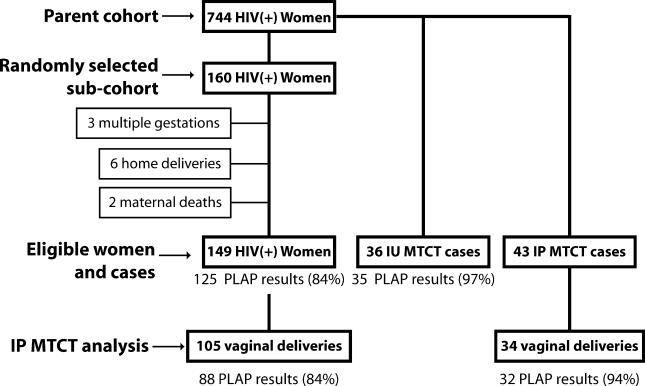
Placental alkaline phosphatase (PLAP) is a 130-kD maternal enzyme that cannot cross the intact placental barrier. We measured PLAP activity in umbilical vein serum as an indicator of maternal-fetal microtransfusion, and related this to the risk of HIV-1 MTCT. A case-cohort study was conducted of 149 women randomly selected from a cohort of HIV-1-infected pregnant Malawians; these women served as a reference group for 36 cases of in utero MTCT and 43 cases of intrapartum (IP) MTCT. Cord PLAP activity was measured with an immunocatalytic assay. Infant HIV status was determined by real-time PCR. The association between cord PLAP activity and HIV-1 MTCT was measured with logistic regression using generalized estimating equations. Among vaginal deliveries, PLAP was associated with IP MTCT (risk ratio, 2.25 per log10 ng/ml PLAP; 95% confidence interval, 0.95-5.32) but not in utero MTCT. In a multivariable model adjusted for HIV-1 RNA load, chorioamnionitis, and self-reported fever, the risk of IP MTCT almost tripled for every log10 increase in cord PLAP activity (risk ratio, 2.87; 95% confidence interval, 1.05-7.83).
These results suggest that during vaginal deliveries, placental microtransfusions are a risk factor for IP HIV-1 MTCT. Future studies are needed to identify factors that increase the risk for microtransfusions in order to prevent IP HIV-1 MTCT.
感染艾滋病毒的母亲所生婴儿中有25%至35%会感染HIV-1。母婴传播(MTCT)的一种潜在途径可能是胎盘屏障的破坏(即母胎微量输血)。
胎盘碱性磷酸酶(PLAP)是一种130-kD的母体酶,不能穿过完整的胎盘屏障。我们测量脐静脉血清中的PLAP活性作为母胎微量输血的指标,并将其与HIV-1母婴传播风险相关联。对从一群感染HIV-1的马拉维孕妇中随机选取的149名妇女进行了病例队列研究;这些妇女作为36例宫内MTCT和43例分娩期(IP)MTCT病例的参照组。用免疫催化测定法测量脐带PLAP活性。通过实时PCR确定婴儿的艾滋病毒状况。使用广义估计方程,通过逻辑回归测量脐带PLAP活性与HIV-1母婴传播之间的关联。在阴道分娩中,PLAP与分娩期MTCT相关(风险比,每log10 ng/ml PLAP为2.25;95%置信区间,0.95 - 5.32),但与宫内MTCT无关。在针对HIV-1 RNA载量、绒毛膜羊膜炎和自我报告的发热进行调整的多变量模型中,脐带PLAP活性每增加log10,分娩期MTCT的风险几乎增加两倍(风险比,2.87;95%置信区间,1.05 - 7.83)。
这些结果表明,在阴道分娩期间,胎盘微量输血是分娩期HIV-1母婴传播的一个风险因素。需要进一步研究以确定增加微量输血风险的因素,从而预防分娩期HIV-1母婴传播。