van Passel M W J, Bart A, Thygesen H H, Luyf A C M, van Kampen A H C, van der Ende A
Department of Medical Microbiology, Academic Medical Center, Amsterdam, The Netherlands.
BMC Genomics. 2005 Nov 18;6:163. doi: 10.1186/1471-2164-6-163.
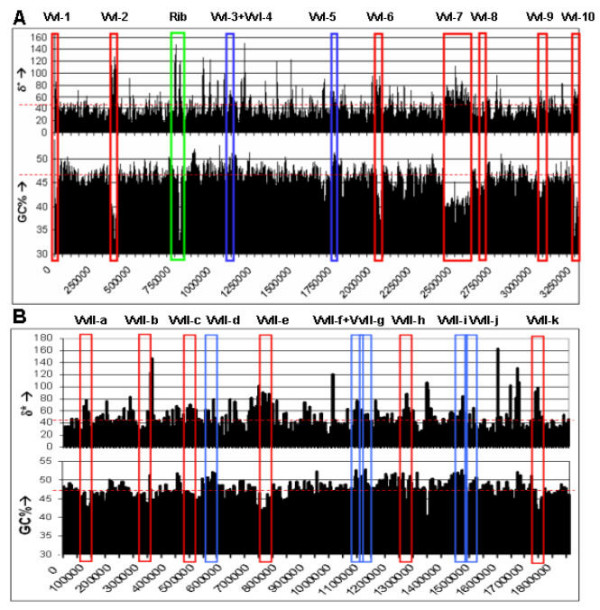
Recent analyses of prokaryotic genome sequences have demonstrated the important force horizontal gene transfer constitutes in genome evolution. Horizontally acquired sequences are detectable by, among others, their dinucleotide composition (genome signature) dissimilarity with the host genome. Genomic islands (GIs) comprise important and interesting horizontally transferred sequences, but information about acquisition events or relatedness between GIs is scarce. In Vibrio vulnificus CMCP6, 10 and 11 GIs have previously been identified in the sequenced chromosomes I and II, respectively. We assessed the compositional similarity and putative acquisition account of these GIs using the genome signature. For this analysis we developed a new algorithm, available as a web application.
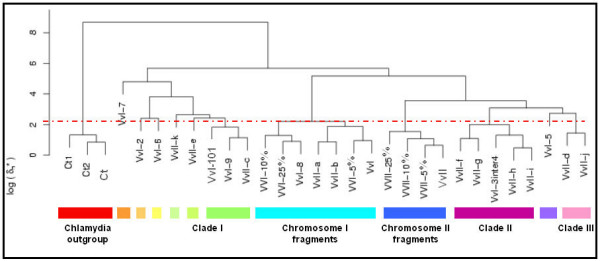
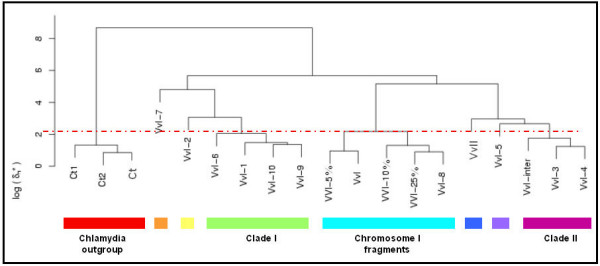
Of 21 GIs, VvI-1 and VvI-10 of chromosome I have similar genome signatures, and while artificially divided due to a linear annotation, they are adjacent on the circular chromosome and therefore comprise one GI. Similarly, GIs VvI-3 and VvI-4 of chromosome I together with the region between these two islands are compositionally similar, suggesting that they form one GI (making a total of 19 GIs in chromosome I + chromosome II). Cluster analysis assigned the 19 GIs to 11 different branches above our conservative threshold. This suggests a limited number of compositionally similar donors or intragenomic dispersion of ancestral acquisitions. Furthermore, 2 GIs of chromosome II cluster with chromosome I, while none of the 19 GIs group with chromosome II, suggesting an unidirectional dispersal of large anomalous gene clusters from chromosome I to chromosome II.
From the results, we infer 10 compositionally dissimilar donors for 19 GIs in the V. vulnificus CMCP6 genome, including chromosome I donating to chromosome II. This suggests multiple transfer events from individual donor types or from donors with similar genome signatures. Applied to other prokaryotes, this approach may elucidate the acquisition account in their genome sequences, and facilitate donor identification of GIs.
近期对原核生物基因组序列的分析表明,水平基因转移在基因组进化中是一股重要力量。通过与宿主基因组的二核苷酸组成(基因组特征)差异等方法,可检测到水平获得的序列。基因组岛(GIs)包含重要且有趣的水平转移序列,但关于获得事件或基因组岛之间的相关性信息却很稀少。在创伤弧菌CMCP6中,先前已分别在已测序的染色体I和II中鉴定出10个和11个基因组岛。我们使用基因组特征评估了这些基因组岛的组成相似性和假定的获得情况。为此分析,我们开发了一种新算法,并以网络应用程序的形式提供。
在21个基因组岛中,染色体I的VvI - 1和VvI - 10具有相似的基因组特征,虽然由于线性注释而被人为分开,但它们在环状染色体上相邻,因此构成一个基因组岛。同样,染色体I的基因组岛VvI - 3和VvI - 4以及这两个岛之间的区域在组成上相似,表明它们形成一个基因组岛(染色体I +染色体II中共有19个基因组岛)。聚类分析将这19个基因组岛分配到高于我们保守阈值的11个不同分支中。这表明组成相似的供体数量有限,或者祖先获得的序列在基因组内分散。此外,染色体II的2个基因组岛与染色体I聚类,而19个基因组岛中没有一个与染色体II聚类,这表明大的异常基因簇从染色体I到染色体II存在单向分散。
从结果中,我们推断创伤弧菌CMCP6基因组中19个基因组岛有10个组成不同的供体,包括染色体I向染色体II的转移。这表明存在来自单个供体类型或具有相似基因组特征的供体的多次转移事件。应用于其他原核生物,这种方法可能阐明其基因组序列中的获得情况,并有助于基因组岛供体的鉴定。