Figueiro Mariana G, Bullough John D, Parsons Robert H, Rea Mark S
Lighting Research Center, Rensselaer Polytechnic Institute, 21 Union Street, Troy, NY 12180, USA.
J Circadian Rhythms. 2005 Dec 11;3:14. doi: 10.1186/1740-3391-3-14.
It is well established that the absolute sensitivity of the suprachiasmatic nucleus to photic stimulation received through the retino-hypothalamic tract changes throughout the 24-hour day. It is also believed that a combination of classical photoreceptors (rods and cones) and melanopsin-containing retinal ganglion cells participate in circadian phototransduction, with a spectral sensitivity peaking between 440 and 500 nm. It is still unknown, however, whether the spectral sensitivity of the circadian system also changes throughout the solar day. Reported here is a new study that was designed to determine whether the spectral sensitivity of the circadian retinal phototransduction mechanism, measured through melatonin suppression and iris constriction, varies at night.
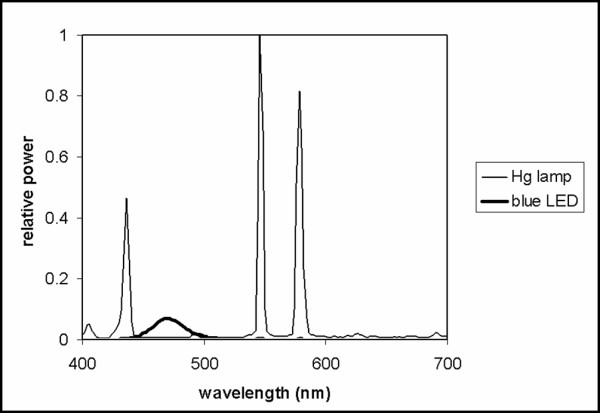
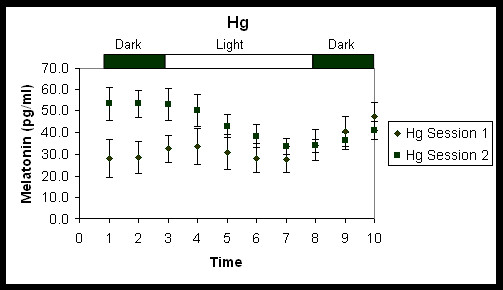
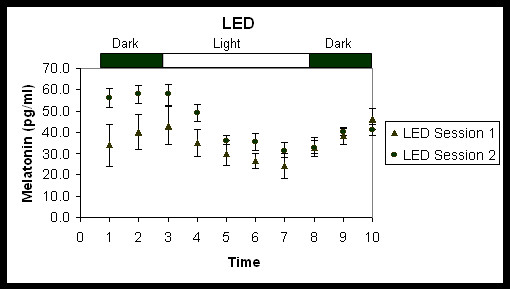
Human adult males were exposed to a high-pressure mercury lamp [450 lux (170 microW/cm2) at the cornea] and an array of blue light emitting diodes [18 lux (29 microW/cm2) at the cornea] during two nighttime experimental sessions. Both melatonin suppression and iris constriction were measured during and after a one-hour light exposure just after midnight and just before dawn.
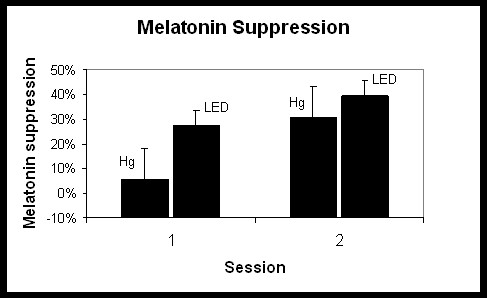
An increase in the percentage of melatonin suppression and an increase in pupil constriction for the mercury source relative to the blue light source at night were found, suggesting a temporal change in the contribution of photoreceptor mechanisms leading to melatonin suppression and, possibly, iris constriction by light in humans.
The preliminary data presented here suggest a change in the spectral sensitivity of circadian phototransduction mechanisms at two different times of the night. These findings are hypothesized to be the result of a change in the sensitivity of the melanopsin-expressing retinal ganglion cells to light during the night.
视交叉上核对通过视网膜 - 下丘脑束接收的光刺激的绝对敏感性在24小时内会发生变化,这一点已得到充分证实。人们还认为,经典光感受器(视杆细胞和视锥细胞)和含黑视蛋白的视网膜神经节细胞共同参与昼夜节律光转导,其光谱敏感性在440至500纳米之间达到峰值。然而,昼夜节律系统的光谱敏感性是否也会在整个白天发生变化仍不清楚。本文报道了一项新研究,旨在确定通过褪黑素抑制和虹膜收缩测量的昼夜节律视网膜光转导机制的光谱敏感性在夜间是否会发生变化。
在两个夜间实验阶段,将成年男性暴露于高压汞灯(角膜处为450勒克斯(170微瓦/平方厘米))和一系列蓝光发光二极管(角膜处为18勒克斯(29微瓦/平方厘米))下。在午夜刚过和黎明前进行一小时光照期间及之后,测量褪黑素抑制和虹膜收缩情况。
发现夜间汞光源相对于蓝光光源的褪黑素抑制百分比增加,瞳孔收缩增加,这表明导致褪黑素抑制以及可能导致光引起的虹膜收缩的光感受器机制的贡献存在时间变化。
本文提供的初步数据表明,昼夜节律光转导机制的光谱敏感性在夜间的两个不同时间发生了变化。这些发现被假设是夜间表达黑视蛋白的视网膜神经节细胞对光的敏感性变化的结果。