Department of Microbiology, University of Groningen, Kerklaan 30, 9751 NN Haren, The Netherlands.
Appl Environ Microbiol. 1991 Sep;57(9):2586-90. doi: 10.1128/aem.57.9.2586-2590.1991.
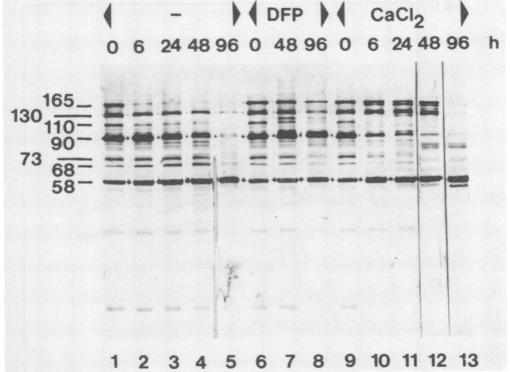
The molecular masses of purified extracellular serine proteinase of a number of Lactococcus lactis strains vary significantly, and these molecular mass values do not correspond to the values estimated on the basis of genetic data. The discrepancies can only partially be explained by N-terminal processing during maturation of the precursor enzyme and by C-terminal cleaving during the release from the cell envelope. With a monoclonal antibody that binds in the active site region of the L. lactis proteinase, the processing of the released proteinase was followed. At 30 degrees C the proteinase was degraded with a concomitant loss of beta-casein hydrolytic activity. In the presence of CaCl(2), proteinase degradation was inhibited, and new degradation products were detected. The specific serine proteinase inhibitors phenylmethylsulfonyl fluoride and diisopropylfluorophosphate also inhibited proteinase degradation. Two major high-molecular-mass proteinase fragments (165 and 90 kDa) were found to have the same N-terminal amino acid sequence as the mature proteinase, i.e., [Asp-1-Ala-2-Lys-3-Ala-4-Asn-5-Ser-6, indicating that both fragments were formed by cleavage at the C terminus. The N terminus of a proteinase fragment with low molecular mass (58 kDa) started with Gln-215. In this fragment part of the active site region was eliminated, suggesting that it is proteolytically inactive. Unlike larger fragments, this 58-kDa fragment remained intact after prolonged incubations. These results indicate that autoproteolysis of the L. lactis subsp. cremoris Wg2 proteinase ultimately leads to inactivation of the proteinase by deletion of the active site region.
一些乳球菌(Lactococcus lactis)菌株的纯化细胞外丝氨酸蛋白酶的分子质量变化很大,这些分子质量值与基于遗传数据估计的值不对应。这些差异只能部分通过成熟前体酶的 N 端加工和从细胞包膜释放时的 C 端切割来解释。使用一种结合在乳球菌蛋白酶活性部位的单克隆抗体,跟踪了释放的蛋白酶的加工过程。在 30°C 时,蛋白酶被降解,同时丧失了β-酪蛋白水解活性。在 CaCl2 的存在下,蛋白酶降解被抑制,并检测到新的降解产物。特异性丝氨酸蛋白酶抑制剂苯甲基磺酰氟和二异丙基氟磷酸酯也抑制了蛋白酶的降解。发现两个主要的高分子量蛋白酶片段(165 和 90 kDa)与成熟蛋白酶具有相同的 N 末端氨基酸序列,即 [Asp-1-Ala-2-Lys-3-Ala-4-Asn-5-Ser-6,表明这两个片段都是由 C 端切割形成的。分子量较低的蛋白酶片段(58 kDa)的 N 端以 Gln-215 开始。在这个片段中,部分活性部位被消除,表明它没有蛋白水解活性。与较大片段不同,这个 58 kDa 片段在长时间孵育后仍保持完整。这些结果表明,乳球菌乳亚种(Lactococcus lactis subsp. cremoris)Wg2 蛋白酶的自切最终导致活性部位缺失,使蛋白酶失活。