Research Station, Agriculture Canada, Lethbridge, Alberta, Canada T1J 4B1, and Research Station, Agriculture Canada, Saskatoon, Saskatchewan, Canada S7N 0X2.
Appl Environ Microbiol. 1993 Jul;59(7):2132-8. doi: 10.1128/aem.59.7.2132-2138.1993.
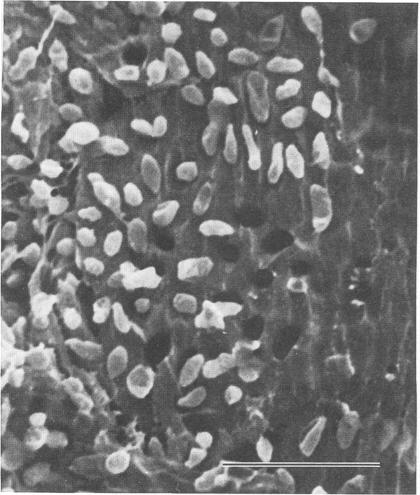
The effect of condensed tannins from birdsfoot trefoil (Lotus corniculatus L.) on the cellulolytic rumen bacterium Fibrobacter succinogenes S85 was examined. Condensed tannins inhibited endoglucanase activity in the extracellular culture fluid, at concentrations as low as 25 mug ml. In contrast, cell-associated endoglucanase activity increased in concentrations of condensed tannins between 100 and 300 mug ml. Inhibition of endoglucanase activity in both the extracellular and the cell-associated fractions was virtually complete at 400 mug of condensed tannins ml. Despite the sharp decline in extracellular endoglucanase activity with increasing concentrations of condensed tannins, filter paper digestion declined only moderately between 0 and 200 mug of condensed tannins ml. However, at 300 mug ml, filter paper digestion was dramatically reduced and at 400 mug ml, almost no filter paper was digested. F. succinogenes S85 was seen to form digestive grooves on the surface of cellulose, and at 200 mug ml, digestive pits were formed which penetrated into the interior of cellulose fibers. Cells grown with condensed tannins (100 to 300 mug ml) possessed large amounts of surface material, and although this material may have been capsular carbohydrate, its osmiophilic nature suggested that it had arisen from the formation of tannin-protein complexes on the cell surface. The presence of electron-dense extracellular material suggested that similar complexes were formed with extracellular protein.
研究了雀儿豆( Lotus corniculatus L.)中的缩合单宁对纤维分解菌纤维丁酸弧菌( Fibrobacter succinogenes S85)的影响。缩合单宁在低至 25 µg/ml 的浓度下就可抑制胞外培养液中的内切葡聚糖酶活性。相比之下,在 100 至 300 µg/ml 的缩合单宁浓度下,细胞相关的内切葡聚糖酶活性增加。在 400 µg/ml 的缩合单宁浓度下,胞外和细胞相关部分的内切葡聚糖酶活性几乎完全被抑制。尽管随着缩合单宁浓度的增加,胞外内切葡聚糖酶活性急剧下降,但滤纸消化仅在 0 至 200 µg/ml 的缩合单宁浓度范围内适度下降。然而,在 300 µg/ml 时,滤纸消化显著减少,在 400 µg/ml 时,几乎没有滤纸被消化。观察到纤维丁酸弧菌 S85 在纤维素表面形成消化槽,在 200 µg/ml 时,形成了穿透纤维素纤维内部的消化坑。用缩合单宁(100 至 300 µg/ml)培养的细胞具有大量的表面物质,尽管这些物质可能是荚膜碳水化合物,但它的亲脂性表明它是由细胞表面上的单宁-蛋白质复合物形成的。存在电子致密的细胞外物质表明,类似的复合物也在细胞外蛋白质中形成。