Tucker Pattie, Liao Youlian, Giles Wayne H, Liburd Leandris
Division of Adult and Community Health, National Center for Chronic Disease Prevention and Health Promotion, Centers for Disease Control and Prevention (CDC), 4770 Buford Hwy, NE, Mail Stop K-30, Atlanta, GA 30341, USA.
Prev Chronic Dis. 2006 Jan;3(1):A21. Epub 2005 Dec 15.
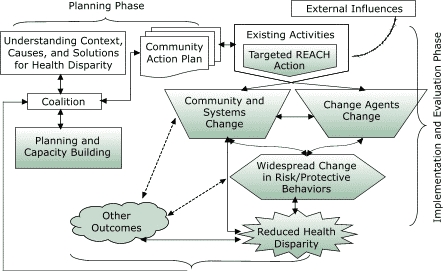
The Centers for Disease Control and Prevention (CDC) supports 40 Racial and Ethnic Approaches to Community Health (REACH 2010) community coalitions in designing, implementing, and evaluating community-driven strategies to eliminate health disparities in racial and ethnic groups. The REACH 2010 logic model was developed to assist grantees in identifying, documenting, and evaluating local attributes of the coalition and its partners to reduce and eliminate local health disparities. The model emphasizes the program's theory of change for addressing health disparities; it displays five distinct stages of evaluation for which qualitative and quantitative measurement data are collected. The CDC is relying on REACH 2010 grantees to provide credible evidence that explains how community contributions have changed conditions and behaviors, thus leading to the reduction and elimination of health disparities.
疾病控制与预防中心(CDC)为40个种族与族裔社区健康途径(2010年社区健康途径)社区联盟提供支持,以设计、实施和评估由社区驱动的战略,消除种族和族裔群体中的健康差距。2010年社区健康途径逻辑模型的开发旨在帮助受资助者识别、记录和评估联盟及其合作伙伴的当地属性,以减少和消除当地的健康差距。该模型强调该项目解决健康差距的变革理论;它展示了五个不同的评估阶段,针对这些阶段收集定性和定量测量数据。疾病控制与预防中心依靠2010年社区健康途径的受资助者提供可靠证据,解释社区贡献如何改变状况和行为,从而减少和消除健康差距。