Tamura K, Tanimoto K, Murakami K, Fukamizu A
Institute of Applied Biochemistry, University of Tsukuba, Japan.
Nucleic Acids Res. 1992 Jul 25;20(14):3617-23. doi: 10.1093/nar/20.14.3617.
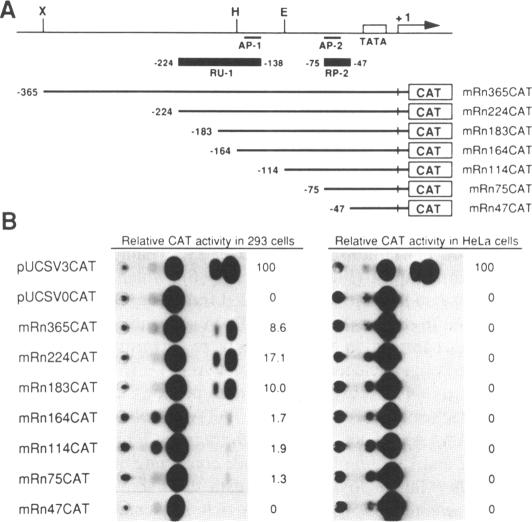
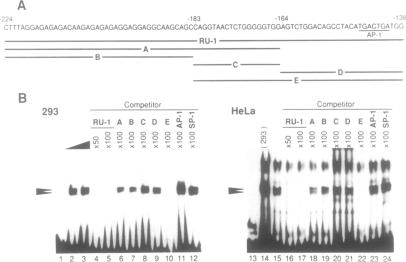
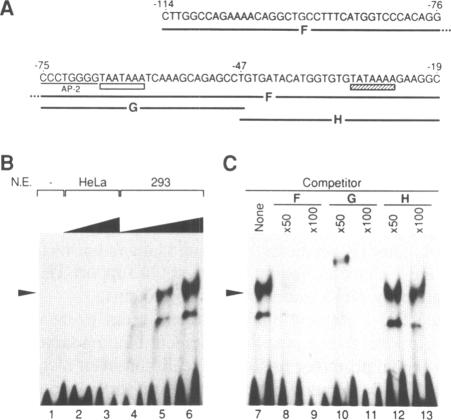
Renin, a key enzyme controlling blood pressure, is produced mainly in the kidney. To identify the transcriptional regulatory elements of the mouse Ren-1c gene, the promoter regions were fused to the CAT reporter gene and transfected into embryonic kidney-derived 293 cells and four extrarenal cell lines, HeLa, HepG2, HT1080 and NIH3T3 cells. Transient transfection assay showed that sequences from -365 to +16 of the renin gene could direct transcription of the CAT hybrid gene only in 293 cells. Deletion analysis identified two transcriptionally active regions; the renin upstream-promoter element (RU-1 element; position -224 to -138) and the renin proximal-promoter element (RP-2 element; position -75 to -47). Although the RU-1 element functioned as an activator, depending on its orientation, it failed to trans-activate the renin promoter when the RP-2 element was deleted. By contrast, the proximal element alone exhibited a weak trans-activator property. Gel shift assay identified RU-1 element-binding factors in both 293 and HeLa cells, whereas 293 cell-dominant factors were shown to bind only to RP-2 element. Therefore, both RU-1 and RP-2 elements were found to be necessary for efficient CAT expression from the renin promoter in 293 cells, suggesting that activation of the Ren-1c promoter requires combined action between cell type-dominant and ubiquitous nuclear factors.
肾素是控制血压的关键酶,主要在肾脏中产生。为了鉴定小鼠Ren-1c基因的转录调控元件,将启动子区域与CAT报告基因融合,并转染到源自胚胎肾的293细胞和四种肾外细胞系(HeLa、HepG2、HT1080和NIH3T3细胞)中。瞬时转染分析表明,肾素基因从-365到+16的序列仅能在293细胞中指导CAT杂交基因的转录。缺失分析确定了两个转录活性区域:肾素上游启动子元件(RU-1元件;位置-224至-138)和肾素近端启动子元件(RP-2元件;位置-75至-47)。尽管RU-1元件根据其方向起激活剂的作用,但当RP-2元件缺失时,它无法反式激活肾素启动子。相比之下,单独的近端元件表现出较弱的反式激活特性。凝胶迁移试验在293和HeLa细胞中均鉴定出RU-1元件结合因子,而293细胞优势因子仅与RP-2元件结合。因此,发现RU-1和RP-2元件对于293细胞中肾素启动子高效表达CAT都是必需的,这表明Ren-1c启动子的激活需要细胞类型优势因子和普遍存在的核因子之间的联合作用。