Rosemann Thomas, Wensing Michel, Rueter Gernot, Szecsenyi Joachim
Department of General Practice and Health Services Research, University of Heidelberg, 69115 Heidelberg, Germany.
BMC Health Serv Res. 2006 Jan 19;6:5. doi: 10.1186/1472-6963-6-5.
Referrals of patients from primary care to medical specialist care are an important activity in any health care system. German data show that the number of referrals by GPs have increased since 2004, but detailed insight into the experiences of patients, GPs and consultants regarding referrals is very limited. This study aimed at describing the experiences of consultants, GPs and patients with referrals from primary care to medical specialist care. An additional objective was to examine the impact of purpose regarding the referral and of the referrer on the experiences of GPs and patients.
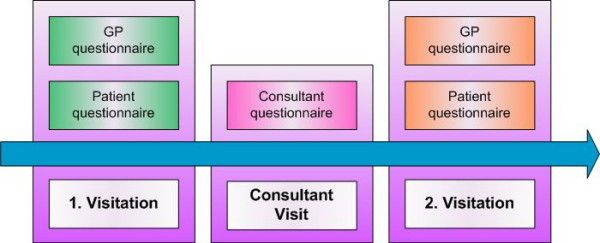
Referrals of 26 general practitioners (GPs) from 25 practices in Marbach, a rural region in the south of Germany were studied. All adult patients referred after consulting these GPs in a period of five weeks were eligible for the study. GPs, consultants and patients completed short structured forms to document factual characteristics of each referral and their experiences with the referral. GPs and patients completed forms before and after the referral was made, while the consultants completed forms after the patient had consulted them.
Overall, consultants were very positive about appropriateness of the referral (91%). They were somewhat more critical regarding the information provided on the patients' medical history (61%) and prescriptions (48%). In 258 referrals (63%) GPs perceived clear diagnostic benefits, while in 202 referrals (49%) they perceived clear treatment benefits. GPs' experiences were more positive if the GP's purpose was to reduce diagnostic uncertainty (beta = 0.318, p < 0.001) or if the purpose was to exclude serious illness (beta = 0.143, p < 0.010). Other purposes of the referral had no impact on their experiences. Patients' expectations regarding the referrals mostly referred to diagnosis, including increased diagnostic certainty (80%), detailed information about the illness (66%) and exclusion of serious illness (62%). They were overall satisfied with the referral (83%). Their experiences with the referral were more positive if the initiative for the referral came from the physician (beta = 0.365, p < 0.000).
Patients, GPs and consultants have positive views on the value of referrals from primary care to medical specialists. Patients were most positive if the physician had initiated the referral, which supports the gate keeper role of the GP.
在任何医疗体系中,患者从基层医疗转诊至专科医疗都是一项重要活动。德国的数据表明,自2004年以来,全科医生(GP)的转诊数量有所增加,但对于患者、全科医生和专科医生在转诊方面的经历,深入了解非常有限。本研究旨在描述专科医生、全科医生和患者在从基层医疗转诊至专科医疗方面的经历。另一个目标是考察转诊目的及转诊医生对全科医生和患者经历的影响。
对德国南部农村地区马尔巴赫25家诊所的26名全科医生的转诊情况进行研究。在为期五周内咨询这些全科医生后被转诊的所有成年患者均符合研究条件。全科医生、专科医生和患者填写简短的结构化表格,记录每次转诊的实际特征以及他们在转诊方面的经历。全科医生和患者在转诊前后填写表格,而专科医生在患者咨询后填写表格。
总体而言,专科医生对转诊的适宜性非常认可(91%)。他们对提供的患者病史信息(61%)和处方(48%)的批评意见略多一些。在258次转诊(63%)中,全科医生认为有明确的诊断益处,而在202次转诊(49%)中,他们认为有明确的治疗益处。如果全科医生的目的是减少诊断不确定性(β = 0.318,p < 0.001)或排除严重疾病(β = 0.143,p < 0.010),全科医生的体验会更积极。转诊的其他目的对他们的体验没有影响。患者对转诊的期望大多涉及诊断,包括提高诊断确定性(80%)、关于疾病的详细信息(66%)和排除严重疾病(62%)。他们总体上对转诊感到满意(83%)。如果转诊由医生发起,他们在转诊方面的体验会更积极(β = 0.365,p < 0.000)。
患者、全科医生和专科医生对从基层医疗转诊至专科医疗的价值持积极看法。如果由医生发起转诊,患者的态度最为积极,这支持了全科医生的把关人角色。