Demars Julie, Riquet Juliette, Feve Katia, Gautier Mathieu, Morisson Mireille, Demeure Olivier, Renard Christine, Chardon Patrick, Milan Denis
Laboratoire de Génétique Cellulaire, INRA, BP52627, 31326 Castanet-Tolosan, France.
BMC Genomics. 2006 Jan 24;7:13. doi: 10.1186/1471-2164-7-13.
On porcine chromosome 7, the region surrounding the Major Histocompatibility Complex (MHC) contains several Quantitative Trait Loci (QTL) influencing many traits including growth, back fat thickness and carcass composition. Previous studies highlighted that a fragment of approximately 3.7 Mb is located within the Swine Leucocyte Antigen (SLA) complex. Internal rearrangements of this fragment were suggested, and partial contigs had been built, but further characterization of this region and identification of all human chromosomal fragments orthologous to this porcine fragment had to be carried out.
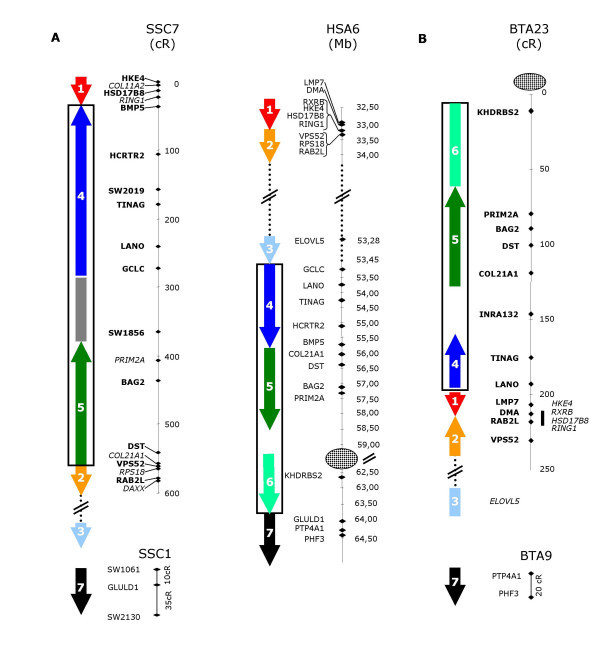
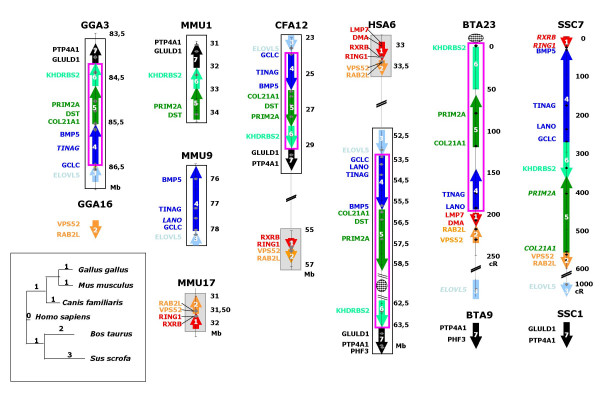
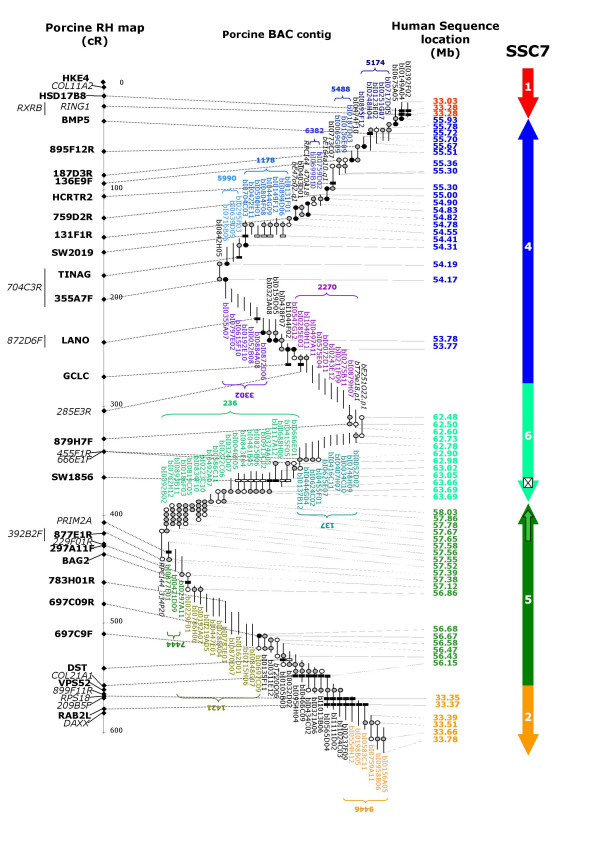
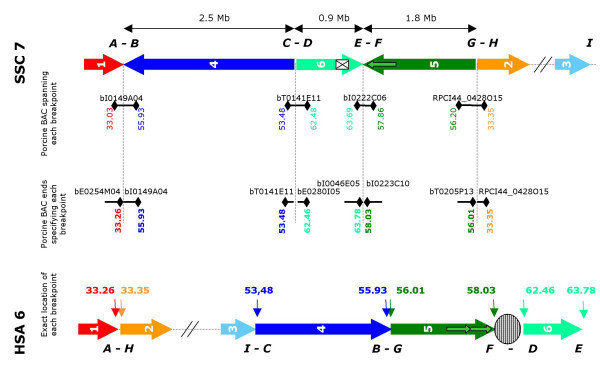
A whole physical map of the region was constructed by integrating Radiation Hybrid (RH) mapping, BAC fingerprinting data of the INRA BAC library and anchoring BAC end sequences on the human genome. 17 genes and 2 reference microsatellites were ordered on the high resolution IMNpRH212000rad Radiation Hybrid panel. A 1000:1 framework map covering 550 cR12000 was established and a complete contig of the region was developed. New micro rearrangements were highlighted between the porcine and human genomes. A bovine RH map was also developed in this region by mapping 16 genes. Comparison of the organization of this region in pig, cattle, human, mouse, dog and chicken genomes revealed that 1) the translocation of the fragment described previously is observed only on the bovine and porcine genomes and 2) the new internal micro rearrangements are specific of the porcine genome.
We estimate that the region contains several rearrangements and covers 5.2 Mb of the porcine genome. The study of this complete BAC contig showed that human chromosomal fragments homologs of this heavily rearranged QTL region are all located in the region of HSA6 that surrounds the centromere. This work allows us to define a list of all candidate genes that could explain these QTL effects.
在猪的7号染色体上,主要组织相容性复合体(MHC)周围区域包含几个影响多种性状的数量性状位点(QTL),这些性状包括生长、背膘厚度和胴体组成。先前的研究表明,一段约3.7 Mb的片段位于猪白细胞抗原(SLA)复合体内部。有人提出该片段存在内部重排,并且已经构建了部分重叠群,但仍需对该区域进行进一步表征,并鉴定与该猪片段直系同源的所有人染色体片段。
通过整合辐射杂种(RH)图谱、法国国家农业研究院(INRA)BAC文库的BAC指纹数据以及将BAC末端序列锚定到人类基因组上,构建了该区域的完整物理图谱。在高分辨率IMNpRH212000rad辐射杂种板上对17个基因和2个参考微卫星进行了排序。建立了一个覆盖550 cR12000的1000:1框架图谱,并构建了该区域的完整重叠群。猪和人类基因组之间发现了新的微重排。通过对16个基因进行定位,还绘制了该区域的牛RH图谱。对该区域在猪、牛、人、小鼠、狗和鸡基因组中的组织方式进行比较后发现:1)先前描述的片段易位仅在牛和猪基因组中观察到;2)新的内部微重排是猪基因组特有的。
我们估计该区域包含多个重排,覆盖猪基因组的5.2 Mb。对这个完整的BAC重叠群的研究表明,这个重排严重的QTL区域的人类染色体同源片段都位于人6号染色体(HSA6)围绕着丝粒的区域。这项工作使我们能够确定所有可能解释这些QTL效应的候选基因列表。