Tsai K S, Thomson R G
Infect Immun. 1975 Apr;11(4):770-82. doi: 10.1128/iai.11.4.770-782.1975.
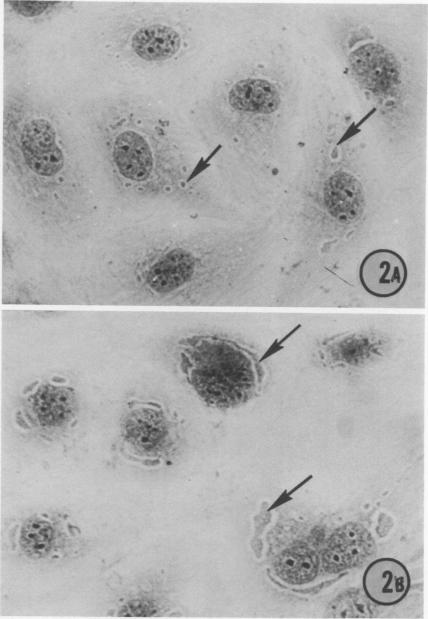
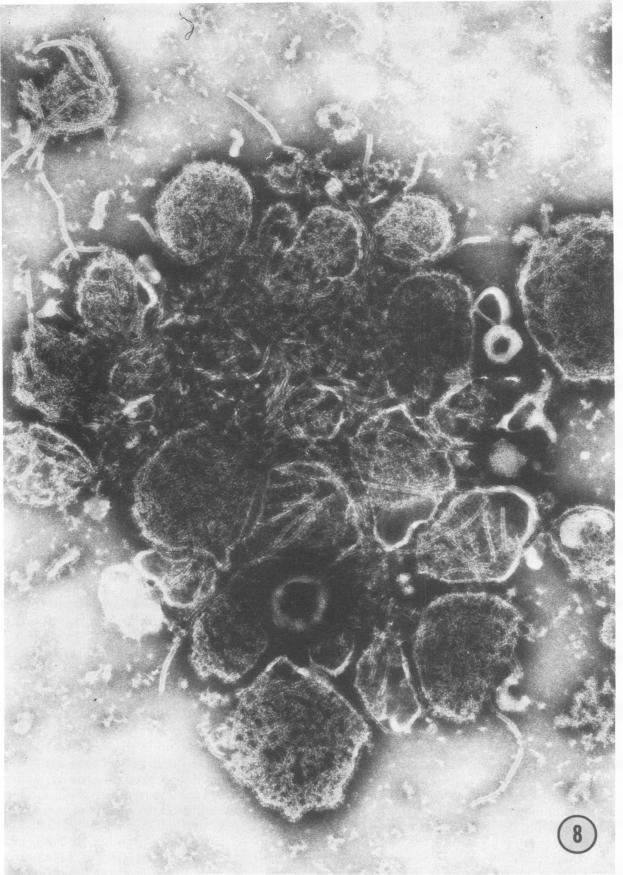
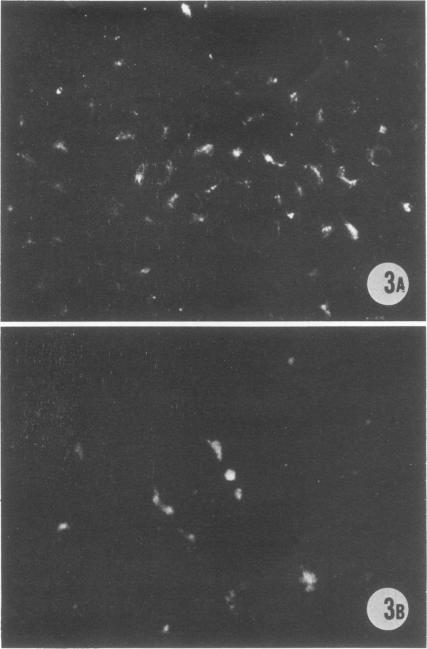
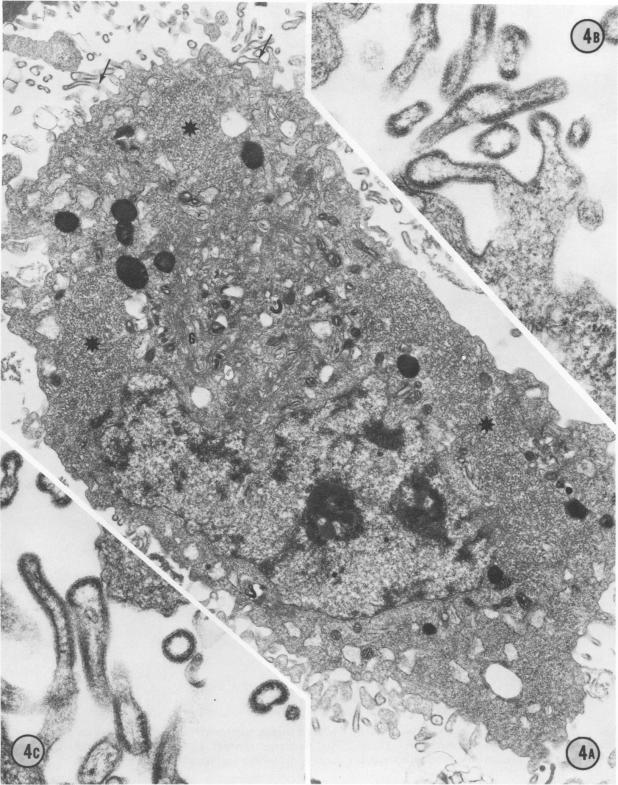
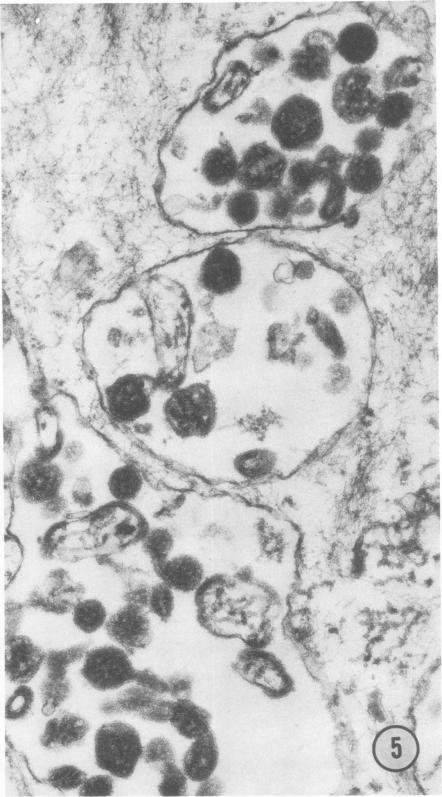
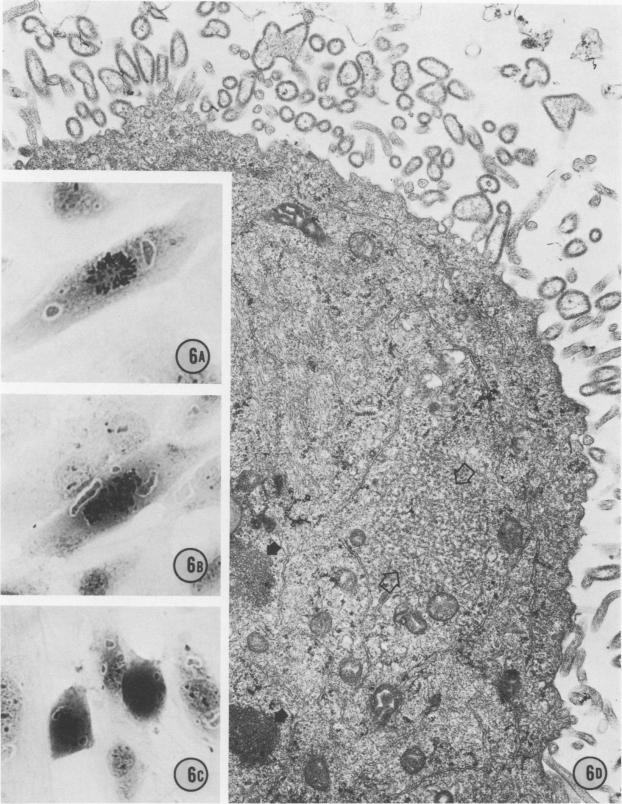
Replicative sequences of a bovine strain of parainfluenza type 3 virus in bovine embryonic kidney and spleen cell cultures were investigated by light and fluorescence microscopy and by ultrathin section and negative-contrast electron microscopy. Observations from light and fluorescence microscopy showed that intracytoplasmic inclusions were detected as small granules surrounding the nuclei of more than 90 percent of the cell population by day 2 postinoculation. With the increase of postexposure times, these inclusions coalesced into larger bodies which occupied large portions of the cell. Ultrastructurally, the first sign of virus development was the appearance of aggregates of viral nucleocapsids in the vicinity of the nucleus. With the concomitant accumulation of viral nucleocapsids in the cytoplasm, the virus maturation was expressed by budding processes through the cell membrane into round, oval, or elongated forms. Eosinophilic inclusions were demonstrable in many mitotic cells. Ultrastructurally, these cells were observed to produce virus particles by a process identical to that of resting cells. Virions, prepared from infected culture fluid and negatively stained, appeared to be pleomorphic and their diameter ranged from 200 to 600 mm. The virions were separated, by rate-zonal centrifugation, into two subclasses in a sucrose gradient (15 to 60 percent, wt/wt). The slowly sedimenting virions had a density approximately 1.20 gm/cm3 and an average size of 200 nm in diameter, whereas the faster-sedimenting virions had a density of 1.24 gm/cm3 and average diameter of 400 nm.
利用光学显微镜、荧光显微镜、超薄切片及负染色电子显微镜对牛副流感3型病毒牛株在牛胚胎肾和脾细胞培养物中的复制序列进行了研究。光学显微镜和荧光显微镜观察结果显示,接种后第2天,超过90%的细胞群体中,细胞核周围的胞质内包涵体被检测为小颗粒。随着暴露后时间的增加,这些包涵体融合成更大的体块,占据了细胞的大部分区域。在超微结构上,病毒发育的第一个迹象是细胞核附近出现病毒核衣壳聚集体。随着病毒核衣壳在细胞质中的积累,病毒成熟表现为通过细胞膜出芽形成圆形、椭圆形或细长形。在许多有丝分裂细胞中可显示嗜酸性包涵体。在超微结构上,观察到这些细胞通过与静止细胞相同的过程产生病毒颗粒。从感染的培养液中制备并经负染色的病毒粒子似乎呈多形性,其直径范围为200至600毫米。通过速率区带离心,病毒粒子在蔗糖梯度(15%至60%,重量/重量)中被分为两个亚类。沉降较慢的病毒粒子密度约为1.20克/立方厘米,平均直径为200纳米,而沉降较快的病毒粒子密度为1.24克/立方厘米,平均直径为400纳米。