Yakovchuk Peter, Protozanova Ekaterina, Frank-Kamenetskii Maxim D
Center for Advanced Biotechnology and Department of Biomedical Engineering, Boston University, 36 Cummington Street, Boston, MA 02215, USA.
Nucleic Acids Res. 2006 Jan 31;34(2):564-74. doi: 10.1093/nar/gkj454. Print 2006.
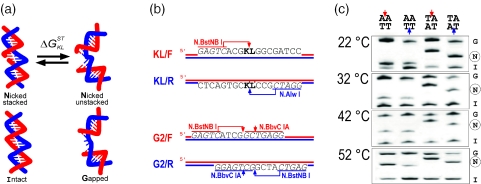
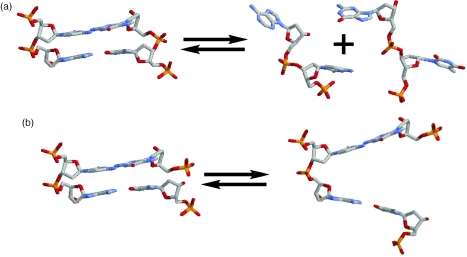
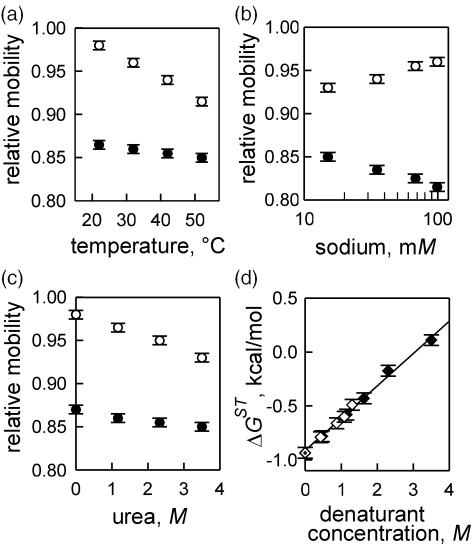
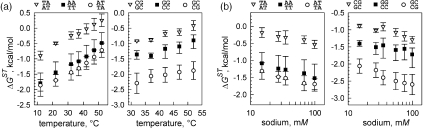
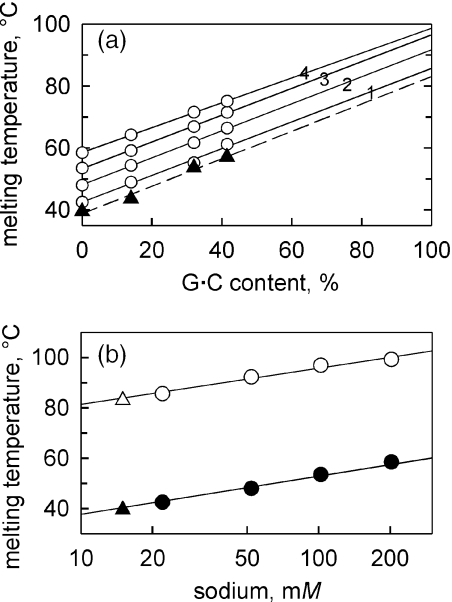
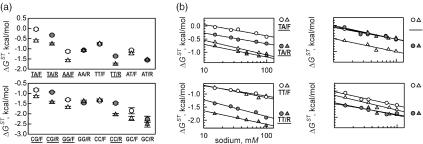
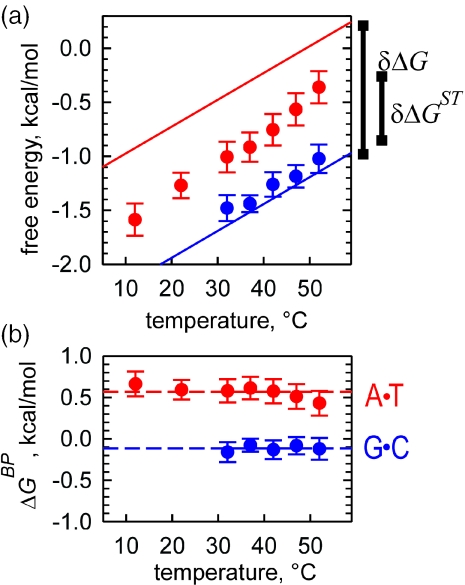
Two factors are mainly responsible for the stability of the DNA double helix: base pairing between complementary strands and stacking between adjacent bases. By studying DNA molecules with solitary nicks and gaps we measure temperature and salt dependence of the stacking free energy of the DNA double helix. For the first time, DNA stacking parameters are obtained directly (without extrapolation) for temperatures from below room temperature to close to melting temperature. We also obtain DNA stacking parameters for different salt concentrations ranging from 15 to 100 mM Na+. From stacking parameters of individual contacts, we calculate base-stacking contribution to the stability of AT- and GC-containing DNA polymers. We find that temperature and salt dependences of the stacking term fully determine the temperature and the salt dependence of DNA stability parameters. For all temperatures and salt concentrations employed in present study, base-stacking is the main stabilizing factor in the DNA double helix. AT pairing is always destabilizing and GC pairing contributes almost no stabilization. Base-stacking interaction dominates not only in the duplex overall stability but also significantly contributes into the dependence of the duplex stability on its sequence.
DNA双螺旋稳定性主要由两个因素决定:互补链之间的碱基配对以及相邻碱基之间的堆积作用。通过研究带有单个切口和缺口的DNA分子,我们测量了DNA双螺旋堆积自由能的温度和盐浓度依赖性。首次直接(无需外推)获得了从室温以下到接近解链温度范围内的DNA堆积参数。我们还获得了15至100 mM Na+不同盐浓度下的DNA堆积参数。根据单个碱基对间相互作用的堆积参数,我们计算了碱基堆积对含AT和GC的DNA聚合物稳定性的贡献。我们发现堆积项的温度和盐浓度依赖性完全决定了DNA稳定性参数的温度和盐浓度依赖性。在本研究采用的所有温度和盐浓度条件下,碱基堆积是DNA双螺旋中的主要稳定因素。AT配对总是起 destabilizing作用,而GC配对几乎没有稳定作用。碱基堆积相互作用不仅主导双链的整体稳定性,还显著影响双链稳定性对其序列的依赖性。