Windler E, Greeve J, Levkau B, Kolb-Bachofen V, Daerr W, Greten H
Medizinische Kernklinik und Poliklinik, Universitäts-Krankenhaus Eppendorf, Hamburg, Federal Republic of Germany.
Biochem J. 1991 May 15;276 ( Pt 1)(Pt 1):79-87. doi: 10.1042/bj2760079.
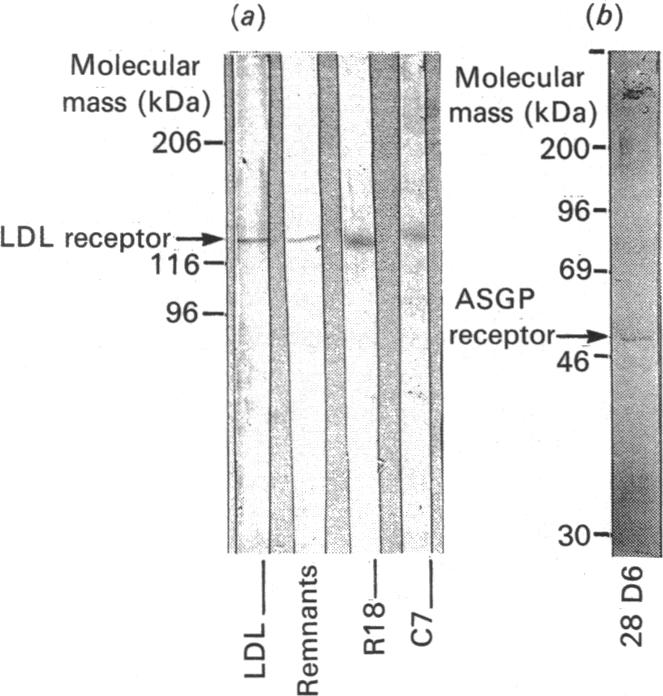
Binding and internalization of chylomicron remnants from rat mesenteric lymph by HepG2 cells was inhibited by both excess remnants and low-density lipoprotein (LDL) to the same extent. Ligand blots revealed binding of remnants and LDL to the LDL receptor. Measures regulating LDL receptor activity greatly influenced the binding of remnants: ethinyloestradiol, the hydroxymethylglutaryl-CoA reductase inhibitor pravastatin and the absence of LDL all increased binding, whereas high cell density or the presence of LDL decreased binding. Also, asialofetuin, asialomucin, the neoglycoprotein galactosyl-albumin and an antibody against the asialoglycoprotein receptor all decreased substantially the binding of remnants. At high cell density, binding internalization and degradation of chylomicron remnants was inhibited by up to 70-80%, yet binding of LDL was inhibited by no more than 20-30%. In cross-competition studies, the binding of 125I-asialofetuin was efficiently competed for by asialofetuin itself or by the antibody, and also by LDL and remnants, yet remnants displayed an approx. 100-fold higher affinity than LDL. Likewise, remnants of human triacylglycerol-rich lipoproteins and asialofetuin interfered with each others' binding to HepG2 cells or human liver membranes. It is concluded that the LDL receptor mediates the internalization of chylomicron remnants into hepatocytes depending on its activity, according to demand for cholesterol. Additionally, the asialoglycoprotein receptor may contribute to the endocytosis of LDL, but predominantly of chylomicron remnants.
过量的乳糜微粒残粒和低密度脂蛋白(LDL)对HepG2细胞结合和内化大鼠肠系膜淋巴中的乳糜微粒残粒具有同等程度的抑制作用。配体印迹显示残粒和LDL与LDL受体结合。调节LDL受体活性的措施对残粒的结合有很大影响:乙炔雌二醇、羟甲基戊二酰辅酶A还原酶抑制剂普伐他汀以及无LDL存在时均增加结合,而高细胞密度或LDL的存在则降低结合。此外,去唾液酸胎球蛋白、去唾液酸粘蛋白、新糖蛋白半乳糖基白蛋白以及抗去唾液酸糖蛋白受体抗体均显著降低残粒的结合。在高细胞密度下,乳糜微粒残粒的结合、内化和降解被抑制达70% - 80%,而LDL的结合仅被抑制不超过20% - 30%。在交叉竞争研究中,125I - 去唾液酸胎球蛋白的结合可被去唾液酸胎球蛋白自身、抗体有效竞争,也可被LDL和残粒竞争,但残粒的亲和力比LDL高约100倍。同样,富含三酰甘油的人脂蛋白残粒和去唾液酸胎球蛋白会相互干扰它们与HepG2细胞或人肝细胞膜的结合。结论是,LDL受体根据对胆固醇的需求,通过其活性介导乳糜微粒残粒内化进入肝细胞。此外,去唾液酸糖蛋白受体可能有助于LDL的内吞作用,但主要是乳糜微粒残粒的内吞作用。