Yazdani Shahram, Jahandideh Hesam, Ghofrani Hossein
Education Development Center, Shaheed Beheshti University of Medical Sciences, Evin, Tabnak St, Tehran, Iran.
BMC Emerg Med. 2006 Feb 16;6:3. doi: 10.1186/1471-227X-6-3.
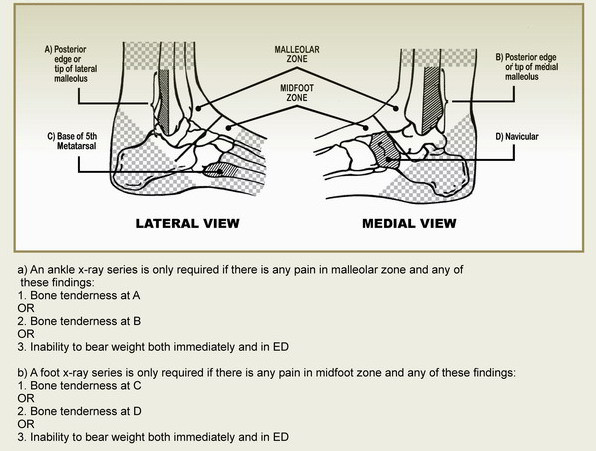
Acute ankle injuries are one of the most common reasons for presenting to emergency departments, but only a small percentage of patients--approximately 15%--have clinically significant fractures. However, these patients are almost always referred for radiography. The Ottawa Ankle Rules (OARs) have been designed to reduce the number of unnecessary radiographs ordered for these patients. The objective of this study was to validate the OARs in the Iranian population.
This prospective survey was done among 200 patients with acute ankle injury from January 2004 to April 2004 in the Akhtar Orthopedics Hospital Emergency Department. Main outcome measures of this survey were: sensitivity, specificity, positive predictive value, negative predictive value, and likelihood ratios (positive and negative) of the OARs.
Sensitivity of the OARs for detecting 37 ankle fractures (23 in the malleolar zone and 14 in the midfoot zone) was 100% for each of the two zones, and 100% for both zones. Specificity of the OARs for detecting fractures was 40.50% for both zones, 40.50% for the malleolar zone, and 56.00% for the midfoot zone. Implementation of the OARs had the potential for reducing radiographs by 33%.
OARs are very accurate and highly sensitive tools for detecting ankle fractures. Implementation of these rules would lead to significant reduction in the number of radiographs, costs, radiation exposure and waiting times in emergency departments.
急性踝关节损伤是患者前往急诊科就诊的最常见原因之一,但只有一小部分患者(约15%)存在具有临床意义的骨折。然而,这些患者几乎总是被转诊去进行X线检查。渥太华踝关节规则(OARs)旨在减少为这些患者开具的不必要X线检查的数量。本研究的目的是在伊朗人群中验证OARs。
2004年1月至2004年4月期间,在阿克塔尔骨科医院急诊科对200例急性踝关节损伤患者进行了这项前瞻性调查。该调查的主要结局指标为:OARs的敏感性、特异性、阳性预测值、阴性预测值以及似然比(阳性和阴性)。
OARs检测37例踝关节骨折(23例在踝关节区域,14例在足中部区域)时,两个区域各自的敏感性均为100%,两个区域总体的敏感性也为100%。OARs检测骨折的特异性在两个区域均为40.50%,在踝关节区域为40.50%,在足中部区域为56.00%。实施OARs有可能将X线检查减少33%。
OARs是检测踝关节骨折非常准确且高度敏感的工具。实施这些规则将显著减少急诊科的X线检查数量、成本、辐射暴露和等待时间。