Amano Hisayuki, Itakura Ken, Maruyama Masayoshi, Ichisaka Tomoko, Nakagawa Masato, Yamanaka Shinya
Department of Stem Cell Biology, Institute for Frontier Medical Sciences, Kyoto University, Kyoto, Japan.
BMC Dev Biol. 2006 Feb 28;6:11. doi: 10.1186/1471-213X-6-11.
Embryonic stem cell-specific gene (ESG) 1, which encodes a KH-domain containing protein, is specifically expressed in early embryos, germ cells, and embryonic stem (ES) cells. Previous studies identified genomic clones containing the mouse ESG1 gene and five pseudogenes. However, their chromosomal localizations or physiological functions have not been determined.
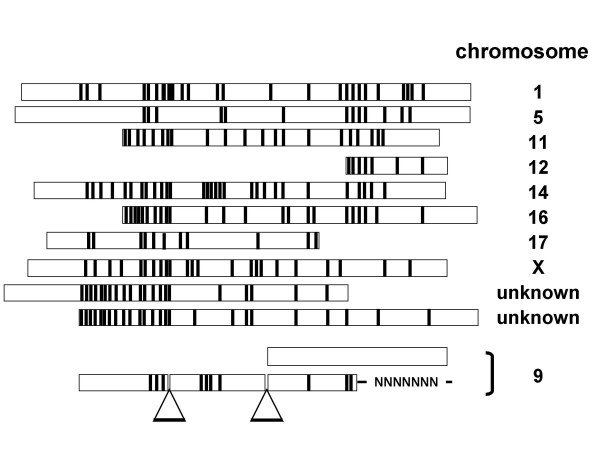
A Blast search of mouse genomic databases failed to locate the ESG1 gene. We identified several bacterial artificial clones containing the mouse ESG1 gene and an additional ESG1-like sequence with a similar gene structure from chromosome 9. The ESG1-like sequence contained a multiple critical mutations, indicating that it was a duplicated pseudogene. The 5' flanking region of the ESG1 gene, but not that of the pseudogene, exhibited strong enhancer and promoter activity in undifferentiated ES cells by luciferase reporter assay. To study the physiological functions of the ESG1 gene, we replaced this sequence in ES cells with a beta-geo cassette by homologous recombination. Despite specific expression in early embryos and germ cells, ESG1-/- mice developed normally and were fertile. We also generated ESG1-/- ES cells both by a second independent homologous recombination and directly from blastocysts derived from heterozygous intercrosses. Northern blot and western blot analyses confirmed the absence of ESG1 in these cells. These ES cells demonstrated normal morphology, proliferation, and differentiation.
The mouse ESG1 gene, together with a duplicated pseudogene, is located on chromosome 9. Despite its specific expression in pluripotent cells and germ cells, ESG1 is dispensable for self-renewal of ES cells and establishment of germcells.
胚胎干细胞特异性基因(ESG)1编码一种含KH结构域的蛋白质,在早期胚胎、生殖细胞和胚胎干细胞(ES细胞)中特异性表达。先前的研究鉴定出了包含小鼠ESG1基因和五个假基因的基因组克隆。然而,它们的染色体定位或生理功能尚未确定。
对小鼠基因组数据库进行Blast搜索未能定位到ESG1基因。我们从9号染色体上鉴定出了几个包含小鼠ESG1基因的细菌人工克隆以及一个具有相似基因结构的额外ESG1样序列。该ESG1样序列包含多个关键突变,表明它是一个重复的假基因。通过荧光素酶报告基因检测,ESG1基因的5'侧翼区域而非假基因的5'侧翼区域在未分化的ES细胞中表现出强大的增强子和启动子活性。为了研究ESG1基因的生理功能,我们通过同源重组用β-geo盒替换了ES细胞中的该序列。尽管ESG1在早期胚胎和生殖细胞中特异性表达,但ESG1基因敲除小鼠发育正常且可育。我们还通过第二次独立的同源重组以及直接从杂合子杂交产生的囊胚中生成了ESG1基因敲除的ES细胞。Northern印迹和Western印迹分析证实这些细胞中不存在ESG1。这些ES细胞表现出正常的形态、增殖和分化。
小鼠ESG1基因与一个重复的假基因位于9号染色体上。尽管ESG1在多能细胞和生殖细胞中特异性表达,但它对于ES细胞的自我更新和生殖细胞的形成并非必需。