Sundaramurthy Arvind, Schuck P James, Conley Nicholas R, Fromm David P, Kino Gordon S, Moerner W E
E.L. Ginzton Laboratory and Department of Chemistry, Stanford University, California 94305, USA.
Nano Lett. 2006 Mar;6(3):355-60. doi: 10.1021/nl052322c.
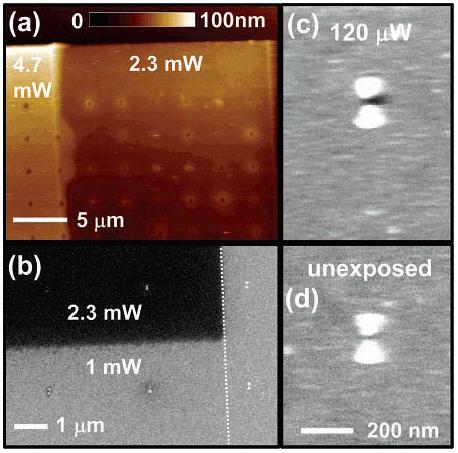
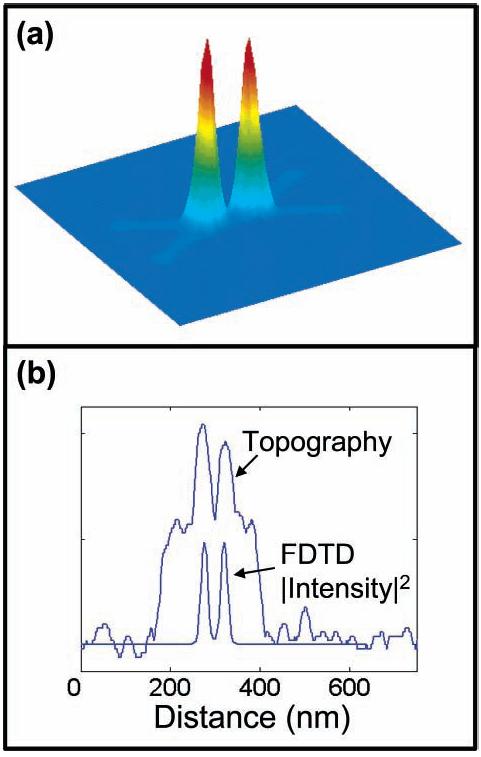
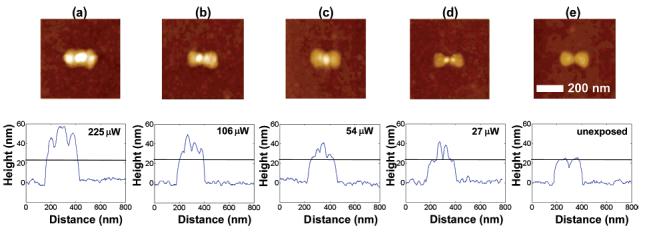
Optically resonant metallic bowtie nanoantennas are utilized as fabrication tools for the first time, resulting in the production of polymer resist nanostructures <30 nm in diameter at record low incident multiphoton energy densities. The nanofabrication is accomplished via nonlinear photopolymerization, which is initiated by the enhanced, confined optical fields surrounding the nanoantenna. The position, size, and shape of the resist nanostructures directly correlate with rigorous finite-difference time-domain computations of the field distribution, providing a nanometer-scale measurement of the actual field confinement offered by single optical nanoantennas. In addition, the size of the photoresist regions yields strong upper bounds on photoacid diffusion and resist resolution in SU-8, demonstrating a technique that can be generalized to the study of many current and yet-to-be-developed photoresist systems.
光学共振金属领结型纳米天线首次被用作制造工具,在创纪录的低入射多光子能量密度下,制造出了直径小于30纳米的聚合物抗蚀剂纳米结构。这种纳米制造是通过非线性光聚合完成的,它由纳米天线周围增强的受限光场引发。抗蚀剂纳米结构的位置、尺寸和形状与场分布的严格时域有限差分计算直接相关,提供了对单个光学纳米天线实际场限制的纳米级测量。此外,光致抗蚀剂区域的尺寸对SU-8中的光酸扩散和抗蚀剂分辨率产生了很强的上限,证明了一种可推广到许多当前和尚未开发的光致抗蚀剂系统研究的技术。