Nishikiori Nobuyuki, Abe Tomoko, Costa Dehiwala G M, Dharmaratne Samath D, Kunii Osamu, Moji Kazuhiko
Research Center for Tropical Infectious Diseases, Institute of Tropical Medicine, Nagasaki University, Nagasaki, Japan.
BMC Public Health. 2006 Mar 20;6:73. doi: 10.1186/1471-2458-6-73.
Describing adverse health effects and identifying vulnerable populations during and after a disaster are important aspects of any disaster relief operation. This study aimed to describe the mortality and related risk factors which affected the displaced population over a period of two and a half months after the 2004 Indian Ocean tsunami in an eastern coastal district of Sri Lanka.
A cross-sectional household survey was conducted in 13 evacuation camps for internally displaced persons (IDP). Information on all pre-tsunami family members was collected from householders, and all deaths which occurred during the recall period (77 to 80 days starting from the day of the tsunami) were recorded. The distribution of mortality and associated risk factors were analysed. Logistic regression modelling using the generalized estimating equations method was applied in multivariate analysis.
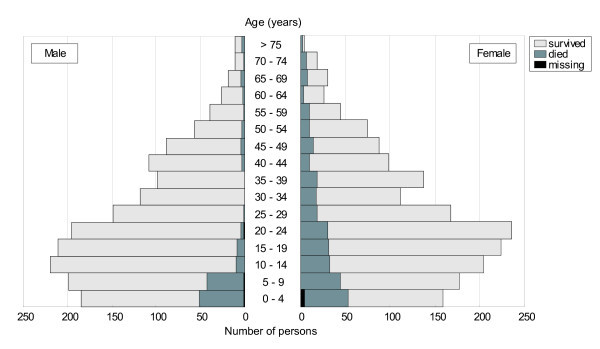
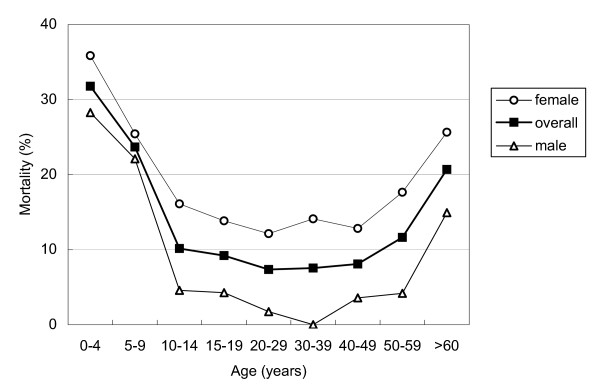
Overall mortality rate out of 3,533 individuals from 859 households was 12.9% (446 deaths and 11 missing persons). The majority of the deaths occurred during and immediately after the disaster. A higher mortality was observed among females (17.5% vs. 8.2% for males, p < 0.001), children and the elderly (31.8%, 23.7% and 15.3% for children aged less than 5 years, children aged 5 to 9 years and adults over 50 years, respectively, compared with 7.4% for adults aged 20 to 29 years, p < 0.001). Other risk factors, such as being indoors at the time of the tsunami (13.8% vs. 5.9% outdoors, p < 0.001), the house destruction level (4.6%, 5.5% and 14.2% in increasing order of destruction, p < 0.001) and fishing as an occupation (15.4% vs. 11.2% for other occupations, p < 0.001) were also significantly associated with increased mortality. These correlations remained significant after adjusting for the confounding effects by multivariate analysis.
A significantly high mortality was observed in women and children among the displaced population in the eastern coastal district of Sri Lanka who were examined by us. Reconstruction activities should take into consideration these changes in population structure.
描述灾难期间及灾后的不良健康影响并确定弱势群体是任何救灾行动的重要方面。本研究旨在描述2004年印度洋海啸后斯里兰卡东部沿海一个地区在两个半月时间里影响流离失所人口的死亡率及相关风险因素。
对13个境内流离失所者(IDP)疏散营地进行了横断面家庭调查。从户主那里收集了海啸前所有家庭成员的信息,并记录了回忆期(从海啸当天开始的77至80天)内发生的所有死亡情况。分析了死亡率及相关风险因素的分布情况。多变量分析采用广义估计方程法进行逻辑回归建模。
来自859户家庭的3533人中,总死亡率为12.9%(446人死亡,11人失踪)。大多数死亡发生在灾难期间及刚结束后。女性死亡率较高(女性为17.5%,男性为8.2%,p<0.001),儿童和老年人也是如此(5岁以下儿童、5至9岁儿童和50岁以上成年人的死亡率分别为31.8%、23.7%和15.3%,而20至29岁成年人的死亡率为7.4%,p<0.001)。其他风险因素,如海啸发生时在室内(室内为13.8%,室外为5.9%,p<0.001)、房屋破坏程度(破坏程度递增时分别为4.6%、5.5%和14.2%,p<0.001)以及以捕鱼为职业(从事捕鱼职业的死亡率为15.4%,其他职业为11.2%,p<0.001)也与死亡率增加显著相关。经过多变量分析调整混杂效应后,这些相关性仍然显著。
我们调查的斯里兰卡东部沿海地区流离失所人口中,妇女和儿童的死亡率显著偏高。重建活动应考虑到人口结构的这些变化。