Department of Chronic Diseases, Gansu Center for Disease Control and Prevention, Lanzhou City, Gansu Province, China.
PLoS One. 2013 Sep 9;8(9):e72711. doi: 10.1371/journal.pone.0072711. eCollection 2013.
To prospectively evaluate the efficiency of daily providing complementary food supplements decreasing malnutrition and anemia prevalence in elder infants and young children living in areas affected by Wenchuan Earthquake.
Using promotional probability sampling method, 250 to 300 children from six-randomized townships (30 to 50 children in each township) in Kang County affected by the Earthquake were randomly chosen for follow up to evaluate intervention effectiveness using anthropometric measurement and hemoglobin level at six, twelve and eighteen months after start of intervention.
All children from 6 to 18 months of age in Kang County (in North Western China) were daily provided with complementary food supplements containing multiple vitamins and minerals for up to 24 months of age. The intervention period lasted for one and half year.
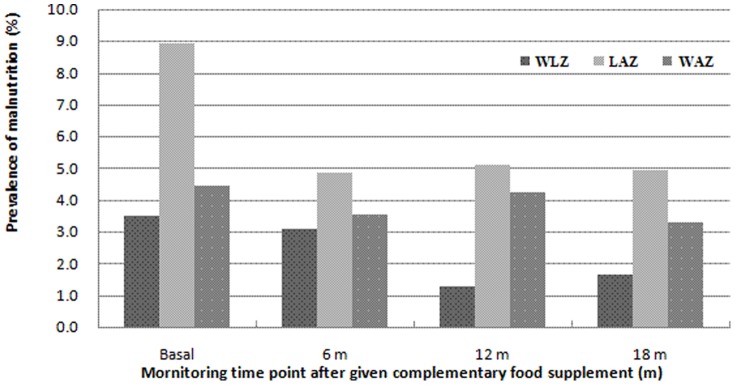
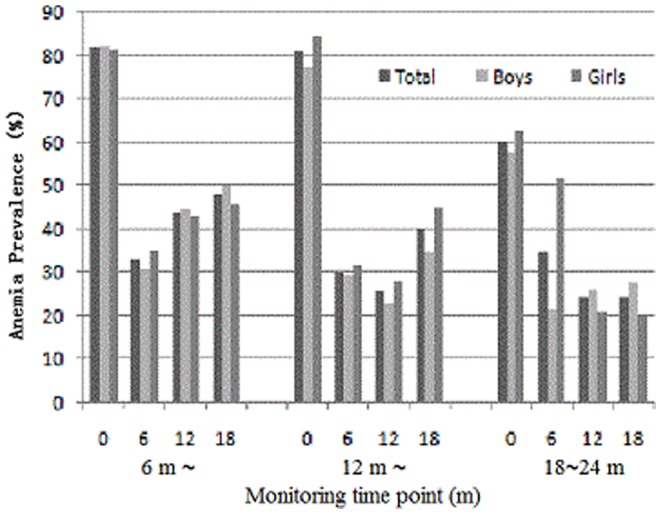
At beginning of intervention, malnutrition prevalence, including underweight, stunting and wasting were respectively 4.5%, 8.9% and 3.5%; anemia prevalence was 74.3%. After one and half year intervention, the growth and anemia status were significantly improved; the percentages of wasting, stunting underweight prevalence were decreased from 3.5%, 8.9% and 4.5% to 1.7%, 5.0% and 3.3% respectively, and the anemia rates were significantly decreased.
Our results indicated that an intervention using complementary food supplements could improve nutritional status and elevate hemoglobin level in elder infants and young children, which would significantly decrease the prevalence of malnutrition and anemia.
前瞻性评估在汶川地震灾区为年龄较大的婴儿和幼儿提供每日补充食物的效率,以降低营养不良和贫血的患病率。
采用促销概率抽样方法,从受地震影响的康县六个随机乡镇(每个乡镇 30-50 名儿童)中随机选择 250-300 名儿童进行随访,以评估干预效果,在干预开始后 6、12 和 18 个月使用人体测量和血红蛋白水平进行评估。
康县(中国西北部)所有 6-18 个月大的儿童每天都提供含有多种维生素和矿物质的补充食物,直到 24 个月大。干预期持续了一年半。
在干预开始时,营养不良的患病率包括消瘦、发育迟缓、消瘦,分别为 4.5%、8.9%和 3.5%;贫血患病率为 74.3%。经过一年半的干预,生长和贫血状况得到了显著改善;消瘦、发育迟缓、消瘦的比例分别从 3.5%、8.9%和 4.5%下降到 1.7%、5.0%和 3.3%,贫血率也显著下降。
我们的结果表明,补充食物的干预措施可以改善年龄较大的婴儿和幼儿的营养状况,提高血红蛋白水平,显著降低营养不良和贫血的患病率。