Burtscher Martina, Britton Easkey
SeaSisters Sri Lanka, Weligama 81700, Sri Lanka.
European Centre for Environment and Human Health, University of Exeter Medical School, Knowledge Spa, Truro TR1 SHD, UK.
Int J Environ Res Public Health. 2022 Mar 11;19(6):3342. doi: 10.3390/ijerph19063342.
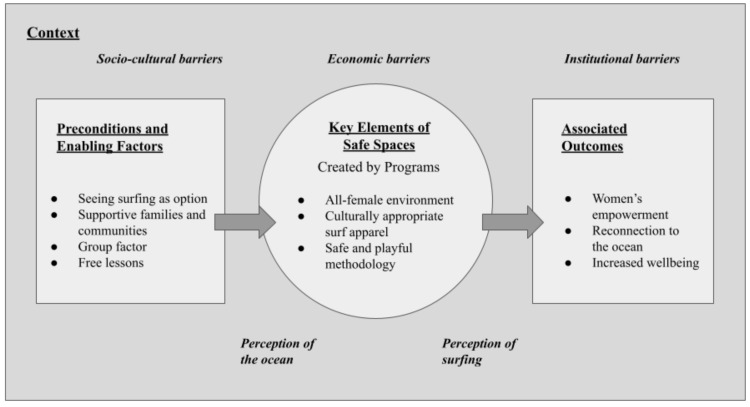
Worldwide, there is growing recognition of the wellbeing benefits of accessing and engaging with healthy blue spaces, especially seas, coasts, and beaches. However, vast gender inequalities persist that impact women's and girls' ability to safely access these spaces for recreational benefit. This is even more pronounced in the context of emerging surf cultures in regions such as Southeast Asia. Using a qualitative and reflective approach, this paper explored how safe spaces for female surfers are created, using case studies from two female-focused surfing programs in Sri Lanka. To facilitate a safe space, the multi-layered challenges that female surfers face were analysed. The common mediators that enable females to participate in surfing were then investigated and identified, including: seeing surfing as an option, supportive families and communities, the group factor, free lessons, an all-female environment, culturally appropriate surf apparel, and a safe and playful methodology. This study highlights pathways for how unsafe spaces of exclusion and fear may be transformed into safe spaces of inclusion, healing, and empowerment. These findings have implications for how safe spaces may be facilitated for other organisations, as well as the sustainability of female access to surfing, beyond the life of surfing programs.
在全球范围内,人们越来越认识到接触和融入健康的蓝色空间,特别是海洋、海岸和海滩,对身心健康有益。然而,巨大的性别不平等现象依然存在,这影响了妇女和女孩为获得娱乐益处而安全进入这些空间的能力。在东南亚等地区新兴的冲浪文化背景下,这种情况更为明显。本文采用定性和反思性方法,以斯里兰卡两个以女性为中心的冲浪项目为例,探讨了如何为女性冲浪者创造安全空间。为营造一个安全的空间,分析了女性冲浪者面临的多层次挑战。随后研究并确定了促使女性参与冲浪运动的常见促成因素,包括:将冲浪视为一种选择、支持性的家庭和社区、群体因素、免费课程、全女性环境、文化上合适的冲浪服装以及安全且有趣的教学方法。本研究突出了将排斥和恐惧的不安全空间转变为包容、治愈和赋权的安全空间的途径。这些发现对于如何为其他组织营造安全空间,以及冲浪项目结束后女性参与冲浪运动的可持续性具有启示意义。