Gutch M J, Reich N C
Department of Pathology, State University of New York, Stony Brook 11794.
Proc Natl Acad Sci U S A. 1991 Sep 15;88(18):7913-7. doi: 10.1073/pnas.88.18.7913.
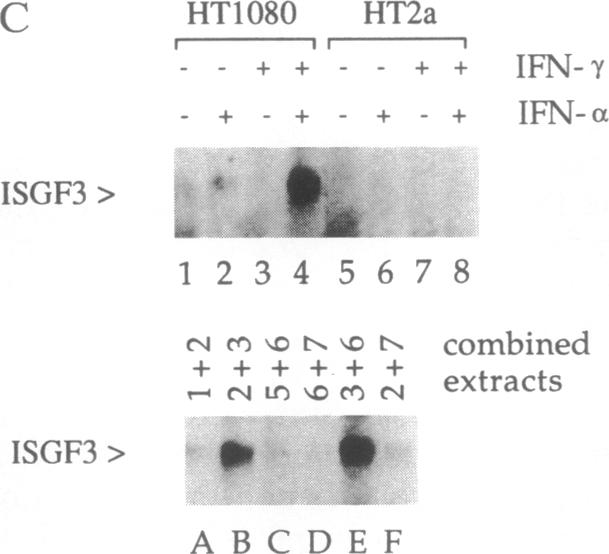
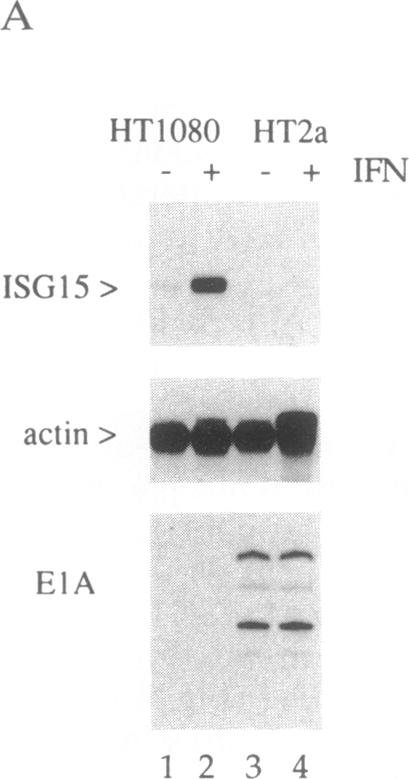
The signal transduction pathway initiated by type I interferon (alpha and beta interferons) is inhibited by expression of the adenovirus type 5 E1A oncogene. Cotransfection analyses with the E1A oncogene and an interferon-stimulated reporter gene show that mutations within an amino-terminal domain of the E1A oncoprotein are defective in transcriptional repression. Cotransfection experiments also revealed that the transcriptional repression is mediated through the interferon-stimulated response element (ISRE) found within the promoter of interferon-stimulated genes. Since interferon treatment activates a latent cytoplasmic DNA-binding factor that can recognize the ISRE and subsequently stimulate transcription, the appearance of this factor was analyzed in a cell line that constitutively expresses the E1A oncogene. The DNA binding activity of this transcriptional activator was found to be inhibited in the E1A-expressing cell line. In vitro cytoplasmic mixing experiments with extracts from control and E1A-expressing cells identified a specific component of this multimeric transcription factor to be defective.
由I型干扰素(α和β干扰素)启动的信号转导途径会被5型腺病毒E1A癌基因的表达所抑制。用E1A癌基因和干扰素刺激的报告基因进行共转染分析表明,E1A癌蛋白氨基末端结构域内的突变在转录抑制方面存在缺陷。共转染实验还表明,转录抑制是通过干扰素刺激基因启动子内的干扰素刺激反应元件(ISRE)介导的。由于干扰素治疗会激活一种潜在的细胞质DNA结合因子,该因子可识别ISRE并随后刺激转录,因此在组成性表达E1A癌基因的细胞系中分析了这种因子的出现情况。发现这种转录激活因子的DNA结合活性在表达E1A的细胞系中受到抑制。用对照细胞和表达E1A的细胞提取物进行的体外细胞质混合实验确定,这种多聚体转录因子的一个特定成分存在缺陷。